• Wyszukiwanie zaawansowane
  • Kategorie
  • Kategorie BISAC
  • Książki na zamówienie
  • Promocje
  • Granty
  • Książka na prezent
  • Opinie
  • Pomoc
  • Załóż konto
  • Zaloguj się

C Programming: The Essentials for Engineers and Scientists » książka

zaloguj się | załóż konto
Logo Krainaksiazek.pl

koszyk

konto

szukaj
topmenu
Księgarnia internetowa
Szukaj
Książki na zamówienie
Promocje
Granty
Książka na prezent
Moje konto
Pomoc
 
 
Wyszukiwanie zaawansowane
Pusty koszyk
Bezpłatna dostawa dla zamówień powyżej 20 złBezpłatna dostawa dla zamówień powyżej 20 zł

Kategorie główne

• Nauka
 [2946600]
• Literatura piękna
 [1856966]

  więcej...
• Turystyka
 [72221]
• Informatyka
 [151456]
• Komiksy
 [35826]
• Encyklopedie
 [23190]
• Dziecięca
 [619653]
• Hobby
 [140543]
• AudioBooki
 [1577]
• Literatura faktu
 [228355]
• Muzyka CD
 [410]
• Słowniki
 [2874]
• Inne
 [445822]
• Kalendarze
 [1744]
• Podręczniki
 [167141]
• Poradniki
 [482898]
• Religia
 [510455]
• Czasopisma
 [526]
• Sport
 [61590]
• Sztuka
 [243598]
• CD, DVD, Video
 [3423]
• Technologie
 [219201]
• Zdrowie
 [101638]
• Książkowe Klimaty
 [124]
• Zabawki
 [2473]
• Puzzle, gry
 [3898]
• Literatura w języku ukraińskim
 [254]
• Art. papiernicze i szkolne
 [8170]
Kategorie szczegółowe BISAC

C Programming: The Essentials for Engineers and Scientists

ISBN-13: 9780387986326 / Angielski / Twarda / 1999 / 479 str.
David R. Brooks; D. Gries; F. B. Schneider
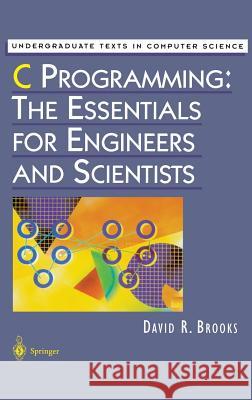
C Programming: The Essentials for Engineers and Scientists David R. Brooks D. Gries F. B. Schneider 9780387986326 Springer - książkaWidoczna okładka, to zdjęcie poglądowe, a rzeczywista szata graficzna może różnić się od prezentowanej.

C Programming: The Essentials for Engineers and Scientists

ISBN-13: 9780387986326 / Angielski / Twarda / 1999 / 479 str.

David R. Brooks; D. Gries; F. B. Schneider
cena 403,47 zł
(netto: 384,26 VAT:  5%)

Najniższa cena z 30 dni: 385,52 zł
Termin realizacji zamówienia:
ok. 22 dni roboczych
Bez gwarancji dostawy przed świętami

Darmowa dostawa!

This text teaches the essentials of C programming, concentrating on what readers need to know in order to produce stand-alone programs and so solve typical scientific and engineering problems. It is a learning-by-doing book, with many examples and exercises, and lays a foundation of scientific programming concepts and techniques that will prove valuable for those who might eventually move on to another language. Written for undergraduates who are familiar with computers and typical applications but are new to programming.


Kategorie:
Informatyka, Programowanie
Kategorie BISAC:
Computers > Languages - C
Computers > Programming - Compilers
Computers > Software Development & Engineering - Computer Graphics
Wydawca:
Springer
Seria wydawnicza:
Undergraduate Texts in Computer Science
Język:
Angielski
ISBN-13:
9780387986326
Rok wydania:
1999
Wydanie:
1999
Ilość stron:
479
Waga:
0.88 kg
Wymiary:
23.88 x 16.51 x 3.56
Oprawa:
Twarda
Wolumenów:
01
Dodatkowe informacje:
Bibliografia
Glosariusz/słownik
Wydanie ilustrowane

1 Programming Preliminaries.- 1.1 A Five-Step Problem-Solving Process.- 1.1.1 Step 1: Define the Problem.- 1.1.2 Step 2: Outline a Solution.- 1.1.3 Step 3: Design an Algorithm.- 1.1.4 Step 4: Convert the Algorithm Into a Program.- 1.1.5 Step 5: Verify the Operation of the Program.- 1.2 Defining a Pseudocode Language for Algorithm Development.- 1.3 Organizing Pseudocode Into a Program.- 1.4 Examples.- 1.5 What Is the Point of Programming?.- 1.6 Your First C Program.- 2 The Basics of C Programming.- 2.1 C Program Layout.- 2.2 Basic Input and Output.- 2.2.1 Keyboard Input and Monitor Output.- Reading and Displaying Numbers.- Reading and Displaying Characters and Strings of Characters.- Reading Values With Leading Zeros and Nonblank Separators.- 2.2.2 File I/O.- 2.2.3 I/O Redirection.- 2.3 Reading External Text Files of Unknown Length.- 2.4 Reading a File One Character at a Time.- 2.5 Applications.- 2.5.1 Maximum Deflection of a Beam Under Load.- 2.5.2 Relativistic Mass and Speed of an Electron.- 2.6 Debugging Your Programs.- 2.6.1 Compile-Time Errors.- 2.6.2 Run-Time Errors.- 2.7 Exercises.- 3 Data Types, Operators, and Functions.- 3.1 Specifying and Using Data Types.- 3.2 Operators.- 3.3 Type Casting.- 3.4 Intrinsic Functions.- 3.5 Simple User-Defined Functions.- 3.6 Applications.- 3.6.1 Refraction of Light.- 3.6.2 Inverse Hyperbolic Functions.- 3.7 Debugging Your Programs.- 3.7.1 Problems With Data Types and Casting.- 3.7.2 Problems With Intrinsic Functions.- 3.7.3 Problems With User-Defined Functions.- 3.8 Exercises.- 4 Selection and Repetition Constructs.- 4.1 Relational and Logical Operators.- 4.2 Selection (IF…THEN…ELSE…) Constructs.- 4.3 Choosing Alternatives From a List of Possibilities.- 4.4 Repetition (LOOP…) Constructs.- 4.4.1 Count-Controlled Loops.- 4.4.2 Conditional Loops.- Pre-Test Loops.- Post-Test Loops.- Loops for Input Validation.- 4.5 Applications.- 4.5.1 Solving the Quadratic Equation.- 4.5.2 Maximum Deflection of a Beam With Various Support/Loading Systems.- 4.5.3 Refraction of Light.- 4.5.4 Oscillating Frequency of an LC Circuit.- 4.5.5 Calculating Radiation Exposures for a Materials Testing Experiment.- 4.6 Debugging Your Programs.- 4.7 Exercises.- 5 More About Modular Programming.- 5.1 Defining Information Interfaces in C.- 5.2 Menu-Driven Programs.- 5.3 More About Function Interfaces.- 5.4 Recursive Functions.- 5.5 Using Prewritten Code Modules.- 5.6 Using Functions as Arguments and Parameters.- 5.7 Passing Arguments to the main Function.- 5.8 Applications.- 5.8.1 The Quadratic Equation Revisited.- 5.8.2 Finding Prime Numbers.- 5.8.3 The Towers of Hanoi.- 5.8.4 Trapezoidal Rule Integration.- 5.9 Debugging Your Programs.- 5.9.1 Passing Multiple Outputs Through Parameter Lists.- 5.9.2 Recursive Functions.- 5.9.3 Reusable Code.- 5.10 Exercises.- 6 Arrays.- 6.1 Arrays in Structured Programming.- 6.2 One-Dimensional Array Implementation in C.- 6.3 Using Arrays in Function Calls.- 6.4 Multidimensional Arrays.- 6.5 Accessing Arrays With Pointers.- 6.6 More About Strings.- 6.6.1 Strings as Arrays.- 6.6.2 String Functions.- 6.7 Applications.- 6.7.1 Cellular Automata and Sierpinski Triangles.- 6.7.2 Probability Analysis for Quality Control of Manufacturing Processes.- 6.7.3 Parsing a String Containing an Unknown Number of Numerical Values.- 6.8 Debugging Your Programs.- 6.9 Exercises.- 7 User-Defined Data Objects.- 7.1 Creating User-Defined Data Objects.- 7.2 Arrays of Structures.- 7.3 Functions With Structures as Parameters and Data Types.- 7.4 Applications.- 7.4.1 Finding the Perimeter and Area of a Plot of Land.- 7.4.2 A Set of Functions to Perform Operations on Complex Numbers.- 7.4.3 Analyzing Data From a Datalogger.- 7.5 Debugging Your Programs.- 7.6 Exercises.- 8 Searching and Sorting Algorithms.- 8.1 Introduction.- 8.2 Searching Algorithms.- 8.2.1 Linear Searches.- 8.2.2 Binary Search.- 8.2.3 Choosing a Searching Algorithm.- 8.3 Sorting Algorithms.- 8.3.1 Selection Sort.- 8.3.2 Insertion Sort.- 8.3.3 The Recursive Quicksort Algorithm.- 8.3.4 Efficiency of Sorting Algorithms.- 8.5 Application: Merging Sorted Lists.- 8.6 Debugging Your Programs.- 8.7 Exercises.- 9 Basic Statistics and Numerical Analysis.- 9.1 Introduction.- 9.2 Basic Descriptive Statistics.- 9.2.1 The Sample Mean and Standard Deviation.- 9.2.2 Linear Regression and the Linear Correlation Coefficient.- 9.2.3 Application: Analyzing Wind Speed Data.- 9.3 Numerical Differentiation.- 9.3.1 Newton’s and Stirling’s Formulas.- 9.3.2 Application: Estimating the Speed of a Falling Object.- 9.4 Numerical Integration.- 9.4.1 Polynomial Approximation Methods.- 9.4.2 Application: Evaluating the Gamma Function.- 9.5 Solving Systems of Linear Equations.- 9.5.1 Linear Equations and Gaussian Elimination.- 9.5.2 Application: Current Flow in a DC Circuit With Multiple Resistive Branches.- 9.6 Finding the Roots of Equations.- 9.7 Numerical Solutions to Differential Equations.- 9.7.1 Motion of a Damped Mass and Spring.- 9.7.2 Application: Current Flow in a Series LRC Circuit.- 9.8 Exercises.- 10 Binary Files, Random Access, and Dynamic Allocation.- 10.1 Binary and Random Access Files.- 10.1.1 Random Access File Concepts.- 10.1.2 Implementing Binary Files.- File Access Modes.- I/O for Binary Files.- Random Access to Binary Files.- 10.2 Dynamic Allocation and Linked Lists.- 10.2.1 The Concept of Dynamic Allocation.- 10.2.2 Dynamically Allocated Arrays.- 10.2.3 Dynamically Allocated Linked Lists.- Data Declarations.- Function Prototypes.- Function main.- Creating the List.- Accessing Nodes in the List.- Adding and Deleting Nodes.- 10.3 Queues and Stacks.- 10.3.1 Implementing Queues.- 10.3.2 Implementing Stacks.- 10.4 Application: Managing Data From Remote Instruments.- 10.5 Exercises.- Appendices.- Appendix 1: Table of ASCII Characters for Windows/DOS-Based PCs.- Appendix 2: Program Listings by Chapter.- Appendix 3: Glossary.


Udostępnij

Facebook - konto krainaksiazek.pl


Opinie o Krainaksiazek.pl na Opineo.pl

Partner Mybenefit

Krainaksiazek.pl w programie rzetelna firma Krainaksiaze.pl - płatności przez paypal

Czytaj nas na:

Facebook - krainaksiazek.pl
  • książki na zamówienie
  • granty
  • książka na prezent
  • kontakt
  • pomoc
  • opinie
  • regulamin
  • polityka prywatności

Zobacz:

  • Księgarnia czeska

  • Wydawnictwo Książkowe Klimaty

1997-2025 DolnySlask.com Agencja Internetowa

© 1997-2022 krainaksiazek.pl
     
KONTAKT | REGULAMIN | POLITYKA PRYWATNOŚCI | USTAWIENIA PRYWATNOŚCI
Zobacz: Księgarnia Czeska | Wydawnictwo Książkowe Klimaty | Mapa strony | Lista autorów
KrainaKsiazek.PL - Księgarnia Internetowa

Polityka prywatnosci - link
Krainaksiazek.pl - płatnośc Przelewy24
Przechowalnia Przechowalnia






