• Wyszukiwanie zaawansowane
  • Kategorie
  • Kategorie BISAC
  • Książki na zamówienie
  • Promocje
  • Granty
  • Książka na prezent
  • Opinie
  • Pomoc
  • Załóż konto
  • Zaloguj się

Building an Enterprise Chatbot: Work with Protected Enterprise Data Using Open Source Frameworks » książka


zaloguj się | załóż konto
Logo Krainaksiazek.pl

koszyk

konto

szukaj
topmenu
Księgarnia internetowa
Szukaj
Książki na zamówienie
Promocje
Granty
Książka na prezent
Moje konto
Pomoc
 
 
Wyszukiwanie zaawansowane
Pusty koszyk
Bezpłatna dostawa dla zamówień powyżej 20 złBezpłatna dostawa dla zamówień powyżej 20 zł

Kategorie główne

• Nauka
 [2950560]
• Literatura piękna
 [1849509]

  więcej...
• Turystyka
 [71097]
• Informatyka
 [151150]
• Komiksy
 [35848]
• Encyklopedie
 [23178]
• Dziecięca
 [617388]
• Hobby
 [139064]
• AudioBooki
 [1657]
• Literatura faktu
 [228597]
• Muzyka CD
 [383]
• Słowniki
 [2855]
• Inne
 [445295]
• Kalendarze
 [1464]
• Podręczniki
 [167547]
• Poradniki
 [480102]
• Religia
 [510749]
• Czasopisma
 [516]
• Sport
 [61293]
• Sztuka
 [243352]
• CD, DVD, Video
 [3414]
• Technologie
 [219456]
• Zdrowie
 [101002]
• Książkowe Klimaty
 [124]
• Zabawki
 [2311]
• Puzzle, gry
 [3459]
• Literatura w języku ukraińskim
 [254]
• Art. papiernicze i szkolne
 [8079]
Kategorie szczegółowe BISAC

Building an Enterprise Chatbot: Work with Protected Enterprise Data Using Open Source Frameworks

ISBN-13: 9781484250334 / Angielski / Miękka / 2019 / 385 str.
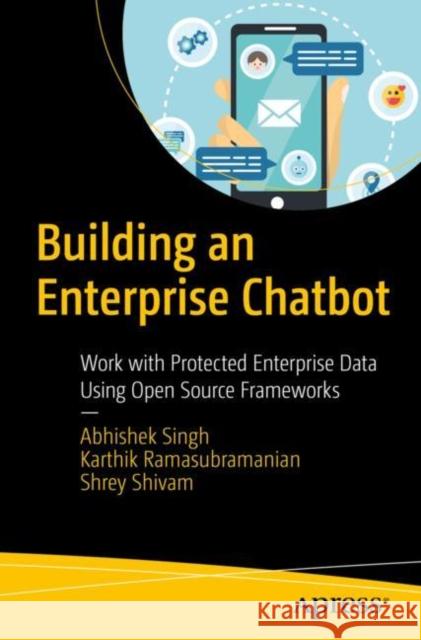
Abhishek Singh; Karthik Ramasubramanian; Shrey Shivam
Building an Enterprise Chatbot: Work with Protected Enterprise Data Using Open Source Frameworks Singh, Abhishek 9781484250334 Apress - książkaWidoczna okładka, to zdjęcie poglądowe, a rzeczywista szata graficzna może różnić się od prezentowanej.

Building an Enterprise Chatbot: Work with Protected Enterprise Data Using Open Source Frameworks

ISBN-13: 9781484250334 / Angielski / Miękka / 2019 / 385 str.

Abhishek Singh; Karthik Ramasubramanian; Shrey Shivam
cena 241,50
(netto: 230,00 VAT:  5%)

Najniższa cena z 30 dni: 231,29
Termin realizacji zamówienia:
ok. 22 dni roboczych
Dostawa w 2026 r.

Darmowa dostawa!
Kategorie:
Informatyka
Kategorie BISAC:
Computers > Languages - Java
Computers > Languages - Python
Computers > Programming - Open Source
Wydawca:
Apress
Język:
Angielski
ISBN-13:
9781484250334
Rok wydania:
2019
Ilość stron:
385
Waga:
0.56 kg
Wymiary:
23.39 x 15.6 x 2.13
Oprawa:
Miękka
Wolumenów:
01
Dodatkowe informacje:
Wydanie ilustrowane

Chapter 1: Processes in the Banking and Insurance Industry

The chapter will focus on explaining some core process within the banking and insurance industry that is suitable for a chatbot application.

No of pages: 30

Chapter 2: Identifying the Sources of Data

This chapter will discuss sources of data for conversation and action-based event triggers for a chatbot. Conversation courses would be from customer service centers, online chats, emails and other NLP sources, while action sources are customer account details and more personalize data.

No of pages: 30

Chapter 3: Mining Intents from the Data Sources

This chapter will discuss how to build a business-specific intent engine for chatbots.

No of pages: 30

Chapter 4: Building a Business Use-Case

This chapter will focus on how to identify the right business process to introduce chatbots. It will also discuss how to look at some of the metrics of success and RoI given a chatbot is deployed.

No of pages: 30

Chapter 5: Natural Language Processing (NLP)

Chapter Goal: This chapter focusses on processing and understanding natural language through the computer algorithm. It also introduces how to prepare data for applying the NLP algorithms. We will use Stanford CoreNLP, NLTK, gensim, OpenIE tools to explore and model.

No of pages: 80

Sub - topics

Introduction: Question & answering, information extraction, sentiment analysis, Machine translation,

Text processing: Regex, tokenization, normalization – lower case, lemmatization, stemming (Porters Algorithm), sentence segmentation

Converting text to features: Syntactical parsing – dependency grammar, PoS, entity parsing – phrase detection, topic modeling, statistical features – TF-IDF, word embeddings

Classification – spam filter using naïve Bayes, sentiment analysis using SVM on Lexicon and text feature.

NLP Tools – nltk, genism, openIE, CoreNLP

Chapter 6: Building Chatbots Using Popular Platforms

For general purpose chatbots, publicly available cloud services can be used to deploy chatbots faster and without any DevOps overhead. We shall discuss some of the major chatbot development platforms available in the market.

No of pages: 50

Sub-Topics

Microsoft Bot framework with LUIS
Google’s DialogFlow
Amazon Lex with Lambda
Bottr, Chatfuel and others
Open framework RASA and Botpress

Chapter 7: Deployment and Continuous Improvement Framework

In this chapter we shall discuss and implement a custom built chatbot . We will discuss designing and implementing state machines and their different state transitions, and how they are critical to maintain the context of user utterance as well as in defining the chat flow using sessions that contains long term and short-term attributes.

No of pages: 50

Sub-topics:

Public endpoint creation
Intent engine development and deployment as API
Building state machine
Integration with Facebook messenger
Deployment of chatbot on AWS
Logging
Mining conversation log to improve intent engine
Recommending similar/next questions, pushing information based on needs prediction


Abhishek Singh is on a mission to profess the de facto language of this millennium, the numbers. He is on a journey to bring machines closer to humans, for a better and more beautiful world by generating opportunities with artificial intelligence and machine learning. He leads a team of data science professionals solving pressing problems in food security, cyber security, natural disasters, healthcare, and many more areas, all with the help of data and technology. Abhishek is in the process of bringing smart IoT devices to smaller cities in India so that people can leverage technology for the betterment of life.

He has worked with colleagues from many parts of the United States, Europe, and Asia, and strives to work with more people from various backgrounds. In 7 years at big corporations, he has stress-tested the assets of U.S. banks at Deloitte, solved insurance pricing models at Prudential, and made telecom experiences easier for customers at Celcom, and core SaaS Data products at Probyto. He is now creating data science opportunities with his team of young minds.

He actively participates in analytics-related thought leadership, authoring, public speaking, meetups, and training in data science. He is a staunch supporter of responsible use of AI to remove biases and fair use of AI for a better society.

Abhishek completed his MBA from IIM Bangalore, a B.Tech. In Mathematics and Computing from IITGuwahati, and a PG Diploma in Cyber Law from NALSAR University, Hyderabad.


Karthik Ramasubramanian has over seven years of practice and leading Data Science and Business Analytics in Retail, FMCG, E-Commerce, Information Technology for a multi-national and two unicorn startups. A researcher and problem solver with a diverse set of experience in the data science lifecycle, starting from a data problem discovery to creating a data science prototype/product.

On the descriptive side of data science, designed, developed and spearheaded many A/B experiment frameworks for improving product features, conceptualized funnel analysis for understanding user interactions and identifying the friction points within a product, designing statistically robust metrics and visual dashboards. On the predictive side, developed intelligent chatbots which understand human-like interactions, customer segmentation models, recommendation systems, identifying medical specialization from a patient query for telemedicine, and many more.

He actively participates in analytics related thought leadership, authoring blogs & books, public speaking, meet-ups, and training & mentoring for Data Science.

 Karthik completed his M.Sc. in Theoretical Computer Science at PSG College of Technology, India, where he pioneered the application of machine learning, data mining, and fuzzy logic in his research work on the computer and network security.


Shrey Shivam extensive experience in leading the design, development, and delivery of solutions in the field of data engineering, stream analytics, machine learning, graph databases, and natural language processing. In his seven years of experience, he has worked with various conglomerates, startups, and big corporations and has gained relevant exposure to digital media, e-commerce, investment banking, insurance, and a suite of transaction-led marketplaces across music, food, lifestyle, news, legal and travel.


He is a keen learner and is actively engaged in designing the next generation of systems powered by artificial intelligence-based analytical and predictive models. He has taken up various roles in product management, data analytics, digital growth, system architecture, and full stack engineering. In the era of rapid acceptance and adoption of new and emerging technologies, he believes in strong technical fundamentals and advocates continuous improvement through self-learning.


Shrey is currently leading a team of machine learning & big data engineers across the US, Europe, and India to build robust and scalable big data pipelines to implement various statistical and predictive models. Shrey has completed his BTech in Information Technology from Cochin University of Science Technology, India.

Explore the adoption of chatbots in business by focusing on the design, deployment, and continuous improvement of chatbots in a business, with a single use-case from the banking and insurance sector. This book starts by identifying the business processes in the banking and insurance industry. This involves data collection from sources such as conversations from customer service centers, online chats, emails, and other NLP sources. You’ll then design the solution architecture of the chatbot. Once the architecture is framed, the author goes on to explain natural language understanding (NLU), natural language processing (NLP), and natural language generation (NLG) with examples. 

In the next section, you’ll discuss the importance of data transfers using natural language platforms, such as Dialogflow and LUIS, and see why this is a key process for chatbot development. In the final section, you’ll work with the RASA and Botpress frameworks. 

By the end of Building an Enterprise Chatbot with Python, you will be able to design and develop an enterprise-ready conversational chatbot using an open source development platform to serve the end user.

You will:
  • Identify business processes 
  • Design the solution architecture for a chatbot
  • Integrate chatbots with internal data sources using APIs
  • Discover the differences between natural language understanding (NLU), natural language processing (NLP), and natural language generation (NLG) 
  • Work with deployment and continuous improvement through representational learning


Udostępnij

Facebook - konto krainaksiazek.pl


Opinie o Krainaksiazek.pl na Opineo.pl

Partner Mybenefit

Krainaksiazek.pl w programie rzetelna firma Krainaksiaze.pl - płatności przez paypal

Czytaj nas na:

Facebook - krainaksiazek.pl
  • książki na zamówienie
  • granty
  • książka na prezent
  • kontakt
  • pomoc
  • opinie
  • regulamin
  • polityka prywatności

Zobacz:

  • Księgarnia czeska

  • Wydawnictwo Książkowe Klimaty

1997-2025 DolnySlask.com Agencja Internetowa

© 1997-2022 krainaksiazek.pl
     
KONTAKT | REGULAMIN | POLITYKA PRYWATNOŚCI | USTAWIENIA PRYWATNOŚCI
Zobacz: Księgarnia Czeska | Wydawnictwo Książkowe Klimaty | Mapa strony | Lista autorów
KrainaKsiazek.PL - Księgarnia Internetowa

Polityka prywatnosci - link
Krainaksiazek.pl - płatnośc Przelewy24
Przechowalnia Przechowalnia






