• Wyszukiwanie zaawansowane
  • Kategorie
  • Kategorie BISAC
  • Książki na zamówienie
  • Promocje
  • Granty
  • Książka na prezent
  • Opinie
  • Pomoc
  • Załóż konto
  • Zaloguj się

Bridging the Communication Gap in Science and Technology: Lessons from India » książka


zaloguj się | załóż konto
Logo Krainaksiazek.pl

koszyk

konto

szukaj
topmenu
Księgarnia internetowa
Szukaj
Książki na zamówienie
Promocje
Granty
Książka na prezent
Moje konto
Pomoc
 
 
Wyszukiwanie zaawansowane
Pusty koszyk
Bezpłatna dostawa dla zamówień powyżej 20 złBezpłatna dostawa dla zamówień powyżej 20 zł

Kategorie główne

• Nauka
 [2948695]
• Literatura piękna
 [1824038]

  więcej...
• Turystyka
 [70868]
• Informatyka
 [151073]
• Komiksy
 [35227]
• Encyklopedie
 [23181]
• Dziecięca
 [621575]
• Hobby
 [138961]
• AudioBooki
 [1642]
• Literatura faktu
 [228651]
• Muzyka CD
 [371]
• Słowniki
 [2933]
• Inne
 [445341]
• Kalendarze
 [1243]
• Podręczniki
 [164416]
• Poradniki
 [479493]
• Religia
 [510449]
• Czasopisma
 [502]
• Sport
 [61384]
• Sztuka
 [243086]
• CD, DVD, Video
 [3417]
• Technologie
 [219673]
• Zdrowie
 [100865]
• Książkowe Klimaty
 [124]
• Zabawki
 [2168]
• Puzzle, gry
 [3372]
• Literatura w języku ukraińskim
 [260]
• Art. papiernicze i szkolne
 [7838]
Kategorie szczegółowe BISAC

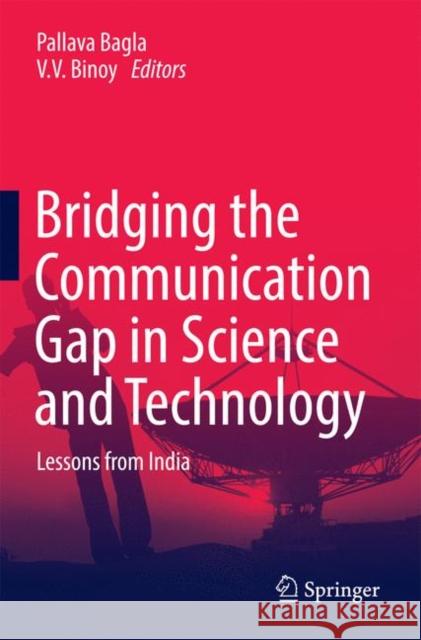
Bridging the Communication Gap in Science and Technology: Lessons from India

ISBN-13: 9789811010248 / Angielski / Miękka / 2017 / 324 str.
Pallava Bagla; V. V. Binoy
Bridging the Communication Gap in Science and Technology: Lessons from India Bagla, Pallava 9789811010248 Springer - książkaWidoczna okładka, to zdjęcie poglądowe, a rzeczywista szata graficzna może różnić się od prezentowanej.

Bridging the Communication Gap in Science and Technology: Lessons from India

ISBN-13: 9789811010248 / Angielski / Miękka / 2017 / 324 str.

Pallava Bagla; V. V. Binoy
cena 140,53
(netto: 133,84 VAT:  5%)

Najniższa cena z 30 dni: 134,90
Termin realizacji zamówienia:
ok. 22 dni roboczych.

Darmowa dostawa!

This first-of-a-kind volume provides a snapshot of existing science communication policy and practice in India across different S&T sectors, and offers solutions to building effective communication. It provides an understanding on how to avoid societal clashes in situations when science meets the public in these sectors. The editors and contributors argue that effective S&T communication leads not only to a more informed public but also benefits research itself, and in a changing society like India this is a crucial element related to good governance and policy making. In this volume, experienced masters of the craft provide practical solutions to making S&T communication more effective in a vast democracy like India, which has complex issues related to literacy levels, diverse languages, varying political will, reach, and resources. Through, discussions on cases of creating information modules for the public on the Internet, television and radio, social media, as well as traditional ways of outreach like people's science movements, holding popular science events, and fairs, the volume provides highly valuable directions on how developing countries with low resources and complex populations can communicate S&T research to the public and bridge communication gaps. This volume will interest researchers from science, social science, mass communication and public relations departments, journalists, as well as practitioners and policy makers from government and non-government institutions involved in S&T policy, practice and communication and people who want to understand the complex S&T landscape of India.


Kategorie:
Nauka, Pedagogika i oświata
Kategorie BISAC:
Language Arts & Disciplines > Communication Studies
Science > Study & Teaching
Technology & Engineering > Power Resources - Nuclear
Wydawca:
Springer
Język:
Angielski
ISBN-13:
9789811010248
Rok wydania:
2017
Wydanie:
2017
Ilość stron:
324
Waga:
0.54 kg
Wymiary:
23.37 x 15.49 x 1.78
Oprawa:
Miękka
Wolumenów:
01

"This book is a goldmine of valuable resource material on how to reach out to the masses and make science communication more effective. ... will be of interest to not only science communicators but also researchers from science, social science, mass communication and public relations departments, and journalists. ... also be useful to policy makers from government and non-government institutions involved in S&T policy, practiceand communication, and those who want to understand the complex S&T landscape of India." (Biman Basu, Current Science, Vol. 113 (6), September, 2017)

"The book has successfully captured the current trends of science & technology communicaion in India in its various formats and dimensions including the traditional ones like fairs, science events, competitions, festivals and exhibitions. ... One can safely recommend it as an essential read for media students, practising communicators, scientists, researchers, activists, politicians and policy makers of government and non-government departments alike." (Vinod Varshney, Science Reporter, July, 2017)

Chapter 1. Introduction V.V. Binoy and Pallava Bagla.- Part I: Communicating Science to Win the Hearts and Minds.- Chapter 2. Responsibilities of Science, Responsive to Society: A New Dialogue Jairam Ramesh.- Part II: The Indian Landscape of Communicating Science and Technology.- Chapter 3. India’s Maiden Mission to Mars: Many Firsts and Some Missed Opportunities in Isro’s Efforts at Public Outreach and Communications Pallava Bagla.- Chapter 4. Challenges in Communicating about Defence Research: Insights in Defence Research and Development Organization’s (Drdo) Media Strategy Ravi Kumar Gupta.- Chapter 5. Communicating Issues related to Land and Natural Resources. S. Meenakshisundaram.- Chapter 6. The Art and Science of Communicating Risks of Natural Hazards Ajit Tyagi.- Chapter 7. The Challenges of Earthquake Risk Communicatio

n to Public R. K. Chadha.- Chapter 8. The Queer Case of Communicating Risks Associated With Use of Mobile Phones and Neighbourhood Mobile Towers: Are People Contracting More Brain Cancers K.S. Parthasarathy.- Chapter 9. Atomic Energy: Reaching Out the People for Perception Management S.K. Malhotra.- Part III: Time-Tested ways of Communication.- Chapter 10. Communicating Science for a Better Tomorrow Hasan Jawaid Khan.- Chapter 11. Current Status of Public Understanding of Science: Results of Kumbh Mela Survey Studies Gauhar Raza and Surjit Singh.- Chapter 12. Challenges of Communicating Science in Regional Languages: Experiments in Kannada A.S.K.V.S. Sharma.- Chapter 13. Challenges Faced by Science Journalists and Communicators Working in Vernacular Languages and Insights Pertaining to Science Communication Courses Nimish Kapoor.- Part IV: Using Television, the Internet and Social Media for Messages.- Chapter 14. Enhancing Science Content on Indian Tv: Status, Issues and Way Forward T.V. Venkateswaran.- Chapter 15. Scidev.net T.V. Padma.- Chapter 16. Smart Websites: Insights from DBT Archita Bhatta.- Chapter 17. Using Social Media for Research and Reaching Out Sandhya Sekar and Sudhira H. S..- Part V: Bridging the Gap Between Scientists and the Public.- Chapter 18. Vigyan Rail: Science Exhibition on Wheels Vinay B. Kamble.- Chapter 19. Organising Children’s Science Congress:  Challenges and Opportunities E.R. Anuj Sinha.- Chapter 20. Bridging Educational Institutions For a Citizen Science Project: A Case Study From Malappuram District, Kerala, India V.V. Binoy, S. Radhakrishna and A. Kurup.- Chapter 21. Community Driven Approach for Artificial Recharge: The TBS Experience Rajendra Singh.

Pallava Bagla is an Indian science journalist, communicator & photojournalist with over 25 years of experience. In 2014 he was the Shri T.V. Raman Pai Chair Visiting Professor of Science Communication, at the National Institute of Advanced Studies, Bangalore. He has been the Science Editor of India’s highly respected private television channel New Delhi Television (NDTV) since 2006. In his almost two decades of continuous writing for Science magazine, he has critically analysed India’s prowess in S&T. He also runs a weekly column on science, technology, health and environment for India’s trusted news agency, the Press Trust of India (PTI). Bagla's recent work includes giving an insider’s look into India’s little known but highly developed missile development programme. He is the author of several books, some of the most recent being Reaching for the Stars: India’s Journey to Mars and Beyond (Bloomsbury, 2014), Destination Moon: India’s Quest for Moon, Mars and Beyond (HarperCollins, 2008). He is the winner of many awards for his work, and most recently in 2014, he was feted by the Prime Minister of India with an award for `excellence in journalism’. 

V.V. Binoy is Assistant Professor, School of Natural Sciences and Engineering, National Institute of Advanced Studies, Bangalore, India. Dr. Binoy explores the biological and environmental basis of decision-making and personality traits (also referred to as individual variation in the behaviour or behavioural syndrome) in vertebrates using fish and amphibian model systems. He is interested in the popularization of science using non-conventional methodologies of communication and also studies the efficacy of ‘citizen science’ in data collection and dissemination of information to the grass-roots levels of society. Binoy has been a recipient of the ‘Cognitive Science Research Initiative Postdoctoral Fellowship’ and ‘Young Scientist’ start-up research grant from the Department of Science and Technology, Government of India.  

This first-of-a-kind volume provides a snapshot of existing science communication policy and practice in India across different S&T sectors, and offers solutions to building effective communication. It provides an understanding on how to avoid societal clashes in situations when science meets the public in these sectors. The editors and contributors argue that effective S&T communication leads not only to a more informed public but also benefits research itself, and in a changing society like India this is a crucial element related to good governance and policy making. In this volume, experienced masters of the craft provide practical solutions to making S&T communication more effective in a vast democracy like India, which has complex issues related to literacy levels, diverse languages, varying political will, reach, and resources. Through, discussions on cases of creating information modules for the public on the Internet, television and radio, social media, as well a

s traditional ways of outreach like people’s science movements, holding popular science events, and fairs, the volume provides highly valuable directions on how developing countries with low resources and complex populations can communicate S&T research to the public and bridge communication gaps. 

This volume will interest researchers from science, social science, mass communication and public relations departments, journalists, as well as practitioners and policy makers from government and non-government institutions involved in S&T policy, practice and communication and people who want to understand the complex S&T landscape of India.



Udostępnij

Facebook - konto krainaksiazek.pl


Opinie o Krainaksiazek.pl na Opineo.pl

Partner Mybenefit

Krainaksiazek.pl w programie rzetelna firma Krainaksiaze.pl - płatności przez paypal

Czytaj nas na:

Facebook - krainaksiazek.pl
  • książki na zamówienie
  • granty
  • książka na prezent
  • kontakt
  • pomoc
  • opinie
  • regulamin
  • polityka prywatności

Zobacz:

  • Księgarnia czeska

  • Wydawnictwo Książkowe Klimaty

1997-2026 DolnySlask.com Agencja Internetowa

© 1997-2022 krainaksiazek.pl
     
KONTAKT | REGULAMIN | POLITYKA PRYWATNOŚCI | USTAWIENIA PRYWATNOŚCI
Zobacz: Księgarnia Czeska | Wydawnictwo Książkowe Klimaty | Mapa strony | Lista autorów
KrainaKsiazek.PL - Księgarnia Internetowa

Polityka prywatnosci - link
Krainaksiazek.pl - płatnośc Przelewy24
Przechowalnia Przechowalnia





