Brain Changer: A Mother's Guide to Cognitive Science » książka





Brain Changer: A Mother's Guide to Cognitive Science
ISBN-13: 9780692782224 / Angielski / Miękka / 2016 / 70 str.
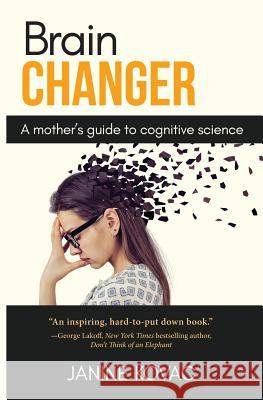
After completing her degree in cognitive science at UC Berkeley, Janine Kovac became pregnant with she thought was her second child. Instead, it was twins. Not just any twins, but high-risk, mono-chorionic/mono-amniotic twins, a condition that occurs in one out of 45,000 twin pregnancies. Survival outcomes hover at the 50/50 mark. Mono-chorionic/mono-amniotic twins share a placenta and an amniotic sac and there's nothing to separate the umbilical cords. Nothing to keep one baby's cord from strangling his brother. After carefully outlining the risks and the protocols the doctor, "There is nothing you can do to prevent the babies from dying. Don't let it stress you out. You can't do anything about it." Then he sent her home. There was anger, denial, panic and lots of Googling. But there was something else, too. A thesis she'd just written titled "A Cognitive Linguistic Analysis of Parenting." As the parent of a toddler girl, she was trying to make sense of the parenting books she'd read. If all these people were experts, why they didn't all agree? Janine took a novel approach to answer her questions--she analyzed the metaphors that parenting experts used to describe morality, emotional development, and human nature. This analysis became the topic of her thesis, which received the Robert J. Glushko prize for "Distinguished Undergraduate Research in Cognitive Science." Talking to doctors about her risky pregnancy was very similar to reading conflicting opinions from parenting experts. One doctor thought she should be on 24/7 bedrest. Another saw no problem with light exercise. One doctor advised, "Try not to think about it." Another reminded her, "You have to be prepared at every ultrasound to have a dead baby." Her high-risk pregnancy was just the beginning of her challenges as the mother of twins. She went into labor before she hit the six-month mark and her babies were born weighing just over a pound and a half apiece. The boys spent the next three months in the Newborn Intensive Care Unit (NICU) where they had IVs, breathing tubes, feeding tubes, x-rays, blood transfusions, and surgery to fix their heart murmurs. An undergraduate in cognitive science learns the basics of neural networks: when some neurons are activated, other networks must be inhibited. It's called mutual inhibition. It's the reason a person can't feel fear and joy at the same time. Fear activates the fight-or-flight resources while joy makes one want to stop and smell the roses. Cognitive science students, at least the ones at UC Berkeley, learn something else, too. They learn that words and concepts are directly connected to neural networks. In other words, fear-related thought and messaging is directly connected to a network. Joy-related messaging is directly connected to a different network. If you could activate the joy-network through words, then you'd simultaneously inhibit the fear network. The doctor's advice, "Try not to think about it" was actually not that ridiculous. And according to her thesis, Janine already knew how to do it. These essays explore some of the techniques that helped her cope as a mom: the practical application of putting on her oxygen mask, expressing gratitude, managing flow, and cultivating a growth mindset--but with a twist of cutting-edge cognitive science.
After completing her degree in cognitive science at UC Berkeley, Janine Kovac became pregnant with she thought was her second child. Instead, it was twins. Not just any twins, but high-risk, mono-chorionic/mono-amniotic twins, a condition that occurs in one out of 45,000 twin pregnancies. Survival outcomes hover at the 50/50 mark. Mono-chorionic/mono-amniotic twins share a placenta and an amniotic sac and there’s nothing to separate the umbilical cords. Nothing to keep one baby’s cord from strangling his brother.After carefully outlining the risks and the protocols the doctor, “There is nothing you can do to prevent the babies from dying. Don’t let it stress you out. You can’t do anything about it.” Then he sent her home.There was anger, denial, panic and lots of Googling.But there was something else, too. A thesis she’d just written titled “A Cognitive Linguistic Analysis of Parenting.” As the parent of a toddler girl, she was trying to make sense of the parenting books she’d read. If all these people were experts, why they didn’t all agree? Janine took a novel approach to answer her questions—she analyzed the metaphors that parenting experts used to describe morality, emotional development, and human nature. This analysis became the topic of her thesis, which received the Robert J. Glushko prize for “Distinguished Undergraduate Research in Cognitive Science.” Talking to doctors about her risky pregnancy was very similar to reading conflicting opinions from parenting experts. One doctor thought she should be on 24/7 bedrest. Another saw no problem with light exercise. One doctor advised, “Try not to think about it.” Another reminded her, “You have to be prepared at every ultrasound to have a dead baby.”Her high-risk pregnancy was just the beginning of her challenges as the mother of twins. She went into labor before she hit the six-month mark and her babies were born weighing just over a pound and a half apiece. The boys spent the next three months in the Newborn Intensive Care Unit (NICU) where they had IVs, breathing tubes, feeding tubes, x-rays, blood transfusions, and surgery to fix their heart murmurs. An undergraduate in cognitive science learns the basics of neural networks: when some neurons are activated, other networks must be inhibited. It’s called mutual inhibition. It’s the reason a person can’t feel fear and joy at the same time. Fear activates the fight-or-flight resources while joy makes one want to stop and smell the roses. Cognitive science students, at least the ones at UC Berkeley, learn something else, too. They learn that words and concepts are directly connected to neural networks. In other words, fear-related thought and messaging is directly connected to a network. Joy-related messaging is directly connected to a different network. If you could activate the joy-network through words, then you’d simultaneously inhibit the fear network. The doctor’s advice, “Try not to think about it” was actually not that ridiculous. And according to her thesis, Janine already knew how to do it. These essays explore some of the techniques that helped her cope as a mom: the practical application of putting on her oxygen mask, expressing gratitude, managing flow, and cultivating a growth mindset—but with a twist of cutting-edge cognitive science.




Czytaj nas na:
KrainaKsiazek.PL - Księgarnia Internetowa


