Bowing to the Emperor: We Were Captives in WWII » książka





Bowing to the Emperor: We Were Captives in WWII
ISBN-13: 9780996411905 / Angielski / Miękka / 2015 / 360 str.
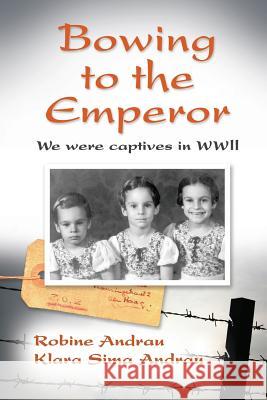
More than 10,000 women and children. That's how many civilian prisoners of the Japanese were packed into Tjideng, reportedly the worst Japanese concentration camp in Java during World War II. Among these 10,000 mostly Dutch women and children were Hungarian-born Klara and her three young daughters. Meanwhile Klara's Dutch husband, Wim, a captain in the Royal Dutch Air Force, was among the 1500 military men crammed into a hell ship and transported to Japan as a slave laborer. "Bowing to the Emperor: We Were Captives in WWII," a memoir/biography penned by Klara and daughter Robine, chronicles the Andrau family's experience during those dark years in the then-Dutch East Indies (now Indonesia) and in Japan. The story reveals the fierce determination and ingenuity of a mother and the strength and leadership of a father when faced with starvation, brutality, and unspeakable living conditions. Klara's part of the story details what she did to keep the couple's three children and herself alive and well in body and mind, both during the Japanese occupation in 1942 and during the children's and her subsequent internment. Left with no income after Wim was taken away, Klara scraped along by giving language lessons, teaching the three R's to classes of children, and making and selling jams. Later, when interned in camp, she supplemented their daily diet of a handful of rice, a little piece of gummy bread, and a few leaves of a spinach-like plant by digging up the packed earth and planting some leafy vegetables, which she fertilized with night soil. She also pawed through the camp kitchen garbage looking for anything edible and knitted socks for the Japanese to earn some sweets for her children. She kept the wonder of Christmas alive one year by stealthily evading the patrolling Japanese guard in the predawn darkness, climbing a fir tree next to the barbed wire and bamboo camp fence, and sawing off the tree's top with a toy saw. When decorated with a few candles, the top was transformed into the most magical of Christmas trees. Wim's story centers on his role as the senior officer in charge of 400 Dutch and later an additional 200 American and 2 British POWs in camp Fukuoka #7 in the Japanese coal-mining town of Futase. He led his men with good humor and optimism and negotiated tirelessly with the Japanese commander, sometimes successfully, for shorter work hours in the coal mines (from 12-to-14-hour days to 10-to-12-hour days), for more rest and recreation time (from a partial to a full day "off" every ten days), and for more food. Beatings on the part of the Japanese guards were a perennial problem. By bypassing the Japanese commander and slipping a list of brutality complaints among other suggestions for changes into the hands of the visiting Swedish consul, Wim succeeded in marginally improving the situation for his men. His greatest success, however, was in maintaining order and discipline among the prisoners, reducing friction and increasing understanding between the two main national groups, and building morale despite the dirt, near-starvation rations, disease, brutality, and horrendous work and living conditions in the damp dangerous coal mines and the flea- and lice-infested barracks. Besides being the personal story of a family, "Bowing to the Emperor" is also a universal story of survival and of hope despite loss of country and loss of all material possessions.
More than 10,000 women and children. That’s how many civilian prisoners of the Japanese were packed into Tjideng, reportedly the worst Japanese concentration camp in Java during World War II. Among these 10,000 mostly Dutch women and children were Hungarian-born Klara and her three young daughters. Meanwhile Klara’s Dutch husband, Wim, a captain in the Royal Dutch Air Force, was among the 1500 military men crammed into a hell ship and transported to Japan as a slave laborer. "Bowing to the Emperor: We Were Captives in WWII," a memoir/biography penned by Klara and daughter Robine, chronicles the Andrau family’s experience during those dark years in the then-Dutch East Indies (now Indonesia) and in Japan. The story reveals the fierce determination and ingenuity of a mother and the strength and leadership of a father when faced with starvation, brutality, and unspeakable living conditions.Klara’s part of the story details what she did to keep the couple’s three children and herself alive and well in body and mind, both during the Japanese occupation in 1942 and during the children’s and her subsequent internment. Left with no income after Wim was taken away, Klara scraped along by giving language lessons, teaching the three R’s to classes of children, and making and selling jams. Later, when interned in camp, she supplemented their daily diet of a handful of rice, a little piece of gummy bread, and a few leaves of a spinach-like plant by digging up the packed earth and planting some leafy vegetables, which she fertilized with night soil. She also pawed through the camp kitchen garbage looking for anything edible and knitted socks for the Japanese to earn some sweets for her children. She kept the wonder of Christmas alive one year by stealthily evading the patrolling Japanese guard in the predawn darkness, climbing a fir tree next to the barbed wire and bamboo camp fence, and sawing off the tree’s top with a toy saw. When decorated with a few candles, the top was transformed into the most magical of Christmas trees.Wim’s story centers on his role as the senior officer in charge of 400 Dutch and later an additional 200 American and 2 British POWs in camp Fukuoka #7 in the Japanese coal-mining town of Futase. He led his men with good humor and optimism and negotiated tirelessly with the Japanese commander, sometimes successfully, for shorter work hours in the coal mines (from 12-to-14-hour days to 10-to-12-hour days), for more rest and recreation time (from a partial to a full day “off” every ten days), and for more food. Beatings on the part of the Japanese guards were a perennial problem. By bypassing the Japanese commander and slipping a list of brutality complaints among other suggestions for changes into the hands of the visiting Swedish consul, Wim succeeded in marginally improving the situation for his men. His greatest success, however, was in maintaining order and discipline among the prisoners, reducing friction and increasing understanding between the two main national groups, and building morale despite the dirt, near-starvation rations, disease, brutality, and horrendous work and living conditions in the damp dangerous coal mines and the flea- and lice-infested barracks.Besides being the personal story of a family, “Bowing to the Emperor” is also a universal story of survival and of hope despite loss of country and loss of all material possessions.




Czytaj nas na:
KrainaKsiazek.PL - Księgarnia Internetowa


