• Wyszukiwanie zaawansowane
  • Kategorie
  • Kategorie BISAC
  • Książki na zamówienie
  • Promocje
  • Granty
  • Książka na prezent
  • Opinie
  • Pomoc
  • Załóż konto
  • Zaloguj się

Boundary Element Techniques in Computer-Aided Engineering » książka


zaloguj się | załóż konto
Logo Krainaksiazek.pl

koszyk

konto

szukaj
topmenu
Księgarnia internetowa
Szukaj
Książki na zamówienie
Promocje
Granty
Książka na prezent
Moje konto
Pomoc
 
 
Wyszukiwanie zaawansowane
Pusty koszyk
Bezpłatna dostawa dla zamówień powyżej 20 złBezpłatna dostawa dla zamówień powyżej 20 zł

Kategorie główne

• Nauka
 [2946912]
• Literatura piękna
 [1852311]

  więcej...
• Turystyka
 [71421]
• Informatyka
 [150889]
• Komiksy
 [35717]
• Encyklopedie
 [23177]
• Dziecięca
 [617324]
• Hobby
 [138808]
• AudioBooki
 [1671]
• Literatura faktu
 [228371]
• Muzyka CD
 [400]
• Słowniki
 [2841]
• Inne
 [445428]
• Kalendarze
 [1545]
• Podręczniki
 [166819]
• Poradniki
 [480180]
• Religia
 [510412]
• Czasopisma
 [525]
• Sport
 [61271]
• Sztuka
 [242929]
• CD, DVD, Video
 [3371]
• Technologie
 [219258]
• Zdrowie
 [100961]
• Książkowe Klimaty
 [124]
• Zabawki
 [2341]
• Puzzle, gry
 [3766]
• Literatura w języku ukraińskim
 [255]
• Art. papiernicze i szkolne
 [7810]
Kategorie szczegółowe BISAC

Boundary Element Techniques in Computer-Aided Engineering

ISBN-13: 9789400961944 / Angielski / Miękka / 2011 / 440 str.
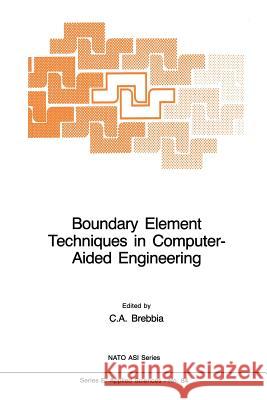
C. A. Brebbia
Boundary Element Techniques in Computer-Aided Engineering C. a. Brebbia 9789400961944 Springer - książkaWidoczna okładka, to zdjęcie poglądowe, a rzeczywista szata graficzna może różnić się od prezentowanej.

Boundary Element Techniques in Computer-Aided Engineering

ISBN-13: 9789400961944 / Angielski / Miękka / 2011 / 440 str.

C. A. Brebbia
cena 806,99
(netto: 768,56 VAT:  5%)

Najniższa cena z 30 dni: 771,08
Termin realizacji zamówienia:
ok. 22 dni roboczych
Bez gwarancji dostawy przed świętami

Darmowa dostawa!

This book constitutes the edited proceedings of the Advanced Studies Institute on Boundary Element Techniques in Computer Aided Engineering held at The Institute of Computational Mechanics, Ashurst Lodge, Southampton, England, from September 19 to 30, 1984. The Institute was held under the auspices of the newly launched "Double Jump Programme" which aims to bring together academics and industrial scientists. Consequently the programme was more industr- ially based than other NATO ASI meetings, achieving an excellent combination of theoretical and practical aspects of the newly developed Boundary Element Method. In recent years engineers have become increasingly interested in the application of boundary element techniques for'the solution of continuum mechanics problems. The importance of boundary elements is that it combines the advantages of boundary integral equations (i.e. reduction of dimensionality of the problems, possibility of modelling domains extending to infinity, numerical accura'cy) with the versatility of finite elements (i.e. modelling of arbitrary curved surfaces). Because of this the technique has been well received by the engineering and scientific communities. Another important advantage of boundary elements stems from its reduction of dimensionality, that is that the technique requires much less data input than classical finite elements. This makes the method very well suited for Computer Aided Design and in great part explains the interest of the engineering profession in the new technique.


Kategorie:
Nauka, Matematyka
Kategorie BISAC:
Mathematics > Równania różniczkowe
Mathematics > Systemy liczbowe
Technology & Engineering > Electrical
Wydawca:
Springer
Seria wydawnicza:
NATO Science Series E: (Closed)
Język:
Angielski
ISBN-13:
9789400961944
Rok wydania:
2011
Wydanie:
Softcover Repri
Numer serii:
000343614
Ilość stron:
440
Waga:
0.69 kg
Wymiary:
23.5 x 15.5
Oprawa:
Miękka
Wolumenów:
01

1. Weighted Residual Formulation of Approximate Methods.- 1.1. Introduction.- 1.2. Basic Definition.- 1.3. Approximate Solutions.- 1.4. Method of Weighted Residuals.- 1.5. Weak Formulations.- 1.6. The Inverse Problem.- 1.7. Conclusions.- References.- 2. Boundary Element Methods.- 2.1. Fundamentals of Functional Analysis.- 2.2. Generalized Green’s Formula.- 2.3. Variational Formulation.- 2.4. Weighted Residual Scheme.- 2.5. Boundary Element Formulation of Poisson’s Equation.- 2.6. Fundamental Solutions.- 2.7. Boundary Discretisation and Systems Equations.- 2.8. Computation of Integrals — 2D case.- 3. Boundary Integral Equations.- 3.1. Simple-layer Formulations.- 3.2. Double-layer Formulations.- 3.3. Direct Formulations.- 3.4. Indirect Vector Formulations.- 3.5. Direct Formulations.- References.- 4. Scalar and Vector Potential Theory.- 4.1. The Simple-layer Potential.- 4.2. The Double-layer Potential.- 4.3. Green’s Formula.- 4.4. Identification of Scalar and Vector Symbolism.- 4.5. Somigliana’s Identity.- 4.6. Rigid-body Displacement Field.- References.- 5. Potential Problems in Two Dimensions.- 5.1. Introduction.- 5.2. Flow past an Obstacle.- 5.3. Discretisation.- 5.4. Green’s Boundary Formula.- 5.5. Applications.- 5.6. Boundary Singularities.- 5.7. Composite Domains.- 5.8. Conclusion.- References.- 6. Three-dimensional Axisymmetrical Potential Problems.- 6.1. Introduction.- 6.2. The Newtonian Potential.- 6.3. Discretisation.- 6.4. General Domain.- 6.5. Axisymmetric Problems.- 6.6. Conclusion.- References.- 7. Heat Transfer Applications.- 7.1. Introduction.- 7.2. Integral Equations associated with Steady Heat Conduction Problems.- 7.3. Numerical Solution of the Integral Equations.- 7.4. Poisson’s Equation.- 7.5. Non-homogeneous Bodies; Method of Subregions.- 7.6. Anisotropic Bodies.- References.- 8. Numerical Integration and other Computational Techniques.- 8.1. Introduction.- 8.2. Isoparametric Elements.- 8.3. Numerical Integration.- References.- 9. Starting to work with Boundary Elements.- 9.1. Introduction.- 9.2. The Boundary Element Method.- 9.3. Advantages and Disadvantages of the BEM compared to FEM.- 9.4. Introduction to BEASY.- 9.5. Examples.- 9.6. Conclusions.- References.- 10. Experiences in Boundary Element Applications.- 10.1. Introduction.- 10.2. Pre- and Post Processing.- 10.3. C.A.D. Coupling.- 10.4. Installation on Different Computers.- 10.5. Recommendations for BEM use.- 11. Electrostatics Problems.- 11.1. Introduction.- 11.2. Theoretical Basis.- 11.3. Boundary Elements.- 11.4. Applications.- 11.5. Conclusions.- References.- 12. A Boundary Element Solution of the Wave Equation.- 12.1. Introduction.- 12.2. Theoretical Development.- 12.3. Boundary Conditions.- 12.4. Numerical Implementation.- 12.5. Velocities and Pressures.- 12.6. Identification of Areas in Shadow.- 12.7. Test Example.- 12.8. Conclusions.- References.- 13. Elasticity Problems.- 13.1. Introduction.- 13.2. Governing Equations.- 13.3. Boundary Integral Formulation.- 13.4. Two Dimensional Elasticity Problems.- 13.5. Three Dimensional Elasticity Problems.- 13.6. Axisymmetric Elasticity Problems.- References.- 14. Elasticity Problems with Body Forces.- 14.1. Introduction.- 14.2. Transformation to Boundary Integrals.- 14.3. 2D Body Forces.- 14.4. 3D Body Forces.- 14.5. Axisymmetric Body Forces.- References.- 15. Time Dependent Problems.- 15.1. Introduction.- 15.2. Time Dependent Diffusion.- 15.3. The Scalar Wave Equation.- 15.4. Transient Elastodynamics.- 15.5. Mass Matrix Representation.- 15.6. Conclusions.- References.- 16. Time Dependent Potential Problems.- 16.1. Introduction.- 16.2. Integral Formulation of Heat Conduction Problems.- 16.3. Numerical Solution of the Integral Equations.- 16.4. Conclusions.- References.- 17. Plate Bending Problems.- 17.1. Preliminaries.- 17.2. Reciprocal Work Relation.- 17.3. Boundary Integral Representations.- 17.4. Concluding Remarks.- References.- 18. A Choice of Fundamental Solutions.- 18.1. Introductory Remarks.- 18.2. A simple example: 2D Heat Conduction.- 18.3. A more significant example: Plane Elastostatics.- 18.4. Concluding Remarks.- References.- 19. Formulation for Cracks in Plate Bending.- 19.1. Fundamental Solutions for Cracks.- 19.2. Augmented Boundary Integral Equations.- 19.3. Concluding Remarks.- References.- 20. Fracture Mechanics Stress Analysis, I..- 20.1. Introduction.- 20.2. Stress Intensity Factors.- 20.3. Integral Equation Methods for Crack Tip Stress Analysis.- References.- 21. Fracture Mechanics Stress Analysis, II.- 21.1. Introduction.- 21.2. Invariant Integral based on the Energy Momentum Tensor.- 21.3 Invariant Integrals deduced from Betti’s Reciprocal Theorem.- 21.4. Some Numerical Results for a Nocht Problem.- 21.5. A Problem of Debond Stress Analysis.- References.- 22. BEM in Geomechanics.- 22.1. Introduction.- 22.2. Notation and some Basic Ideas.- 22.3. BEM applied to the Interaction between Structures and the Supporting Ground.- 22.4. Inhomogeneity, Zoning and Layering.- 22.5. Elastoplasticity.- 22.6. Concluding Remarks.- References.- 23. An Asymptotic Error Analysis and Underlying Mathematical Principles for Boundary Element Methods.- 23.1. Projection Methods and Garding’s Inequality.- 23.2. Examples of Strongly Elliptic Boundary Integral Equations.- 23.3. Asymptotic Convergence of Galerkin type Boundary Element Methods.- 23.4. Asymptotic Convergence of Collocation Methods.- References.


Udostępnij

Facebook - konto krainaksiazek.pl


Opinie o Krainaksiazek.pl na Opineo.pl

Partner Mybenefit

Krainaksiazek.pl w programie rzetelna firma Krainaksiaze.pl - płatności przez paypal

Czytaj nas na:

Facebook - krainaksiazek.pl
  • książki na zamówienie
  • granty
  • książka na prezent
  • kontakt
  • pomoc
  • opinie
  • regulamin
  • polityka prywatności

Zobacz:

  • Księgarnia czeska

  • Wydawnictwo Książkowe Klimaty

1997-2025 DolnySlask.com Agencja Internetowa

© 1997-2022 krainaksiazek.pl
     
KONTAKT | REGULAMIN | POLITYKA PRYWATNOŚCI | USTAWIENIA PRYWATNOŚCI
Zobacz: Księgarnia Czeska | Wydawnictwo Książkowe Klimaty | Mapa strony | Lista autorów
KrainaKsiazek.PL - Księgarnia Internetowa

Polityka prywatnosci - link
Krainaksiazek.pl - płatnośc Przelewy24
Przechowalnia Przechowalnia





