Biotremology: Studying Vibrational Behavior » książka





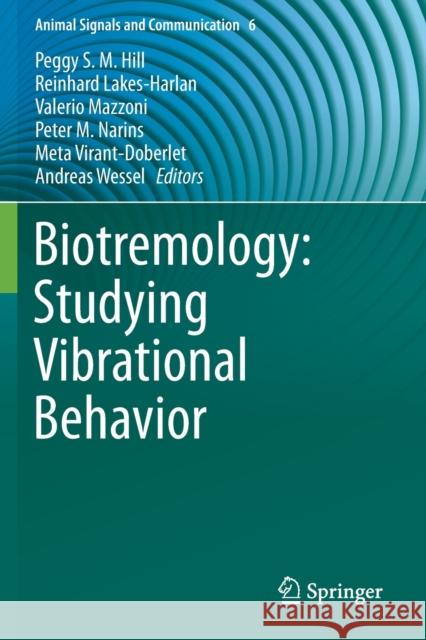
Biotremology: Studying Vibrational Behavior
ISBN-13: 9783030222956 / Angielski / Miękka / 2020 / 534 str.
Biotremology: Studying Vibrational Behavior
ISBN-13: 9783030222956 / Angielski / Miękka / 2020 / 534 str.
(netto: 619,16 VAT: 5%)
Najniższa cena z 30 dni: 578,30
ok. 16-18 dni roboczych.
Darmowa dostawa!
Part I. Studying Vibrational Behavior: Ideas, Concepts and History
1. Peggy S. M. Hill, Valerio Mazzoni, Peter Narins, Meta Virant-Doberlet & Andreas Wessel
Quo Vadis, Biotremology?
2. Peggy S. M. Hill, Meta Virant-Doberlet & Andreas Wessel
What is Biotremology?
3. John A. Endler Biotremology and Sensory Ecology
4. René-Guy Busnel, Francois Pasquinelly & Bernard Dumortier
[transl. & ed. by Hannelore Hoch, Marie-Claire Busnel & Peggy S. M. Hill]
Body Tremulations and their Transmission as Vibrations for Short Distance Information Transfer between Ephippiger Male and Female (1955)
Part II. The State of the Field: Concepts and Frontiers in Vibrational Behavior
5. Sebastian Oberst, Joseph C. S. Lai & Theodore A. Evans
Physical Basis of Vibrational Behavior: Channel Properties, Noise and Excitation signal extraction6. Rafael L. Rodríguez Copulatory Courtship with Vibrational Signals
7. Andrej Čokl, Maria Carolina Blassioli-Moraes, Raul Alberto Laumann, Alenka Žunič & Miguel Borges Stinkbugs: Multisensory Communication with Chemical and Vibratory Signals Transmitted Through Different Media
Part III. Practical Issues in Studying Vibrational Behavior
8. Rok Šturm, Jernej Polajnar & Meta Virant-Doberlet
Practical Issues in Studying Natural Vibroscape and Biotic Noise
9. Gašper Korinšek, Tadej Tuma & Meta Virant-Doberlet
Automated Vibrational Signal Recognition and Playback
Part IV. Vibration Detection and Orientation
10. Matthew J. Mason & Léa M. D. Wenger
Mechanisms of Vibration Detection in Mammals
11. Johannes Strauß, Nataša Stritih Peljhan & Reinhard Lakes-Harlan
Determining Vibroreceptor Sensitivity in Insects: The Influence of Experimental Parameters and Recording Techniques
12. Felix A. Hager & Wolfgang H. Kirchner
Directionality in Insect Vibration Sensing: Behavioral Studies of Vibrational Orientation
Part V. Biology and Evolution of Vibrational Behavior in Some Well-Studied Taxa
13. Caitlin O’Connell-Rodwell, Xiying Guan & Sunil Puria
Vibrational Behavior in Elephants14. Peter M. Narins Seismic Communication in the Amphibia
with Special Emphases on the Anura15. Monika J. B. Eberhard & Mike D. Picker
Vibrational Communication in Heelwalkers (Mantophasmatodea)
16. Felix A. Hager, Kathrin Krausa & Wolfgang H. Kirchner
Vibrational Behavior in Termites (Isoptera)
Part VI. Applied Biotremology
17. Valerio Mazzoni, Rachele Nieri, Anna Eriksson, Meta Virant-Doberlet, Jernej Polajnar, Gianfranco Anfora & Andrea Lucchi
Mating Disruption by Vibrational Signals: State of the Field and Perspectives
18. Shira D. Gordon & Rodrigo Krugner
Mating Disruption by Vibrational Signals: Applications for Management of the Glassy-winged Sharpshooter
19. Jernej Polajnar, Lara Maistrello, Aya Ibrahim & Valerio Mazzoni
Can Vibrational Playback Improve Control of an Invasive Stink bug?
20. Richard W. Mankin Vibrational Trapping and Interference with Mating of Diaphorina citri
21. Richard Hofstetter, Nicholas Aflitto, Carol L. Bedoya, Kasey Yturralde & David D. Dunn
Vibrational Behavior in Bark Beetles: Applied Aspects
Part VII. Outreach and Resources
22. Carrie L. Hall & Daniel R. Howard
Shaking it up in the Classroom: Coupling Biotremology and Active Learning Pedagogy to Promote Authentic Discovery
23. Karl-Heinz Frommolt, Hannelore Hoch & Andreas Wessel
Call for the Establishment of a VibroLibrary at the Animal Sound Archive Berlin
24. Tomas Saraceno, Ally Bisshop, Adrian Krell & Roland Mühlethaler
The Arachnid Orchestras: Artistic Research in Vibrational Interspecies Communication
25. Matija Gogala and Boštjan PerovšekBioacoustic Music Inspired by Biotremological Research
Peggy S.M. Hill received her BS and MS degrees from the University of Tulsa, Oklahoma, USA, where she was broadly trained in organic and environmental biology and specifically trained in community and evolutionary ecology. She taught secondary science for 10 years before returning to the University as an Instructor. She earned her PhD from the University of Oklahoma, specializing in behavioral and physiological ecology, but most importantly began exploring vibrational behavior in molecrickets. In 2008 she published the book Vibrational Communication in Animals (Harvard U Press). She retired as a Professor of Biological Science in 2018, and continues to write and study as a Professor Emerita of the University of Tulsa.
Reinhard Lakes-Harlan received his PhD from the University of Marburg with a thesis on plasticity in the grasshopper’s nervous system (Kalmring Lab). He has been a postdoc at McGill University, Montreal (Pollack Lab) and the University of Göttingen (Elsner Lab). He is currently a Professor of Sensory Physiology at the University of Giessen. His chief focus is on the physiology, ecophysiology, and evolution of mechano-sensory organs in insects.
Valerio Mazzoni earned his PhD from the University of Pisa, Italy, where he was trained in leafhopper and planthopper taxonomy and ecology. As a postdoc, he was trained in biotremology at the National Institute of Ljubljana, where he contributed to substantial advances in the concept of biotremology as applied to arthropod pests. Currently, he is the leader of the Agricultural Entomology unit at the Research and Innovation Centre, Fondazione Edmund Mach of San Michele all’Adige, where he directs the Bioacoustics Lab. In 2016 and 2018, he was the convener of the first two editions of the International Symposium of Biotremology.
Peter M. Narins received his B.S. and M.E.E. in Electrical Engineering and his Ph.D. in Neurobiology & Behavior from Cornell University, Ithaca. He is currently a Distinguished Professor of Neuroethology at the Department of Integrative Biology & Physiology at the University of California, Los Angeles (UCLA). His research explores the mechanisms underlying the evolution of sound and vibration communication in vertebrates. He has led or participated in 57 overseas research expeditions to seven continents, and is an Honorary Member of the Cuban Zoological Society and Professor Ad Honorem at the University of the Republic, Montevideo, Uruguay.
Meta Virant-Doberlet received her PhD from the University of Ljubljana. Having initially trained as an insect neurobiologist at the Max Planck Institute for Behavioural Physiology in Seewiesen, she is now focusing her research on various aspects of arthropod vibrational communication. She has been a Marie Curie fellow at Cardiff University and is now Head of the Department of Organisms and Ecosystems Research at the National Institute of Biology in Ljubljana, where she uses leafhoppers as a model for studying interactions shaping the evolution of the vibrational communication channel.
Andreas Wessel was trained in evolutionary and behavioral biology at the University of Vienna and Humboldt University Berlin. He currently works in Berlin, Germany, as an independent researcher and is affiliated with the Museum of Natural History as a guest scientist. His research focus is on cave planthoppers as models for vibrational communication as well as adaptation to extreme environments and rapid speciation. Furthermore, he publishes frequently on the history and philosophy of biology, and writes for various newspapers and magazines.
This volume is a self-contained companion piece to Studying Vibrational Communication, published in 2014 within the same series. The field has expanded considerably since then, and has even acquired a name of its own: biotremology.
In this context, the book reports on new concepts in this fascinating discipline, and features chapters on state-of-the art methods for studying behavior tied to substrate-borne vibrations, as well as an entire section on applied biotremology. Also included are a historical contribution by pioneers in the field and several chapters reviewing the advances that have been made regarding specific animal taxa. Other new topics covered are vibrational communication in vertebrates, multimodal communication, and biotremology in the classroom, as well as in art and music. Given its scope, the book will appeal to all those interested in communication and vibrational behavior, but also to those seeking to learn about an ancient mode of communication.




Czytaj nas na:
1997-2026 DolnySlask.com Agencja Internetowa
KrainaKsiazek.PL - Księgarnia Internetowa


