Biotechnologies of Crop Improvement, Volume 1: Cellular Approaches » książka





Biotechnologies of Crop Improvement, Volume 1: Cellular Approaches
ISBN-13: 9783319782829 / Angielski / Twarda / 2018 / 497 str.
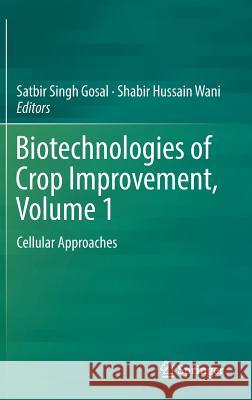
Biotechnologies of Crop Improvement, Volume 1: Cellular Approaches
ISBN-13: 9783319782829 / Angielski / Twarda / 2018 / 497 str.
(netto: 766,76 VAT: 5%)
Najniższa cena z 30 dni: 771,08
ok. 22 dni roboczych.
Darmowa dostawa!
Likewise, significant advances have been made towards increasing crop yields, improving nutritional quality, enabling crops to be raised under adverse conditions and developing resistance to pests and diseases for sustaining global food and nutritional security.
1. Cell and tissue culture approaches in relation to crop improvement
Satbir Singh Gosal and Shabir Hussain Wani
2. Micropropagation and somatic embryogenesis in sugarcane
Ajinder Kaur, Pawan K. Malhotra, Pooja Manchanda and Satbir S. Gosal3. Production of super-elite planting material through in vitro culturing in banana
Pooja Manchanda, Manav Inder Singh Gill, Swati Megha and Satbir Singh Gosal
4. Recent advances in virus elimination and tissue culture for quality potato seed production
Prakash S Naik and Tanuja Buckseth
5. In vitro approaches for the improvement of eucalyptus
Shuchishweta Vinay Kendurkar and Mamatha Rangaswamy
6. In vitro propagation of important rootstocks of apple for rapid cloning and improvement
Amanpreet Kaur, Davinder Singh, Varsha, Nidhi Gupta, Anil Kumar
7. Advances in bamboo biotechnology- present status and future perspective
PoojaThapa, Amita Bhattacharya, Priyanka Sood, Kiran Devi, Anil Sood
8. Fundamental facets of somatic embryogenesis and their applications on advancement of peanut biotechnology
Suprabuddha Kundu, Saikat Gantait
9. Somaclonal variation for sugarcane improvement
10. Developing stress tolerant plants through in vitro tissue culture: family brassicaceae
Nelofer Jan, Hilal Ahmad Qazi, Salika Ramzan and Riffat John
11. Somatic embryogenesis, in vitro selection and plantlet regeneration for citrus improvement
Krishan Kumar, Manav Indra Singh Gill, and Satbir Singh Gosal
12. In vitro androgenesis for accelerated breeding in rice
Navraj Kaur Sarao and Satbir Singh Gosal
13. Accelerated wheat breeding: doubled haploids and rapid generation advancement
Puja Srivastava and Navtej Singh Bains
14. In vitro assisted compression of breeding cycles
Janine Croser, Federico Ribalta, Maria Pazos Navarro, Christine Munday, Richard Bennett, Parwinder Kaur, Sergio Ochatt
15. Tissue culture approaches in relation to medicinal plant improvement
Frank Marthe
Satbir Singh Gosal
Dr. Satbir Singh Gosal possesses B.Sc. (Med.) from P U Chandigarh, India and M.Sc. & Ph. D. (Plant breeding) from Punjab Agricultural University, Ludhiana, India. He was awarded Fellowships by The Royal Society London and The Rockefeller Foundation (USA) for his Post Doctoral Research at the University of Nottingham, England and John Innes Centre Norwich, England. Dr Gosal has served Punjab Agricultural University in various capacities such as Professor Biotechnology, Director School of Agricultural Biotechnology, Additional Director Research and Director of Research. He has also served FAO/IAEA, Vienna, Austria and took tissue culture expert mission to Iraq during 1997. Dr Gosal has rigorous training on ‘Biosafety of GM crops' from Dan Forth Centre for Plant Science Research, St. Louis; APHIS, EPA (USDA), USTDA, Washington DC, USA. He has been an Honorary Member of the Board of Assessors, Australian Research Council, Canberra, President Punjab Academy of Sciences, elected member (Fellow) of Plant Tissue Culture Association (India), Fellow of Indian Society of Genetics and Plant Breeding. He is a recipient of Distinction Award by Society for the Promotion of Plant Science Research, Jaipur, India (2009), Fellow of Punjab Academy of Sciences, Advisory member of several universities/institutes in the area of biotechnology. He served as a member of Review Committee on Genetic Manipulation (RCGM) for 3 years at Department of Biotechnology (DBT), Government of India, New Delhi, and is a member of panel of experts in area of Biotechnology for National Fund for Strategic Research of Indian Council of Agricultural Research, New Delhi. He has participated in more than 125 national/international conferences/meetings held in India, England, Scotland, Yugoslavia, Philippines, Indonesia, Thailand, The Netherlands, Malaysia, Singapore, Austria, Iraq, P R China, Australia, Mexico, Germany and USA. He has guided more than 75 (M.Sc. & Ph.D.) students for theses research on various aspects of plant tissue culture and plant transformation. He executed more than 20 externally funded research projects funded by various national and international organizations such as Punjab State Government, ICAR, DBT, DAC NATP, FAO/IAEA, and The Rockefeller Foundation, USA. He has more than 200 research papers in refereed journals of high repute, 135 research papers in conference proceedings, several T.V./Radio talks, and 30 book chapters. He has co authored 5 Laboratory Manuals, one Text Book and 2 Edited Books.
Dr Shabir Hussain Wani
Dr. Shabir H. Wani is an Assistant Professor cum Scientist, Plant Breeding and Genetics, at the Mountain Research Centre for Field Crops, Khudwani Sher-e-Kashmir University of Agricultural Sciences and Technology of Kashmir, Srinagar, Jammu and Kashmir, India since May 2013 till date. He received his B.Sc. in Agriculture from BhimRao Agricultural University Agra, India, M.Sc. and Ph.D. in Genetics and Plant Breeding from Central Agricultural University, Manipur, India. His Ph.D. research fetched the first prize in North zone at National level competition in India. After obtaining his Ph.D., he worked as Research Associate in the Biotechnology Laboratory, ICAR-Central Institute of Temperate Horticulture, Rangreth Srinagar, India for two years, up to October 2011. In November 2011 he joined the Krishi Vigyan Kendra (Farm Science Centre) as Programme Coordinator (i/c) at Senapati Manipur, India. He teaches courses related to plant breeding, seed science and technology, and stress breeding. He has published more than 100 scientific papers/chapters in peer reviewed journals, and books of international and national repute. He has served as Review Editor of Frontiers in Plant Sciences, Switzerland from 2015-2017. He is an editor of SKUAST Journal of Research, and LS: An International Journal of Life Sciences. He has also edited ten books on current topics in crop Improvement published by reputed publishers including CRC press, Taylor and Francis Group, USA and Springer. He is a Fellow of the Linnean Society of London and Society for Plant Research, India. He received various awards including Young Scientist Award (Agriculture) 2015, Young Scientist Award 2016, Young Achiever award 2016 by various prestigious scientific societies. He has also worked as visiting Scientist in department of Plant Soil and Microbial Sciences, Michigan State University, USA for the year 2016-17 under the Raman Post Doctoral Research Fellowship programme sponsored by University Grants Commission, Govt. of India, New Delhi. He is a member of the Crop Science Society of America.
During the past 15 years, cellular and molecular approaches have emerged as valuable adjuncts to supplement and complement conventional breeding methods for a wide variety of crop plants. Biotechnology increasingly plays a role in the creation, conservation, characterization and utilization of genetic variability for germplasm enhancement. For instance, anther/microspore culture, somaclonal variation, embryo culture and somatic hybridization are being exploited for obtaining incremental improvement in the existing cultivars. In addition, genes that confer insect- and disease-resistance, abiotic stress tolerance, herbicide tolerance and quality traits have been isolated and re-introduced into otherwise sensitive or susceptible species by a variety of transgenic techniques. Together these transformative methodologies grant access to a greater repertoire of genetic diversity as the gene(s) may come from viruses, bacteria, fungi, insects, animals, human beings, unrelated plants or even be artificially derived. Remarkable achievements have been made in the production, characterization, field evaluation and commercialization of transgenic crop varieties worldwide. Likewise, significant advances have been made towards increasing crop yields, improving nutritional quality, enabling crops to be raised under adverse conditions and developing resistance to pests and diseases for sustaining global food and nutritional security. The overarching purpose of this 3-volume work is to summarize the history of crop improvement from a technological perspective but to do so with a forward outlook on further advancement and adaptability to a changing world. Our carefully chosen “case studies of important plant crops” intend to serve a diverse spectrum of audience looking for the right tools to tackle complicated local and global issues.




Czytaj nas na:
1997-2026 DolnySlask.com Agencja Internetowa
KrainaKsiazek.PL - Księgarnia Internetowa


