• Wyszukiwanie zaawansowane
  • Kategorie
  • Kategorie BISAC
  • Książki na zamówienie
  • Promocje
  • Granty
  • Książka na prezent
  • Opinie
  • Pomoc
  • Załóż konto
  • Zaloguj się

Biologically Responsive Biomaterials for Tissue Engineering » książka


zaloguj się | załóż konto
Logo Krainaksiazek.pl

koszyk

konto

szukaj
topmenu
Księgarnia internetowa
Szukaj
Książki na zamówienie
Promocje
Granty
Książka na prezent
Moje konto
Pomoc
 
 
Wyszukiwanie zaawansowane
Pusty koszyk
Bezpłatna dostawa dla zamówień powyżej 20 złBezpłatna dostawa dla zamówień powyżej 20 zł

Kategorie główne

• Nauka
 [2946600]
• Literatura piękna
 [1856966]

  więcej...
• Turystyka
 [72221]
• Informatyka
 [151456]
• Komiksy
 [35826]
• Encyklopedie
 [23190]
• Dziecięca
 [619653]
• Hobby
 [140543]
• AudioBooki
 [1577]
• Literatura faktu
 [228355]
• Muzyka CD
 [410]
• Słowniki
 [2874]
• Inne
 [445822]
• Kalendarze
 [1744]
• Podręczniki
 [167141]
• Poradniki
 [482898]
• Religia
 [510455]
• Czasopisma
 [526]
• Sport
 [61590]
• Sztuka
 [243598]
• CD, DVD, Video
 [3423]
• Technologie
 [219201]
• Zdrowie
 [101638]
• Książkowe Klimaty
 [124]
• Zabawki
 [2473]
• Puzzle, gry
 [3898]
• Literatura w języku ukraińskim
 [254]
• Art. papiernicze i szkolne
 [8170]
Kategorie szczegółowe BISAC

Biologically Responsive Biomaterials for Tissue Engineering

ISBN-13: 9781489992567 / Angielski / Miękka / 2014 / 254 str.
Iulian Vasile Antoniac
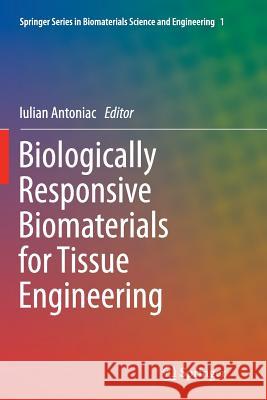
Biologically Responsive Biomaterials for Tissue Engineering Iulian Vasile Antoniac 9781489992567 Springer - książkaWidoczna okładka, to zdjęcie poglądowe, a rzeczywista szata graficzna może różnić się od prezentowanej.

Biologically Responsive Biomaterials for Tissue Engineering

ISBN-13: 9781489992567 / Angielski / Miękka / 2014 / 254 str.

Iulian Vasile Antoniac
cena 403,47 zł
(netto: 384,26 VAT:  5%)

Najniższa cena z 30 dni: 385,52 zł
Termin realizacji zamówienia:
ok. 22 dni roboczych
Bez gwarancji dostawy przed świętami

Darmowa dostawa!
inne wydania

Developments in the area of biomaterials, bionanotechnology, tissue engineering, and medical devices are becoming the core of health care. Almost all medical specialties involve the use of biomaterials, and research plays a key role in the development of new and improved treatment modalities. This volume focuses on several current trends in tissue engineering, remodelling and regeneration. Leading researchers describe the use of nanomaterials to create new functionalities when interfaced with biological molecules or structures. In addition to coverage of basic science and engineering aspects, a range of applications in bionanotechnology are presented, including diagnostic devices, contrast agents, analytical tools, physical therapy applications, and vehicles for targeted drug delivery. The use of polymers, alloys, and composites, or a combination of these, for biomaterials applications in orthopaedics is also explored. These contributions represent essential reading for the biomaterials and biomedical engineering communities, and can serve as instructional course lectures targeted at graduate and post-graduate students.


Kategorie:
Nauka, Medycyna
Kategorie BISAC:
Technology & Engineering > Materials Science - General
Science > Biofizyka
Technology & Engineering > Engineering (General)
Wydawca:
Springer
Seria wydawnicza:
Springer Series in Biomaterials Science and Engineering
Język:
Angielski
ISBN-13:
9781489992567
Rok wydania:
2014
Wydanie:
2013
Numer serii:
000452152
Ilość stron:
254
Waga:
4.04 kg
Wymiary:
23.5 x 15.5
Oprawa:
Miękka
Wolumenów:
01
Dodatkowe informacje:
Wydanie ilustrowane

From the book reviews:

"This is a comprehensive textbook of artificial biomaterials including metals, ceramics, screw dynamics, etc. for use in cervical spine and the C1-C3 regions. The mechanical engineering and physics of screws, artificial vertebral bodies, and plastics is part of the discussion. Anatomically accurate prostheses are the major focus of the book with tremendous import for surgeons, engineers, and students as are welcome audiences." (Joseph J. Grenier, Amazon.com, July, 2014)

Preface

Chapter 1 Scaffold Design For Bone Tissue Engineering: From Micrometric To Nanometric Level
1.1 Introduction
1.2 Scaffold Design: basic criteria
1.3 Designing microstructure
1.3.1 Hierarchically organized architecture
1.3.2 Multi-scale degradation
1.4 Surface and bulk bioactivation
1.5 Designing nanostructures
1.5.1 Micro or nanotexture?
1.5.2 Chemical cues for cell recognition
1.6 Conclusion
1.7 References

Chapter 2 Molecular Scissors - from Biomaterials Implant to Tissue Remodeling
2.1 Introduction
2.2 Extracellular matrix tailoring by specific means
2.3 Proteases and MMPs family
2.4 MMPs activity depends on catalytic domain structure and behavior
2.5 MMPs natural inhibitors
2.6 MMPs in wound repair
2.7 MMPs in epithelial repair
2.8 MMP involvement in resolution step of wound healing
2.9 TIMPs in wound repair
2.10 Evaluation of immunohistochemical detection of MMPs in periimplant tissues
2.11 Summary
2.12 References

Chapter 3 Synthetic Morphogens and Pro-morphogens for Aided Tissue Regeneration
3.1 Introduction: morphogen definition
3.2 Morphogens in vertebrates
3.3 Morphogen long-distance transport and local mechanisms
3.4 Growth factors as morphogens
3.5 Knowledge in developmental biology: lessons for therapeutically-driven tissue regeneration
3.6 Growth factors in adult tissue repair and regeneration
3.6.1 Use of growth factors in clinical intervention
3.6.2 Limitation in the use of growth factors in clinical intervention
3.7 Synthetic morphogens, growth factors and bioligands
3.7.1 Identification of bioactive sequences by phage displayed peptide technique
3.8 Current limitations and future strategies to improve the therapeutic potential of analogue morphogens, growth factors and bioligands
3.8.1 Current limitations
3.8.2 Future strategies
3.9 Conclusions
3.10 References

Chapter 4 The role of oxidative stress in the response of endothelial cells to metals
4.1 Metallic materials for implantation
4.2 Aseptic loosening and metal corrosion
4.3 Integration of metal implants and the role of endothelial cells
4.4 Oxidative stress: ROS formation and antioxidant defence mechanisms
4.5 Ti6Al4V-induced oxidative stress
4.6 Cathodic half-reaction of corrosion as the possible source of oxidative stress on Ti6Al4V alloy
4.7 Summary
4.8 References

Chapter 5 Comparative properties of ethyl, n-butyl and n-octyl cyanoacrylate bioadhesives intended for wound closure
5.1 Introduction
5.2 Experimental
5.2.1 Materials
5.2.2 Experimental techniques
5.3 Results and discussion
5.4 Conclusions
5.5 References

Chapter 6 Development of bioabsorbable interference screws – how influence biomaterials composition, clinical and retrieval studies the innovative screw design and manufacturing processes
6.1. Introduction
6.2. Interference screws classification and design
6.3. New design for a bioresorbable interference screw
6.3.1 Clinical and retrieval study
6.3.2. Innovative design of a bioresorbable interference screw
6.3.3 Discussion about the functionality of the new design for bioresorbable interference screw
6.4. Biodegradable interference screws manufacturing processes
6.5 Conclusions
6.6. References

Chapter 7 Modeling And Numerical Analysis Of A Cervical Spine Unit
7.1 Introduction
7.2 Solid Reconstruction Modeling of a Cervical Vertebra
7.2.1 Image Acquisition
7.2.2 Image Processing
7.2.3 Surface Generation
7.2.4 Solid Generation
7.3 Classical Geometric Modeling of a Functional Implanted Unit C2-C3
7.4 Simulation of Mechanical Behavior for Implanted Cervical Unit
7.4.1 FEA Main Stages
7.4.2 Mechanical Effects at the Bone – Screw Interfaces
7.5 Conclusions
7.6 References

Chapter 8 Carbon Nanotubes in Acrylic Bone Cement
8.1 The Hip Joint
8.1.1 Potential Problems with the Hip Joint and Primary Joint Replacement
8.2 Acrylic Bone Cement
8.2.1 Composition
8.2.2 Polymerisation Reaction
8.2.3 Thermal and Chemical Necrosis
8.2.4 Mechanical Properties
8.2.5 Biocompatibility of Bone Cement In Vivo
8.2.6 Effect of Residual Stresses and Cement Shrinkage
8.2.7 The Role of Porosity
8.3 Reinforcement of Bone Cement
8.3.1 Developments in Acrylic Bone Cement
8.3.2 Mechanical Performance
8.3.3 Biological Performance
8.3.4 Polymer Matrix Composites
8.3.5 Carbon Nanotubes
8.3.6 CNT-Reinforced Biomaterials
8.4 Biocompatibility of CNTs
8.5 Summary
8.6 References

Chapter 9 Exploring the future of hydrogels in rapid prototyping: a review on current trends and limitations
9.1 Introduction
9.2 ECM mimetics: current concepts
9.2.1 Scaffold-based vs. scaffold-free TE
9.2.2 Scaffolds
9.2.3 Controlling the external and internal geometry
9.3 Rapid prototyping hydrogels: powerful aid in making scaffold-based tissue engineering work
9.3.1 Laser-based systems
9.3.2 Nozzle-based systems
9.3.2 Printer-based systems
9.4 Preserving the mechanical integrity of RP processed hydrogels
9.5 Fundamentals on rapid prototyping in scaffold-free tissue engineering
9.6 Future directions
9.7 References

Developments in the area of biomaterials, bionanotechnology, tissue engineering, and medical devices are becoming the core of health care. Almost all medical specialties involve the use of biomaterials, and research plays a key role in the development of new and improved treatment modalities. This volume focuses on several current trends in tissue engineering, remodelling and regeneration. Leading researchers describe the use of nanomaterials to create new functionalities when interfaced with biological molecules or structures. In addition to coverage of basic science and engineering aspects, a range of applications in bionanotechnology are presented, including diagnostic devices, contrast agents, analytical tools, physical therapy applications, and vehicles for targeted drug delivery. The use of polymers, alloys, and composites, or a combination of these, for biomaterials applications in orthopaedics is also explored. These contributions represent essential reading for the biomaterials and biomedical engineering communities, and can serve as instructional course lectures targeted at graduate and post-graduate students.

Includes the latest results in highly interdisciplinary aspects of the field such as synthetic morphogens and promorphogens in tissue regeneration, the use of restriction enzymes, and endothelial cell response to metals

Presents cutting-edge research on scaffold design and processing for bone tissue engineering, and biodegradable and biocompatible composites in orthopaedic applications

Discusses state-of-the-art developments in treatment and diagnostics

Highlights practical aspects of rapid prototyping in developing new implants

Organized for use as instructional course lectures


Udostępnij

Facebook - konto krainaksiazek.pl


Opinie o Krainaksiazek.pl na Opineo.pl

Partner Mybenefit

Krainaksiazek.pl w programie rzetelna firma Krainaksiaze.pl - płatności przez paypal

Czytaj nas na:

Facebook - krainaksiazek.pl
  • książki na zamówienie
  • granty
  • książka na prezent
  • kontakt
  • pomoc
  • opinie
  • regulamin
  • polityka prywatności

Zobacz:

  • Księgarnia czeska

  • Wydawnictwo Książkowe Klimaty

1997-2025 DolnySlask.com Agencja Internetowa

© 1997-2022 krainaksiazek.pl
     
KONTAKT | REGULAMIN | POLITYKA PRYWATNOŚCI | USTAWIENIA PRYWATNOŚCI
Zobacz: Księgarnia Czeska | Wydawnictwo Książkowe Klimaty | Mapa strony | Lista autorów
KrainaKsiazek.PL - Księgarnia Internetowa

Polityka prywatnosci - link
Krainaksiazek.pl - płatnośc Przelewy24
Przechowalnia Przechowalnia




