• Wyszukiwanie zaawansowane
  • Kategorie
  • Kategorie BISAC
  • Książki na zamówienie
  • Promocje
  • Granty
  • Książka na prezent
  • Opinie
  • Pomoc
  • Załóż konto
  • Zaloguj się

Bioinformatics: Genomics and Post-Genomics » książka


zaloguj się | załóż konto
Logo Krainaksiazek.pl

koszyk

konto

szukaj
topmenu
Księgarnia internetowa
Szukaj
Książki na zamówienie
Promocje
Granty
Książka na prezent
Moje konto
Pomoc
 
 
Wyszukiwanie zaawansowane
Pusty koszyk
Bezpłatna dostawa dla zamówień powyżej 20 złBezpłatna dostawa dla zamówień powyżej 20 zł

Kategorie główne

• Nauka
 [2946600]
• Literatura piękna
 [1856966]

  więcej...
• Turystyka
 [72221]
• Informatyka
 [151456]
• Komiksy
 [35826]
• Encyklopedie
 [23190]
• Dziecięca
 [619653]
• Hobby
 [140543]
• AudioBooki
 [1577]
• Literatura faktu
 [228355]
• Muzyka CD
 [410]
• Słowniki
 [2874]
• Inne
 [445822]
• Kalendarze
 [1744]
• Podręczniki
 [167141]
• Poradniki
 [482898]
• Religia
 [510455]
• Czasopisma
 [526]
• Sport
 [61590]
• Sztuka
 [243598]
• CD, DVD, Video
 [3423]
• Technologie
 [219201]
• Zdrowie
 [101638]
• Książkowe Klimaty
 [124]
• Zabawki
 [2473]
• Puzzle, gry
 [3898]
• Literatura w języku ukraińskim
 [254]
• Art. papiernicze i szkolne
 [8170]
Kategorie szczegółowe BISAC

Bioinformatics: Genomics and Post-Genomics

ISBN-13: 9780470020012 / Angielski / Twarda / 2006 / 272 str.
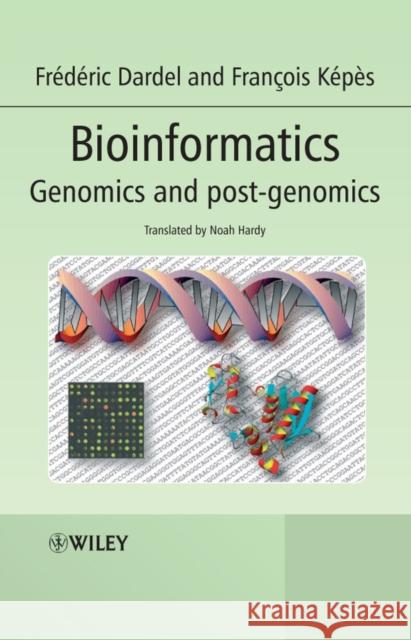
Frederic Dardel; Francois Kepes; Noah Hardy
Bioinformatics: Genomics and Post-Genomics Dardel, Frédéric 9780470020012 John Wiley & Sons - książkaWidoczna okładka, to zdjęcie poglądowe, a rzeczywista szata graficzna może różnić się od prezentowanej.

Bioinformatics: Genomics and Post-Genomics

ISBN-13: 9780470020012 / Angielski / Twarda / 2006 / 272 str.

Frederic Dardel; Francois Kepes; Noah Hardy
cena 337,93 zł
(netto: 321,84 VAT:  5%)

Najniższa cena z 30 dni: 335,16 zł
Termin realizacji zamówienia:
ok. 30 dni roboczych
Bez gwarancji dostawy przed świętami

Darmowa dostawa!

This book is an excellent introductory text describing the use of bioinformatics to analyze genomic and post-genomic data. It has been translated from the original popular French edition, which was based on a course taught at the well-respected Ecole Polytechnique in Palaiseau. This edition has been fully revised and updated by the authors. After a brief introduction to gene structure and sequence determination, it describes the techniques used to identify genes, their protein-coding sequences and regulatory regions. The book discusses the methodology of comparative genomics, using information from different organisms to deduce information about unknown sequences. There is a comprehensive chapter on structure prediction, covering both RNA and protein. Finally, the book describes the complex networks of RNA and protein that exist within the cell and their interactions, ending with a discussion of the simulation approaches that can be used to model these networks. Praise from the reviews: "In context of the new developments the genomic era has brought, Bioinformatics: Genomics and Post-Genomics becomes a fundamental and indispensable resource for undergraduate and early graduate students...insightfully authored...will immensely help students...in establishing important foundations while shaping their careers." NEWSLETTER, BRITISH SOCIETY OF CELL BIOLOGY


Kategorie:
Nauka, Biologia i przyroda
Kategorie BISAC:
Science > Bioinformatics
Science > Life Sciences - Genetics & Genomics
Wydawca:
John Wiley & Sons
Język:
Angielski
ISBN-13:
9780470020012
Rok wydania:
2006
Ilość stron:
272
Waga:
0.62 kg
Wymiary:
24.74 x 17.37 x 1.96
Oprawa:
Twarda
Wolumenów:
01
Dodatkowe informacje:
Bibliografia
Wydanie ilustrowane

"...provides a clear and concise introduction to the popular new science of bioinformatics." ( Bioautomation, volume 7)

Chapter 1. Genome sequencing.

1.1 Automatic sequencing.

1.2 Sequencing strategies.

1.3 Fragmentation strategies.

1.4 Sequence assembly.

1.5 Filling gaps.

1.6 Obstacles to reconstruction.

1.7 Utilizing a complementary large clone library.

1.8 The first large–scale sequencing project: The Haemophilus influenzae genome.

1.9 cDNA and EST.

Chapter 2. Sequence comparisons.

2.1 Introduction: Comparison as a sequence prediction method.

2.2 A sample molecule: the human and rosterone receptor.

2.3 Sequence homologies – functional homologies.

2.4 Comparison matrices.

2.5 The problem of insertions and deletions.

2.6 Optimal alignment: the dynamic programming method.

2.7 Fast heuristic methods.

2.8 Sensitivity, specificity, and confidence level.

2.9 Multiple alignments.

Chapter 3. Comparative genomics.

3.1 General properties of genomes.

3.2 Genome comparisons.

3.3 Gene evolution and phylogeny: applications to annotation.

Chapter 4. Genetic information and biological sequences.

4.1 Introduction: Coding levels.

4.2 Genes and the genetic code.

4.3 Expression signals.

4.4 Specific sites.

4.5 Sites located on DNA.

4.6 Sites present on RNA.

4.7 Pattern detection methods.

Chapter 5. Statistics and sequences.

5.1 Introduction.

5.2 Nucleotide base and amino acid distribution.

5.3 The biological basis of codon bias.

5.4 Using statistical bias for prediction.

5.5 Modeling DNA sequences.

5.6 Complex models.

5.7 Sequencing errors and hidden Markov models.

5.8 Hidden Markov processes: a general sequence analysis tool.

5.9 The search for genes – a difficult art.

Chapter 6. Structure prediction.

6.1 The structure of RNA.

6.2 Properties of the RNA molecule.

6.3 Secondary RNA structures.

6.4 Thermodynamic stability of RNA structures.

6.5 Finding the most stable structure.

6.6 Validation of predicted secondary structures.

6.7 Using chemical and enzymatic probing to analyze folding.

6.8 Long–distance interactions and three–dimensional structure prediction.

6.9 Protein structure.

6.10 Secondary structure prediction.

6.11 Three–dimensional modeling based on homologous protein structure.

6.12 Predicting folding.

Chapter 7. Transcriptome and proteome: macromolecular networks.

7.1 Introduction.

7.2 Post–genomic methods.

7.3 Macromolecular networks.

7.4 Topology of macromolecular networks.

7.5 Modularity and dynamics of macromolecular networks.

7.6 Inference of regulatory networks.

Chapter 8. Simulation of Biological Processes in the Genome Context.

8.1 Types of simulations.

8.2 Prediction and explanation.

8.3 Simulation of molecular networks.

8.4 Generic post–genomic simulators.

Index.

Frédéric Dardel. LCRB – UMR8015 CNRS, Faculté de Pharmacie, Université René Descartes/Paris.

François Képès. Epigenomics Project, Genopole®, Bldg G3, 93 rue Henri Rochefort, 91000 Evry, France.

Translated by Noah Hardy.

Dardel, Frederic Frederic Dardel. LCRB - UMR8015 CNRS, Faculte de P... więcej >


Udostępnij

Facebook - konto krainaksiazek.pl


Opinie o Krainaksiazek.pl na Opineo.pl

Partner Mybenefit

Krainaksiazek.pl w programie rzetelna firma Krainaksiaze.pl - płatności przez paypal

Czytaj nas na:

Facebook - krainaksiazek.pl
  • książki na zamówienie
  • granty
  • książka na prezent
  • kontakt
  • pomoc
  • opinie
  • regulamin
  • polityka prywatności

Zobacz:

  • Księgarnia czeska

  • Wydawnictwo Książkowe Klimaty

1997-2025 DolnySlask.com Agencja Internetowa

© 1997-2022 krainaksiazek.pl
     
KONTAKT | REGULAMIN | POLITYKA PRYWATNOŚCI | USTAWIENIA PRYWATNOŚCI
Zobacz: Księgarnia Czeska | Wydawnictwo Książkowe Klimaty | Mapa strony | Lista autorów
KrainaKsiazek.PL - Księgarnia Internetowa

Polityka prywatnosci - link
Krainaksiazek.pl - płatnośc Przelewy24
Przechowalnia Przechowalnia





