• Wyszukiwanie zaawansowane
  • Kategorie
  • Kategorie BISAC
  • Książki na zamówienie
  • Promocje
  • Granty
  • Książka na prezent
  • Opinie
  • Pomoc
  • Załóż konto
  • Zaloguj się

Bioinformatics Challenges at the Interface of Biology and Computer Science: Mind the Gap » książka


zaloguj się | załóż konto
Logo Krainaksiazek.pl

koszyk

konto

szukaj
topmenu
Księgarnia internetowa
Szukaj
Książki na zamówienie
Promocje
Granty
Książka na prezent
Moje konto
Pomoc
 
 
Wyszukiwanie zaawansowane
Pusty koszyk
Bezpłatna dostawa dla zamówień powyżej 20 złBezpłatna dostawa dla zamówień powyżej 20 zł

Kategorie główne

• Nauka
 [2944077]
• Literatura piękna
 [1814251]

  więcej...
• Turystyka
 [70679]
• Informatyka
 [151074]
• Komiksy
 [35590]
• Encyklopedie
 [23169]
• Dziecięca
 [611005]
• Hobby
 [136031]
• AudioBooki
 [1718]
• Literatura faktu
 [225599]
• Muzyka CD
 [379]
• Słowniki
 [2916]
• Inne
 [443741]
• Kalendarze
 [1187]
• Podręczniki
 [166463]
• Poradniki
 [469211]
• Religia
 [506887]
• Czasopisma
 [481]
• Sport
 [61343]
• Sztuka
 [242115]
• CD, DVD, Video
 [3348]
• Technologie
 [219293]
• Zdrowie
 [98602]
• Książkowe Klimaty
 [124]
• Zabawki
 [2385]
• Puzzle, gry
 [3504]
• Literatura w języku ukraińskim
 [260]
• Art. papiernicze i szkolne
 [7151]
Kategorie szczegółowe BISAC

Bioinformatics Challenges at the Interface of Biology and Computer Science: Mind the Gap

ISBN-13: 9780470035504 / Angielski / Twarda / 2016 / 424 str.
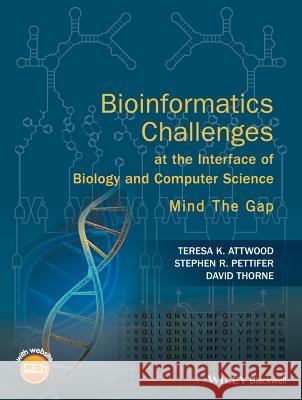
Teresa K. Attwood; Stephen Pettifer
Bioinformatics Challenges at the Interface of Biology and Computer Science: Mind the Gap Attwood, Teresa K. 9780470035504 John Wiley & Sons - książkaWidoczna okładka, to zdjęcie poglądowe, a rzeczywista szata graficzna może różnić się od prezentowanej.

Bioinformatics Challenges at the Interface of Biology and Computer Science: Mind the Gap

ISBN-13: 9780470035504 / Angielski / Twarda / 2016 / 424 str.

Teresa K. Attwood; Stephen Pettifer
cena 721,51
(netto: 687,15 VAT:  5%)

Najniższa cena z 30 dni: 712,70
Termin realizacji zamówienia:
ok. 30 dni roboczych.

Darmowa dostawa!
inne wydania

This innovative book provides a completely fresh exploration of bioinformatics, investigating its complex interrelationship with biology and computer science. It approaches bioinformatics from a unique perspective, highlighting interdisciplinary gaps that often trap the unwary. The book considers how the need for biological databases drove the evolution of bioinformatics; it reviews bioinformatics basics (including database formats, data-types and current analysis methods), and examines key topics in computer science (including data-structures, identifiers and algorithms), reflecting on their use and abuse in bioinformatics. Bringing these disciplines together, this book is an essential read for those who wish to better understand the challenges for bioinformatics at the interface of biology and computer science, and how to bridge the gaps. It will be an invaluable resource for advanced undergraduate and postgraduate students, and for lecturers, researchers and professionals with an interest in this fascinating, fast-moving discipline and the knotty problems that surround it.


Kategorie:
Nauka, Biologia i przyroda
Kategorie BISAC:
Science > Life Sciences - Genetics & Genomics
Wydawca:
John Wiley & Sons
Język:
Angielski
ISBN-13:
9780470035504
Rok wydania:
2016
Ilość stron:
424
Waga:
1.06 kg
Wymiary:
24.64 x 18.54 x 2.54
Oprawa:
Twarda
Wolumenów:
01
Dodatkowe informacje:
Bibliografia
Glosariusz/słownik
Wydanie ilustrowane

Preface x

Acknowledgements xvii

About the companion website xviii

PART 1

1 Introduction 3

1.1 Overview 3

1.2 Bioinformatics 3

1.2.1 What is bioinformatics? 3

1.2.2 The provenance of bioinformatics 4

1.2.3 The seeds of bioinformatics 5

1.3 Computer Science 7

1.3.1 Origins of computer science 7

1.3.2 Computer science meets bioinformatics 9

1.4 What did we want to do with bioinformatics? 10

1.5 Summary 12

1.6 References 13

1.7 Quiz 14

1.8 Problems 16

2 The biological context 17

2.1 Overview 17

2.2 Biological data ]types and concepts 17

2.2.1 Diversity of biological data ]types 17

2.2.2 The central dogma 18

2.2.3 Fundamental building ]blocks and alphabets 19

2.2.4 The protein structure hierarchy 29

2.2.5 RNA processing in prokaryotes and eukaryotes 30

2.2.6 The genetic code 33

2.2.7 Conceptual translation and gene finding 35

2.3 Access to whole genomes 42

2.4 Summary 43

2.5 References 43

2.6 Quiz 46

2.7 Problems 47

3 Biological databases 49

3.1 Overview 49

3.2 What kinds of database are there? 49

3.3 The Protein Data Bank (PDB) 50

3.4 The EMBL nucleotide sequence data library 56

3.5 GenBank 58

3.6 The PIR ]PSD 61

3.7 Swiss ]Prot 62

3.8 PROSITE 64

3.9 TrEMBL 69

3.10 InterPro 71

3.11 UniProt 73

3.12 The European Nucleotide Archive (ENA) 77

3.13 Summary 81

3.14 References 82

3.15 Quiz 85

3.16 Problems 87

4 Biological sequence analysis 89

4.1 Overview 89

4.2 Adding meaning to raw sequence data 89

4.2.1 Annotating raw sequence data 94

4.2.2 Database and sequence formats 96

4.2.3 Making tools and databases interoperate 101

4.3 Tools for deriving sequence annotations 103

4.3.1 Methods for comparing two sequences 103

4.3.2 The PAM and BLOSUM matrices 104

4.3.3 Tools for global and local alignment 110

4.3.4 Tools for comparing multiple sequences 114

4.3.5 Alignment ]based analysis methods 115

4.4 Summary 131

4.5 References 132

4.6 Quiz 134

4.7 Problems 136

5 The gap 138

5.1 Overview 138

5.2 Bioinformatics in the 21st century 138

5.3 Problems with genes 139

5.4 Problems with names 142

5.5 Problems with sequences 143

5.6 Problems with database entries 146

5.6.1 Problems with database entry formats 147

5.7 Problems with structures 148

5.8 Problems with alignments 150

5.8.1 Different methods, different results 150

5.8.2 What properties do my sequences share? 154

5.8.3 How similar are my sequences? 157

5.8.4 How good is my alignment? 160

5.9 Problems with families 163

5.10 Problems with functions 168

5.11 Functions of domains, modules and their parent proteins 173

5.12 Defining and describing functions 176

5.13 Summary 179

5.14 References 180

5.15 Quiz 182

5.16 Problems 183

PART 2

6 Algorithms and complexity 187

6.1 Overview 187

6.2 Introduction to algorithms 187

6.2.1 Mathematical computability 189

6.3 Working with computers 191

6.3.1 Discretisation of solutions 191

6.3.2 When computers go bad 193

6.4 Evaluating algorithms 197

6.4.1 An example: a sorting algorithm 197

6.4.2 Resource scarcity: complexity of algorithms 199

6.4.3 Choices, choices 200

6.5 Data structures 201

6.5.1 Structural consequences 202

6.5.2 Marrying form and function 210

6.6 Implementing algorithms 211

6.6.1 Programming paradigm 212

6.6.2 Choice of language 214

6.6.3 Mechanical optimisation 216

6.6.4 Parallelisation 224

6.7 Summary 227

6.8 References 227

6.9 Quiz 227

6.10 Problems 229

7 Representation and meaning 230

7.1 Overview 230

7.2 Introduction 230

7.3 Identification 233

7.3.1 Namespaces 233

7.3.2 Meaningless identifiers are a good thing 233

7.3.3 Identifying things on the Web 236

7.3.4 Cool URIs don t change 238

7.3.5 Versioning and provenance 238

7.3.6 Case studies 239

7.4 Representing data 243

7.4.1 Design for change 245

7.4.2 Contemporary data ]representation paradigms 247

7.5 Giving meaning to data 255

7.5.1 Bio ontologies in practice 260

7.5.2 First invent the universe 263

7.6 Web services 264

7.6.1 The architecture of the Web 266

7.6.2 Statelessness 267

7.7 Action at a distance 268

7.7.1 SOAP and WSDL 270

7.7.2 HTTP as an API 270

7.7.3 Linked Data 272

7.8 Summary 275

7.9 References 275

7.10 Quiz 276

7.11 Problems 277

8 Linking data and scientific literature 279

8.1 Overview 279

8.2 Introduction 279

8.3 The lost steps of curators 281

8.4 A historical perspective on scientific literature 286

8.5 The gulf between human and machine comprehension 288

8.6 Research objects 295

8.7 Data publishing 297

8.8 Separating scientific wheat from chaff towards semantic searches 298

8.9 Semantic publication 300

8.9.1 Making articles semantic 301

8.10 Linking articles with their cognate data 305

8.10.1 What Utopia Documents does 305

8.10.2 A case study 306

8.11 Summary 314

8.12 References 315

8.13 Quiz 318

8.14 Problems 319

Afterword 321

Glossary 327

Quiz Answers 371

Problem Answers 378

Index 394

David Thoren wurde 1972 in Australien geboren. Offiziell arbeitet er als Grafikdesigner. Am liebsten treibt er jedoch seine Kollegen und Nachbarn mit absurden E-Mails zur Weißglut. 2008 ging sein Versuch, die ausstehende Rechnung seines Chiropraktikers mit einer selbst gezeichneten Spinne zu bezahlen, um die Welt. Seitdem gilt er als der berühmteste notorische Unruhestifter des Internets. Er lebt und provoziert in Adelaide.


Udostępnij

Facebook - konto krainaksiazek.pl


Opinie o Krainaksiazek.pl na Opineo.pl

Partner Mybenefit

Krainaksiazek.pl w programie rzetelna firma Krainaksiaze.pl - płatności przez paypal

Czytaj nas na:

Facebook - krainaksiazek.pl
  • książki na zamówienie
  • granty
  • książka na prezent
  • kontakt
  • pomoc
  • opinie
  • regulamin
  • polityka prywatności

Zobacz:

  • Księgarnia czeska

  • Wydawnictwo Książkowe Klimaty

1997-2026 DolnySlask.com Agencja Internetowa

© 1997-2022 krainaksiazek.pl
     
KONTAKT | REGULAMIN | POLITYKA PRYWATNOŚCI | USTAWIENIA PRYWATNOŚCI
Zobacz: Księgarnia Czeska | Wydawnictwo Książkowe Klimaty | Mapa strony | Lista autorów
KrainaKsiazek.PL - Księgarnia Internetowa

Polityka prywatnosci - link
Krainaksiazek.pl - płatnośc Przelewy24
Przechowalnia Przechowalnia






