• Wyszukiwanie zaawansowane
  • Kategorie
  • Kategorie BISAC
  • Książki na zamówienie
  • Promocje
  • Granty
  • Książka na prezent
  • Opinie
  • Pomoc
  • Załóż konto
  • Zaloguj się

Biodegradation of Pesticides » książka


zaloguj się | załóż konto
Logo Krainaksiazek.pl

koszyk

konto

szukaj
topmenu
Księgarnia internetowa
Szukaj
Książki na zamówienie
Promocje
Granty
Książka na prezent
Moje konto
Pomoc
 
 
Wyszukiwanie zaawansowane
Pusty koszyk
Bezpłatna dostawa dla zamówień powyżej 20 złBezpłatna dostawa dla zamówień powyżej 20 zł

Kategorie główne

• Nauka
 [2949965]
• Literatura piękna
 [1857847]

  więcej...
• Turystyka
 [70818]
• Informatyka
 [151303]
• Komiksy
 [35733]
• Encyklopedie
 [23180]
• Dziecięca
 [617748]
• Hobby
 [139972]
• AudioBooki
 [1650]
• Literatura faktu
 [228361]
• Muzyka CD
 [398]
• Słowniki
 [2862]
• Inne
 [444732]
• Kalendarze
 [1620]
• Podręczniki
 [167233]
• Poradniki
 [482388]
• Religia
 [509867]
• Czasopisma
 [533]
• Sport
 [61361]
• Sztuka
 [243125]
• CD, DVD, Video
 [3451]
• Technologie
 [219309]
• Zdrowie
 [101347]
• Książkowe Klimaty
 [123]
• Zabawki
 [2362]
• Puzzle, gry
 [3791]
• Literatura w języku ukraińskim
 [253]
• Art. papiernicze i szkolne
 [7933]
Kategorie szczegółowe BISAC

Biodegradation of Pesticides

ISBN-13: 9781468440904 / Angielski / Miękka / 2013 / 312 str.
Fumio Matsumura
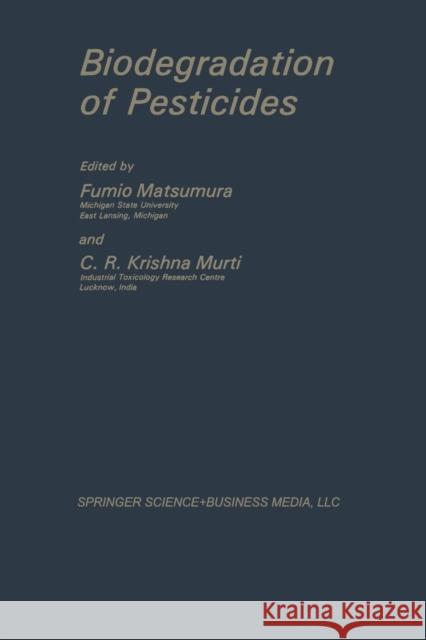
Biodegradation of Pesticides Fumio Matsumura 9781468440904 Springer - książkaWidoczna okładka, to zdjęcie poglądowe, a rzeczywista szata graficzna może różnić się od prezentowanej.

Biodegradation of Pesticides

ISBN-13: 9781468440904 / Angielski / Miękka / 2013 / 312 str.

Fumio Matsumura
cena 201,72
(netto: 192,11 VAT:  5%)

Najniższa cena z 30 dni: 192,74
Termin realizacji zamówienia:
ok. 22 dni roboczych
Bez gwarancji dostawy przed świętami

Darmowa dostawa!

When first developed, chlorinated pesticides such as DDT, dieldrin, and mirex were received with open arms, quickly becoming popular as effective, economic agents against pests. But evidence began to mount that residues of these chemicals remained in the environment, not breaking down, often appearing in plants and animals. By the late seventies many pesticides had achieved a terrible notoriety and were subsequently banned in a number of countries. Of tremendous concern, then, is the persistence of pesticides in the environment. The major thrust of research and development in the area of pesticides has properly been the creation of substances that are both effective and degradable. Yet in order to successfully promote the use of biodegradable pesticides, one must fully understand the mechanism of degradation, and it is to this vital subject that we address ourselves in the present volume. According to the Biodegradation Task Force, Safety of Chemicals Com- mittee, Brussels (1978), biodegradation may be defined as the molecular degradation of an organic substance resulting from the complex action of living organisms. A substance is said to be biodegraded to an environmentally acceptable extent when environmentally undesirable properties are lost. Loss of some characteristic function or property of substance by biodegradation may be referred to as biological transformation.


Kategorie:
Nauka, Medycyna
Kategorie BISAC:
Technology & Engineering > Environmental - General
Medical > Weterynaria
Wydawca:
Springer
Język:
Angielski
ISBN-13:
9781468440904
Rok wydania:
2013
Wydanie:
Softcover Repri
Ilość stron:
312
Waga:
0.44 kg
Wymiary:
22.86 x 15.24 x 1.75
Oprawa:
Miękka
Wolumenów:
01

I Biodegradation of Pesticides: Principles and Mechanisms.- 1 Degradation of Pesticides by Animals.- 1.1. Introduction.- 1.2. Phase I Metabolism.- 1.2.1. Dehydrohalogenation and Dehalogenation.- 1.2.2. Desulfuration.- 1.2.3. Epoxidation.- 1.2.4. Hydrolysis.- 1.2.5. Hydroxylation.- 1.2.6. Oxidation-Reduction Reactions.- 1.2.7. Isomerization.- 1.2.8. Nitrosation.- 1.3. Phase II Metabolism.- 1.3.1. Glycoside Formation.- 1.3.2. Sulfoconjugation.- 1.3.3. Other Conjugation Reactions.- 1.4. Conclusion.- References.- 2 Pesticide Metabolism in Plants: Reactions and Mechanisms.- 2.1. Introduction.- 2.2. Pesticide Metabolism in Plants.- 2.2.1. Absorption.- 2.2.2. Translocation and Distribution.- 2.2.3. Metabolism.- 2.3. Degradation Reactions of Pesticides in Plants.- 2.3.1. Oxidation.- 2.3.2. Reduction.- 2.3.3. Hydrolysis.- 2.3.4. Conjugation.- 2.3.5. Bound or Insoluble Residues.- 2.4. Conclusion.- References.- 3 Degradation of Pesticides in the Environment by Microorganisms and Sunlight.- 3.1. Introduction.- 3.2. Characteristics of Microbial Metabolism.- 3.2.1. Enzymatic Degradation.- 3.2.2. Criteria for Distinguishing One Type of Metabolism from Another.- 3.3. Commonly Occurring Metabolic Processes in Microorganisms.- 3.3.1. Hydrolytic Processes.- 3.3.2. Reductive Systems.- 3.3.3. Oxidative Reactions.- 3.4. Other Metabolic Reactions Related to Pesticide Degradation.- 3.4.1. Dehydrochlorination.- 3.4.2. Isomerization.- 3.4.3. Synthetic Metabolism.- 3.4.4. Polymerization.- 3.5. Degradation by Sunlight and Other Physical Factors.- 3.5.1. Hydrolysis: Nucleophilic Reaction.- 3.5.2. Dehalogenation.- 3.5.3. Oxidation.- 3.5.4. Isomerization and Polymerization.- 3.6. Conclusion.- References.- II Application of the Principles of Biodegrada Tion of Pesticides.- 4 Microbial Degradation of Pesticides in Tropical Soils.- 4.1. Introduction.- 4.2. Residues in Soil.- 4.3. Microbial Degradation.- 4.3.1. Chlorinated Hydrocarbon Insecticides.- 4.3.2. Organophosphorous Insecticides.- 4.3.3. Carbamate Insecticides.- 4.3.4. Fungicides.- 4.4. Factors Influencing Persistence of Pesticides.- 4.4.1. Soil Moisture.- 4.4.2. Organic Matter.- 4.4.3. Redox Conditions.- 4.4.4. Soil Acidity.- 4.4.5. Soil Temperature.- 4.4.6. Sorption-Desorption.- 4.4.7. Mineral Constituents.- 4.4.8. Pesticide Combinations.- 4.5. Conclusion.- References.- 5 Persistence and Biodegradation of Herbicides.- 5.1. Introduction.- 5.2. Persistence.- 5.3. Degradation.- 5.3.1. Biodegradation.- 5.3.2. Nonbiodegradation.- 5.4. Man’s Activities.- 5.5. Conclusion.- References.- 6 Biodegradation of Agricultural Fungicides.- 6.1. Introduction.- 6.2. Toxicity of Fungicides to Nontarget Organisms.- 6.3. Stability of Fungicides.- 6.4. Biodegradation of Selected Fungicides.- 6.4.1. Triphenyltins.- 6.4.2. PCNB (Terraclor, Quintozene).- 6.4.3. Dithiocarbamates.- 6.4.4. Substituted Phthalimides.- 6.4.5. Chloroneb.- 6.4.6. Benzimidazoles.- 6.5. Effect of Fungicides on Pesticide Degradation.- 6.6. Summary and Conclusions.- References.- 7 Biodegradable Insecticides: Their Application in Forestry.- 7.1. Introduction.- 7.2. Need for Insecticides.- 7.3. Use of DDT: 1945–1974.- 7.4. Alternatives to DDT and Other Insecticides.- 7.5. Insecticide Evaluation Research.- 7.6. Testing Protocol.- 7.6.1. Laboratory Testing and Evaluation.- 7.6.2. Bioassay Studies.- 7.6.3. Individual Tree Evaluations.- 7.6.4. Field Testing.- 7.7. Systemic Insecticides.- 7.8. Trends in Forest Pest Management.- 7.9. Conclusions.- References.- 8 The Use of Biodegradable Pesticides in Public Health Entomology.- 8.1. Introduction.- 8.2. The Nature and Diversity of Arthropod-Borne Disease.- 8.3. Insecticides: The Recent Past.- 8.3.1. Mosquito Control in the United States.- 8.3.2. Malaria Control.- 8.4. Integrated Pest and Vector Management.- 8.5. Source Reduction.- 8.5.1. Salt Marsh Mosquitoes.- 8.5.2. Aedes vexons.- 8.5.3. Aedes aegypti.- 8.5.4. Aedes triseriatus.- 8.6. Mass-Produced Biocontrol Agents.- 8.6.1. Larvivorous Fish.- 8.6.2. Insectan Predators.- 8.6.3. Bacterial Pathogens.- 8.6.4. Fungi.- 8.6.5. Protozoa.- 8.6.6. Nematodes.- 8.7. Insecticides for Mosquito Control.- 8.7.1. Conventional Larvicides.- 8.7.2. Synthetic Pyrethroids.- 8.7.3. Insect Growth Regulators.- 8.8. The Need to Apply Existing Knowledge.- References.- 9 Pesticides for Stored Products.- 9.1. Introduction.- 9.2. Fumigants.- 9.3. Protectants.- 9.4. Alternative Chemical Control Techniques.- 9.4.1. Compounds That Affect Insect Development.- 9.4.2. Compounds That Affect Insect Behavior.- 9.5. Conclusion.- References.- 10 Application of Biodegradable Pesticides in India.- 10.1. Introduction.- 10.2. The Pesticide Industry in India.- 10.2.1. Consumption of Pesticides in India.- 10.2.2. Development of Process Technology within the Country.- 10.3. Biodegradation of Pesticides by Microorganisms.- 10.4. Insecticides of Plant Origin.- 10.5. Farm Management and Metabolism.- 10.5.1. Organophosphorus Compounds.- 10.5.2. Organochlorine Insecticides.- 10.5.3. Carbamate Compounds.- 10.5.4. Fungicides, Herbicides, and Fumigants.- 10.6. Postharvest Storage.- 10.7. Bioefficacy and Residue Effects of Pesticides.- 10.8. Pesticides in Forestry.- 10.9. Safety Evaluation Studies.- 10.9.1. Toxicity to Fish.- 10.9.2. Toxicity to Wildlife.- 10.9.3. Toxicity to Animals.- 10.9.4. Toxicity to Man.- 10.10. Future Perspectives.- References.


Udostępnij

Facebook - konto krainaksiazek.pl


Opinie o Krainaksiazek.pl na Opineo.pl

Partner Mybenefit

Krainaksiazek.pl w programie rzetelna firma Krainaksiaze.pl - płatności przez paypal

Czytaj nas na:

Facebook - krainaksiazek.pl
  • książki na zamówienie
  • granty
  • książka na prezent
  • kontakt
  • pomoc
  • opinie
  • regulamin
  • polityka prywatności

Zobacz:

  • Księgarnia czeska

  • Wydawnictwo Książkowe Klimaty

1997-2025 DolnySlask.com Agencja Internetowa

© 1997-2022 krainaksiazek.pl
     
KONTAKT | REGULAMIN | POLITYKA PRYWATNOŚCI | USTAWIENIA PRYWATNOŚCI
Zobacz: Księgarnia Czeska | Wydawnictwo Książkowe Klimaty | Mapa strony | Lista autorów
KrainaKsiazek.PL - Księgarnia Internetowa

Polityka prywatnosci - link
Krainaksiazek.pl - płatnośc Przelewy24
Przechowalnia Przechowalnia





