• Wyszukiwanie zaawansowane
  • Kategorie
  • Kategorie BISAC
  • Książki na zamówienie
  • Promocje
  • Granty
  • Książka na prezent
  • Opinie
  • Pomoc
  • Załóż konto
  • Zaloguj się

Biocommunication and Natural Genome Editing » książka


zaloguj się | załóż konto
Logo Krainaksiazek.pl

koszyk

konto

szukaj
topmenu
Księgarnia internetowa
Szukaj
Książki na zamówienie
Promocje
Granty
Książka na prezent
Moje konto
Pomoc
 
 
Wyszukiwanie zaawansowane
Pusty koszyk
Bezpłatna dostawa dla zamówień powyżej 20 złBezpłatna dostawa dla zamówień powyżej 20 zł

Kategorie główne

• Nauka
 [2949965]
• Literatura piękna
 [1857847]

  więcej...
• Turystyka
 [70818]
• Informatyka
 [151303]
• Komiksy
 [35733]
• Encyklopedie
 [23180]
• Dziecięca
 [617748]
• Hobby
 [139972]
• AudioBooki
 [1650]
• Literatura faktu
 [228361]
• Muzyka CD
 [398]
• Słowniki
 [2862]
• Inne
 [444732]
• Kalendarze
 [1620]
• Podręczniki
 [167233]
• Poradniki
 [482388]
• Religia
 [509867]
• Czasopisma
 [533]
• Sport
 [61361]
• Sztuka
 [243125]
• CD, DVD, Video
 [3451]
• Technologie
 [219309]
• Zdrowie
 [101347]
• Książkowe Klimaty
 [123]
• Zabawki
 [2362]
• Puzzle, gry
 [3791]
• Literatura w języku ukraińskim
 [253]
• Art. papiernicze i szkolne
 [7933]
Kategorie szczegółowe BISAC

Biocommunication and Natural Genome Editing

ISBN-13: 9789400791145 / Angielski / Miękka / 2014 / 213 str.
Guenther Witzany
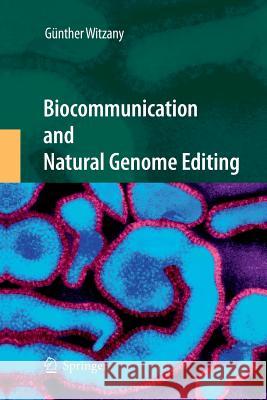
Biocommunication and Natural Genome Editing Guenther Witzany 9789400791145 Springer - książkaWidoczna okładka, to zdjęcie poglądowe, a rzeczywista szata graficzna może różnić się od prezentowanej.

Biocommunication and Natural Genome Editing

ISBN-13: 9789400791145 / Angielski / Miękka / 2014 / 213 str.

Guenther Witzany
cena 605,23
(netto: 576,41 VAT:  5%)

Najniższa cena z 30 dni: 578,30
Termin realizacji zamówienia:
ok. 22 dni roboczych
Bez gwarancji dostawy przed świętami

Darmowa dostawa!
inne wydania

I wrote this book for biologists and those who are interested in both biological affairs in general and perspectives which integrate a large number of specialised biological disciplines. The theory of biocommunication presented herein investigates signal transd- tion processes among cells, tissues, organs and organisms in bacteria, animals (corals and bees), fungi and plants in the light of the current available empirical data. Because life is the central focus of the life sciences, this theory will also focus on typical features of life as opposed to inorganic matter. Because this eld of investigation is based on the methodological primacy of a pragmatic action theory, the book may also be of interest to researchers of lingu- tics, communication sciences and sociology (e.g. plant sociology, animal sociology) who would welcome an overview of these highly specialised biological disciplines. Current molecular biology as well as cell biology investigates its scienti c object by using key terms such as genetic code, code without commas, misre- ing of the genetic code, coding, open reading frame, genetic storage medium DNA, genetic information, genetic alphabet, genetic expression, messenger RNA, ce- to-cell communication, immune response, transcription, translation, nucleic acid language, amino acid language, recognition sequences, recognition sites, protein coding sequences, repeat sequences, signalling, signal transduction, signalling codes, signalling pathways, etc.


Kategorie:
Nauka, Biologia i przyroda
Kategorie BISAC:
Science > Botanika
Science > Mikrobiologia
Science > Zoologia i nauki o zwierzętach
Wydawca:
Springer
Język:
Angielski
ISBN-13:
9789400791145
Rok wydania:
2014
Wydanie:
2010
Ilość stron:
213
Waga:
0.32 kg
Wymiary:
23.39 x 15.6 x 1.22
Oprawa:
Miękka
Wolumenów:
01
Dodatkowe informacje:
Wydanie ilustrowane

Frantisek Baluska,

IZMB, University of Bonn, Germany; email: baluska@uni-bonn.de

This provocative and exciting book opens new avenues to understand the nature of diverse living systems and their evolution on the planet Earth. Identification of communication at all levels of biological complexity - from viruses, via bacteria, fungi, plants, corals, and insects, up to humans is convincing. Intriguingly, the communicative nature of all organisms includes also context-dependent interpretations of signs, feature associated only with humans until now. Guenther Witzany reveals that the communicative competence of all organisms is the most inherent feature of the Living Nature, distinguishing it clearly from the Non-Living Nature.

Peter Gogarten,

Dept. of Molecular and Cell Biology, University of Connecticut, Storrs, USA; email: gogarten@uconn.edu

Günther Witzany, an expert in biocommunication, uses linguistics and communication science to provide a novel framework for the discussion of naturally occurring genome editing and for the interactions of selfish genes and molecular parasites with each other and with the host organism. Many interesting questions, for example the interactions between multiple levels of selection, are illuminated through reformulating the problem as a communication process.

Gertrudis Van de Vijver,

Centre for Critical Philosophy, University of Ghent, Belgium; email: Gertrudis.VandeVijver@Ugent.be

At last a systematic and updated account of the living in terms of communicative processes! Of course there is no life without communication, and of course, as Watzlawick already pointed out, it is not possible not to communicate. But someone like Guenther Witzany had to come along to collect, interpret and systematize the relevant data. Not as a distant spectator, however, but as a participant and engaged thinker very well aware of the philosophical and metaphysical changes that are required to adequately conceive of the living as an essentially communicative process.

Luis P. Villarreal,

Director Center for Virus Research, University of California, Irvine, USA; email: lpvillar@uci.edu

The concept of a code has long been central to biology, especially molecular biology. An entire generation of scientist have been raised to think in terms of a common genetic code. Yet, curiously, the concepts from biocommunication including those of pragmatics and linguistics have seldom impacted code-thinking in the biological sciences. This book represents a much needed symbiosis of these two lines of thinking and will significantly expand our understanding of how codes can be edited or evolved.

Preface.- Acknowledgements.- 1. Introduction: Metaphysical and Post-metaphysical Relationships of Humans with Nature and Life.- 2. Plant Communication.- 3. Communicative Competences of Honey-Bees.- 4. Biocommunication of Corals.- 5. Biocommunication of Fungal Organisms.- 6. Bacteria Communication.- 7. Natural Genome Editing Competences of Viruses and Virus-Like Agents.- 8. How Bacteria Escaped Selection Pressure of the Early RNA-World.- 9. The Viral Origins of Telomeres and Telomerases.- 10. Real Life-world of noncoding RNA-species.- 11. Outlook.

This is the first uniform description of all key levels of communication in the organismic kingdoms of plants, fungi, animals and bacteria based on the most recent empirical data. Biocommunication occurs on three levels (A) intraorganismic, i.e. intra- and intercellular, (B) interorganismic, between the same or related species and (C) transorganismic, between organisms which are not related. The biocommunicative approach demonstrates both that cells, tissues, organs and organisms coordinate and organize by communication processes and genetic nucleotide sequence order in cellular and non-cellular genomes is structured language-like, i.e. follow combinatorial (syntactic), context-sensitive (pragmatic) and content-specific (semantic) rules. Without sign-mediated interactions no vital functions within and between organisms can be coordinated. Exactly this feature is absent in non-living matter.

Additionally the biocommunicative approach investigates natural genome editing competences of viruses. Natural genome editing from a biocommunicative perspective is competent agent-driven generation and integration of meaningful nucleotide sequences into pre-existing genomic content arrangements and the ability to (re)combine and (re)regulate them according to context-dependent (i.e. adaptational) purposes of the host organism. The biocommunicative approach is an original scientific field of investigations. Readers must be competent in basic knowledge of biology and genetics.


Udostępnij

Facebook - konto krainaksiazek.pl


Opinie o Krainaksiazek.pl na Opineo.pl

Partner Mybenefit

Krainaksiazek.pl w programie rzetelna firma Krainaksiaze.pl - płatności przez paypal

Czytaj nas na:

Facebook - krainaksiazek.pl
  • książki na zamówienie
  • granty
  • książka na prezent
  • kontakt
  • pomoc
  • opinie
  • regulamin
  • polityka prywatności

Zobacz:

  • Księgarnia czeska

  • Wydawnictwo Książkowe Klimaty

1997-2025 DolnySlask.com Agencja Internetowa

© 1997-2022 krainaksiazek.pl
     
KONTAKT | REGULAMIN | POLITYKA PRYWATNOŚCI | USTAWIENIA PRYWATNOŚCI
Zobacz: Księgarnia Czeska | Wydawnictwo Książkowe Klimaty | Mapa strony | Lista autorów
KrainaKsiazek.PL - Księgarnia Internetowa

Polityka prywatnosci - link
Krainaksiazek.pl - płatnośc Przelewy24
Przechowalnia Przechowalnia





