• Wyszukiwanie zaawansowane
  • Kategorie
  • Kategorie BISAC
  • Książki na zamówienie
  • Promocje
  • Granty
  • Książka na prezent
  • Opinie
  • Pomoc
  • Załóż konto
  • Zaloguj się

Bio-Economic Models Applied to Agricultural Systems » książka

zaloguj się | załóż konto
Logo Krainaksiazek.pl

koszyk

konto

szukaj
topmenu
Księgarnia internetowa
Szukaj
Książki na zamówienie
Promocje
Granty
Książka na prezent
Moje konto
Pomoc
 
 
Wyszukiwanie zaawansowane
Pusty koszyk
Bezpłatna dostawa dla zamówień powyżej 20 złBezpłatna dostawa dla zamówień powyżej 20 zł

Kategorie główne

• Nauka
 [2952079]
• Literatura piękna
 [1850969]

  więcej...
• Turystyka
 [71058]
• Informatyka
 [151066]
• Komiksy
 [35579]
• Encyklopedie
 [23181]
• Dziecięca
 [620496]
• Hobby
 [139036]
• AudioBooki
 [1646]
• Literatura faktu
 [228729]
• Muzyka CD
 [379]
• Słowniki
 [2932]
• Inne
 [445708]
• Kalendarze
 [1409]
• Podręczniki
 [164793]
• Poradniki
 [480107]
• Religia
 [510956]
• Czasopisma
 [511]
• Sport
 [61267]
• Sztuka
 [243299]
• CD, DVD, Video
 [3411]
• Technologie
 [219640]
• Zdrowie
 [100984]
• Książkowe Klimaty
 [124]
• Zabawki
 [2281]
• Puzzle, gry
 [3363]
• Literatura w języku ukraińskim
 [258]
• Art. papiernicze i szkolne
 [8020]
Kategorie szczegółowe BISAC

Bio-Economic Models Applied to Agricultural Systems

ISBN-13: 9789401780940 / Angielski / Miękka / 2014 / 220 str.
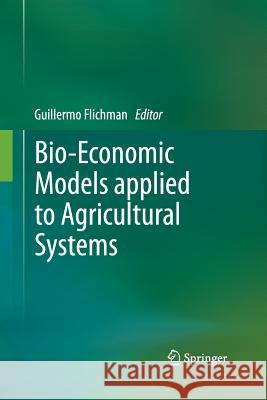
Guillermo Flichman
Bio-Economic Models Applied to Agricultural Systems Flichman, Guillermo 9789401780940 Springer - książkaWidoczna okładka, to zdjęcie poglądowe, a rzeczywista szata graficzna może różnić się od prezentowanej.

Bio-Economic Models Applied to Agricultural Systems

ISBN-13: 9789401780940 / Angielski / Miękka / 2014 / 220 str.

Guillermo Flichman
cena 402,53
(netto: 383,36 VAT:  5%)

Najniższa cena z 30 dni: 385,52
Termin realizacji zamówienia:
ok. 22 dni roboczych
Dostawa w 2026 r.

Darmowa dostawa!

This book has the purpose of providing the "state of the arts" concerning bio-economic modelling dealing with agricultural systems. In most cases, the contributions use a methodology combining the use of biophysical and economic models, in all cases, an engineering production function approach is totally or partially applied. This practice is being developed in the last years as a response to concrete policy matters: agricultural policies are increasingly combined with environmental and natural resources policies, and this reality involves the need of an integrated assessment, that current economic models are not able to provide.


Kategorie:
Nauka, Ekonomia i biznes
Kategorie BISAC:
Business & Economics > Industries - Agribusiness
Business & Economics > Operations Research
Business & Economics > Economics - General
Wydawca:
Springer
Język:
Angielski
ISBN-13:
9789401780940
Rok wydania:
2014
Wydanie:
2011
Ilość stron:
220
Waga:
0.36 kg
Wymiary:
23.5 x 15.5
Oprawa:
Miękka
Wolumenów:
01
Dodatkowe informacje:
Wydanie ilustrowane

From the reviews:

"This book is a collection of articles by European and American researchers on the use of bio-economic models applied to agricultural systems. The objective is ambitious: 'providing the state of the art' regarding bio-economic models. ... It will be indispensable for researchers in the field of mathematical programming applied to the agricultural sector." (Filippo Arfini, European Review of Agricultural Economics, Vol. 39 (5), December, 2012)

Acknowledgments, Preface
Part I
Ch. 1. Modelling the relationship between agriculture and the environment using bio-economic models: some conceptual issues; G. Flichman, K. Louhichi and J.M. Boisson
Ch. 2. Bio physical models as detailed engineering production functions; J.M. Boussard
Ch. 3. Dynamic optimisation problems: Different resolution methods regarding agriculture and natural resource economics; M. Blanco-Fonseca, G. Flichman and H. Belhouchette
Ch. 4. Biophysical models for cropping system simulation; M. Donatelli, R. Confalonieri
Part II
Ch. 5. Incorporating yield information from a biogeochemical model into an agricultural production model to infer adoption of a new bioenergy crop; P. Mérel, F. Yi, S. Bucaram, J. Lee, R. Howitt and J. Six
Ch. 6. Agri-environmental nitrogen indicators for EU27; A. Leip, F. Weiss and W. Britz
Ch. 7. Modelling Nitrogen balance for a regional scale livestock-pasture system as a discussion support tool;  U.B. Nidumolu, M. Lubbers, V. Alary, P. Lecomte, and H. van Keulen
Ch. 8. Using a Bio-economic Model to Assess the Cost-effectiveness of Measures against Nitrogen Pollution; I. Mouratiadou, D. Tarsitano, C. Topp, D. Moran and G. Russell
Ch. 9. On-farm weather risk management in suckler cow farms: A recursive discrete stochastic programming approach; C. Mosnier, J. Agabriel, M. Lherm and A. Reynaud
Ch. 10. Integrated bio-economic farm modeling for biodiversity assessment at landscape level; M. Schönhart, T. Schauppenlehner and Erwin Schmid
Conclusions.

The bio-economic modeling approach presented in this book is a result of two distinct developments: by one side, the improvement of bio-physical simulation models applied to agricultural systems and by the other, the evolution of agricultural policies demanding a kind of assessment that conventional economic models are not able to provide. Some economists began to realize that biophysical models could be considered as detailed engineering production functions, allowing to represent in a consistent manner the joint products of agricultural activities. The perspectives that this vision provides allow dealing with environmental and natural resources issues with an economic perspective in an efficient manner. Representing environmental impacts of agricultural activities measured in physical units allows performing cost-efficiency calculations of alternative policies, potentially able to attain specified policy targets. This capability permitted in recent years the development of applied research related with institutional demands from national and international public institutions. But this approach requires a multidisciplinary approach, with positive and negative effects. The positive one is, both for economists and biophysical scientists, to enlarge their vision of the world. The negative effects are the greater difficulty to get recognized in their specific discipline, the obstacles to obtain the necessary information for properly use these models, and the longer time to perform the research activity. The “productivity” for producing papers is lower for economists applying this approach compared with economists applying econometric methods, using available published data. In spite of these negative effects, as the demands from the real world for the assessment these models are able to provide is increasing, it is quite possible that there is a future for bio-economic models applied to agricultural systems. The challenges of Climate Change, the increase care for the preservation of natural resources and the environment will require further developments of this kind of approach.



Udostępnij

Facebook - konto krainaksiazek.pl


Opinie o Krainaksiazek.pl na Opineo.pl

Partner Mybenefit

Krainaksiazek.pl w programie rzetelna firma Krainaksiaze.pl - płatności przez paypal

Czytaj nas na:

Facebook - krainaksiazek.pl
  • książki na zamówienie
  • granty
  • książka na prezent
  • kontakt
  • pomoc
  • opinie
  • regulamin
  • polityka prywatności

Zobacz:

  • Księgarnia czeska

  • Wydawnictwo Książkowe Klimaty

1997-2025 DolnySlask.com Agencja Internetowa

© 1997-2022 krainaksiazek.pl
     
KONTAKT | REGULAMIN | POLITYKA PRYWATNOŚCI | USTAWIENIA PRYWATNOŚCI
Zobacz: Księgarnia Czeska | Wydawnictwo Książkowe Klimaty | Mapa strony | Lista autorów
KrainaKsiazek.PL - Księgarnia Internetowa

Polityka prywatnosci - link
Krainaksiazek.pl - płatnośc Przelewy24
Przechowalnia Przechowalnia






