• Wyszukiwanie zaawansowane
  • Kategorie
  • Kategorie BISAC
  • Książki na zamówienie
  • Promocje
  • Granty
  • Książka na prezent
  • Opinie
  • Pomoc
  • Załóż konto
  • Zaloguj się

Beyond Gdp: National Accounting in the Age of Resource Depletion » książka


zaloguj się | załóż konto
Logo Krainaksiazek.pl

koszyk

konto

szukaj
topmenu
Księgarnia internetowa
Szukaj
Książki na zamówienie
Promocje
Granty
Książka na prezent
Moje konto
Pomoc
 
 
Wyszukiwanie zaawansowane
Pusty koszyk
Bezpłatna dostawa dla zamówień powyżej 20 złBezpłatna dostawa dla zamówień powyżej 20 zł

Kategorie główne

• Nauka
 [2946600]
• Literatura piękna
 [1856966]

  więcej...
• Turystyka
 [72221]
• Informatyka
 [151456]
• Komiksy
 [35826]
• Encyklopedie
 [23190]
• Dziecięca
 [619653]
• Hobby
 [140543]
• AudioBooki
 [1577]
• Literatura faktu
 [228355]
• Muzyka CD
 [410]
• Słowniki
 [2874]
• Inne
 [445822]
• Kalendarze
 [1744]
• Podręczniki
 [167141]
• Poradniki
 [482898]
• Religia
 [510455]
• Czasopisma
 [526]
• Sport
 [61590]
• Sztuka
 [243598]
• CD, DVD, Video
 [3423]
• Technologie
 [219201]
• Zdrowie
 [101638]
• Książkowe Klimaty
 [124]
• Zabawki
 [2473]
• Puzzle, gry
 [3898]
• Literatura w języku ukraińskim
 [254]
• Art. papiernicze i szkolne
 [8170]
Kategorie szczegółowe BISAC

Beyond Gdp: National Accounting in the Age of Resource Depletion

ISBN-13: 9783319355436 / Angielski / Miękka / 2016 / 201 str.
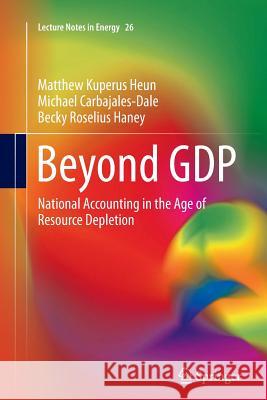
Matthew Kuperus Heun; Michael Carbajales-Dale; Becky Roselius Haney
Beyond Gdp: National Accounting in the Age of Resource Depletion Heun, Matthew Kuperus 9783319355436 Springer - książkaWidoczna okładka, to zdjęcie poglądowe, a rzeczywista szata graficzna może różnić się od prezentowanej.

Beyond Gdp: National Accounting in the Age of Resource Depletion

ISBN-13: 9783319355436 / Angielski / Miękka / 2016 / 201 str.

Matthew Kuperus Heun; Michael Carbajales-Dale; Becky Roselius Haney
cena 255,17 zł
(netto: 243,02 VAT:  5%)

Najniższa cena z 30 dni: 253,00 zł
Termin realizacji zamówienia:
ok. 10-14 dni roboczych
Bez gwarancji dostawy przed świętami

Darmowa dostawa!

This book uses the metaphor "The economy is society's metabolism" as a springboard to develop a rigorous theoretical framework for a better system of national accounts which goes "Beyond GDP" and is relevant to the age of resource depletion. Society is entering a new era in which biophysical limits related to natural resource extraction rates and the biosphere's waste assimilation capacity are becoming binding constraints on mature economies. Unfortunately, the data needed for policy-makers to understand and manage economic growth in this new era are not universally available. All stakeholders need a new way to understand our economy in the context of the biosphere's ability to provide essential natural capital, and we suggest that detailed information about materials, energy, embodied energy, and energy intensity should be routinely gathered, analyzed, and disseminated from a centralized location to provide markets and policymakers with a more comprehensive understanding of the biophysical economy. However, a firm theoretical foundation is needed before proceeding along this new path, which this book is intended to provide. After arguing that the stock of manufactured capital is an important driver of material and energy demands imposed upon the biosphere, a new accounting framework is derived from the laws of thermodynamics to reflect the fact that material and embodied energy accumulate within the capital stock of economic sectors. This framework extends the Energy Input-Output (EI-O) techniques first developed by Bullard, Herendeen, and others to estimate energy intensity of economic products. Implications from the new framework are discussed, including the value of economic metrics for policy-making, the need for physically-based rather than product-based EI-O formulations, a re-assessment of the concept of economic "growth," and an evaluation of recycling, reuse, and dematerialization. The framework also provides an opportunity to assess an array of definitions for Daly's "steady-state economy" in relation to the ideal of a sustainable economy. The book ends with a list of steps to be taken in creating a more comprehensive system of national accounts:

  • National accounting agencies worldwide should develop and maintain balance sheets of both natural and manufactured capital in addition to national income statements
  • All stocks and inter-sector flows should be provided in physical as well as financial units
  • In the US, the Bureau for Economic Analysis (BEA) should restart detailed Capital, Labor, Energy, Material, and Services (KLEMS) reporting
  • National accounting agencies should routinely estimate the energy intensity of economic products, and all of the above should be estimated and disseminated on an annual basis.


Kategorie:
Technologie
Kategorie BISAC:
Business & Economics > Industries - Energy
Business & Economics > Economics - General
Science > Environmental Science (see also Chemistry - Environmental)
Wydawca:
Springer
Seria wydawnicza:
Lecture Notes in Energy
Język:
Angielski
ISBN-13:
9783319355436
Rok wydania:
2016
Wydanie:
Softcover Repri
Numer serii:
000444183
Ilość stron:
201
Waga:
3.58 kg
Wymiary:
23.5 x 15.5
Oprawa:
Miękka
Wolumenów:
01
Dodatkowe informacje:
Wydanie ilustrowane

"The authors make a fundamental advance in economic thought, one that also provides a policy tool. They sharpen the concept of economic metabolism with a detailed analytical accounting of the metabolic flow from nature through the economy and back to nature, with attention to the different roles of stocks and flows, matter, energy, and value. They carefully distinguish value added from that to which value is added. The book is scholarly, well referenced, and full of insights. Highly recommended!"
-Herman Daly, Emeritus Professor, School of Public Policy, University of Maryland

"Heun, Dale, and Haney present a powerful and insightful overview of our economic system and how GDP is connected to biological and physical systems at the extractive interface (agriculture and mining sectors). It begins with a rigorous analytical framework that tracks the flows of materials, energy, and embodied energy to characterize the "footprints" we leave on the planet as our lifestyles "consume" the various components of GDP. The book's major contribution is to show how the incomplete national accounting data systematically underestimates the impact of these footprints, especially during rapid energy infrastructure transitions like the one currently underway. With incomplete data we do the wrong things! For academics, policymakers, and students alike, the book provides a fresh perspective and constructive proposals based on a solid analytical foundation.
-Clark W. Bullard, Professor Emeritus, Mechanical Sciences and Engineering, University of Illinois at Urbana-Champaign

Introduction.- Traditional view of economy.- Brief history of input-output (I-O) modeling.- Basic I-O method.- An I-O method for dynamic (transient) economic analysis.- References.- Material Flows.- Methodology.- Example A: one sector economy.- Example B: two sector economy.- Example C: three sector economy.- References.- Direct Energy Flows.- Methodology.- Example A: one sector economy.- Example B: two sector economy.- Example C: three sector economy.- References.- Embodied Energy Flows.- Methodology.- Example A: one sector economy.- Example B: two sector economy.- Example C: three sector economy.- References.- Value Flows.- Methodology.- Example A: one sector economy.- Example B: two sector economy.- Example C: three sector economy.- References.- Energy Intensity.- References.- Implications.- Implications for economic “development”.- Implications for the I-O method.- Implications for recycling, reuse, and dematerialization.- Comparison to a Steady-state Economy.- References.

This book uses the metaphor “The economy is society's metabolism” as a springboard to develop a rigorous theoretical framework for a better system of national accounts which goes “Beyond GDP” and is relevant to the age of resource depletion. All stakeholders need a new way to understand our economy in the context of the biosphere’s ability to provide essential natural capital, and the authors suggest that detailed information about materials, energy, embodied energy, and energy intensity should be routinely gathered, analyzed, and disseminated from a centralized location to provide markets and policymakers with a more comprehensive understanding of the biophysical economy.

After arguing that the stock of manufactured capital is an important driver of material and energy demands imposed upon the biosphere, a new accounting framework is derived from the laws of thermodynamics to reflect the fact that material and embodied energy accumulate within the capital stock of economic sectors. This framework extends the Energy Input-Output (EI-O) techniques first developed by Bullard, Herendeen, and others to estimate energy intensity of economic products. Implications from the new framework are discussed, including the value of economic metrics for policy-making, the need for physically-based rather than product-based EI-O formulations, a re-assessment of the concept of economic “growth,” and an evaluation of recycling, reuse, and dematerialization. The framework also provides an opportunity to assess an array of definitions for Daly's “steady-state economy” in relation to the ideal of a sustainable economy.


The book ends with a list of steps to be taken toward creating a more comprehensive system of national accounts:

·         National accounting agencies worldwide should develop and maintain balance sheets of both natural and manufactured capital in addition to national income statements,

·         All stocks and inter-sector flows should be provided in physical as well as financial units,

·         In the US, the Bureau for Economic Analysis (BEA) should restart detailed Capital, Labor, Energy, Material, and Services (KLEMS) reporting,

·         National accounting agencies should routinely estimate the energy intensity of economic products,

and all of the above should be estimated and disseminated on an annual basis.



Udostępnij

Facebook - konto krainaksiazek.pl


Opinie o Krainaksiazek.pl na Opineo.pl

Partner Mybenefit

Krainaksiazek.pl w programie rzetelna firma Krainaksiaze.pl - płatności przez paypal

Czytaj nas na:

Facebook - krainaksiazek.pl
  • książki na zamówienie
  • granty
  • książka na prezent
  • kontakt
  • pomoc
  • opinie
  • regulamin
  • polityka prywatności

Zobacz:

  • Księgarnia czeska

  • Wydawnictwo Książkowe Klimaty

1997-2025 DolnySlask.com Agencja Internetowa

© 1997-2022 krainaksiazek.pl
     
KONTAKT | REGULAMIN | POLITYKA PRYWATNOŚCI | USTAWIENIA PRYWATNOŚCI
Zobacz: Księgarnia Czeska | Wydawnictwo Książkowe Klimaty | Mapa strony | Lista autorów
KrainaKsiazek.PL - Księgarnia Internetowa

Polityka prywatnosci - link
Krainaksiazek.pl - płatnośc Przelewy24
Przechowalnia Przechowalnia





