• Wyszukiwanie zaawansowane
  • Kategorie
  • Kategorie BISAC
  • Książki na zamówienie
  • Promocje
  • Granty
  • Książka na prezent
  • Opinie
  • Pomoc
  • Załóż konto
  • Zaloguj się

Beta maritima: The Origin of Beets » książka


zaloguj się | załóż konto
Logo Krainaksiazek.pl

koszyk

konto

szukaj
topmenu
Księgarnia internetowa
Szukaj
Książki na zamówienie
Promocje
Granty
Książka na prezent
Moje konto
Pomoc
 
 
Wyszukiwanie zaawansowane
Pusty koszyk
Bezpłatna dostawa dla zamówień powyżej 20 złBezpłatna dostawa dla zamówień powyżej 20 zł

Kategorie główne

• Nauka
 [2946912]
• Literatura piękna
 [1852311]

  więcej...
• Turystyka
 [71421]
• Informatyka
 [150889]
• Komiksy
 [35717]
• Encyklopedie
 [23177]
• Dziecięca
 [617324]
• Hobby
 [138808]
• AudioBooki
 [1671]
• Literatura faktu
 [228371]
• Muzyka CD
 [400]
• Słowniki
 [2841]
• Inne
 [445428]
• Kalendarze
 [1545]
• Podręczniki
 [166819]
• Poradniki
 [480180]
• Religia
 [510412]
• Czasopisma
 [525]
• Sport
 [61271]
• Sztuka
 [242929]
• CD, DVD, Video
 [3371]
• Technologie
 [219258]
• Zdrowie
 [100961]
• Książkowe Klimaty
 [124]
• Zabawki
 [2341]
• Puzzle, gry
 [3766]
• Literatura w języku ukraińskim
 [255]
• Art. papiernicze i szkolne
 [7810]
Kategorie szczegółowe BISAC

Beta maritima: The Origin of Beets

ISBN-13: 9781489999610 / Angielski / Miękka / 2014 / 294 str.
Enrico Biancardi;Leonard W. Panella;Robert T. Lewellen
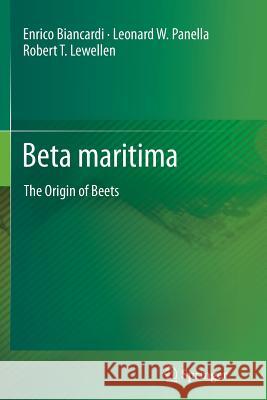
Beta maritima: The Origin of Beets Enrico Biancardi, Leonard W. Panella, Robert T. Lewellen 9781489999610 Springer-Verlag New York Inc. - książkaWidoczna okładka, to zdjęcie poglądowe, a rzeczywista szata graficzna może różnić się od prezentowanej.

Beta maritima: The Origin of Beets

ISBN-13: 9781489999610 / Angielski / Miękka / 2014 / 294 str.

Enrico Biancardi;Leonard W. Panella;Robert T. Lewellen
cena 754,17
(netto: 718,26 VAT:  5%)

Najniższa cena z 30 dni: 720,62
Termin realizacji zamówienia:
ok. 22 dni roboczych
Bez gwarancji dostawy przed świętami

Darmowa dostawa!

Along the undisturbed shores, especially of the Mediterranean Sea and the European North Atlantic Ocean, is a quite widespread plant called Beta maritima by botanists, or more commonly sea beet. Nothing, for the inexperienced observer's eye, distinguishes it from surrounding wild vegetation. Despite its inconspicuous and nearly invisible flowers, the plant has had and will have invaluable economic and scientific importance. Indeed, according to Linne, it is considered "the progenitor of the beet crops possibly born from Beta maritima in some foreign country." Recent molecular research confirmed this lineage. Selection applied after domestication has created many cultivated types with different destinations. The wild plant always has been harvested and used both for food and as a medicinal herb. Sea beet crosses easily with the cultivated types. This facilitates the transmission of genetic traits lost during domestication, which selection processes aimed only at features immediately useful to farmers and consumers may have depleted. Indeed, as with several crop wild relatives, Beta maritima has been successfully used to improve cultivated beet's genetic resistances against many diseases and pests. In fact, sugar beet cultivation currently would be impossible in many countries without the recovery of traits preserved in the wild germplasm. Dr. Enrico Biancardi graduated from Bologna University. From 1977 until 2009, he was involved in sugar beet breeding activity by the Istituto Sperimentale per le Colture Industriali (ISCI)formerly Stazione Sperimentale di Bieticoltura (Rovigo, Italy), where he released rhizomania and cercospora resistant germplasm and collected seeds of Mediterranean sea beet populations as a genetic resource for breeding and ex situ conservation. Retired since 2009, he still collaborates with several working breeders, in particular, at the USDA Agricultural Research Stations, at the Chinese Academy of Agricultural Science (CAAS), and at the Athens University (AUA). He has edited books, books chapters and authored more than 150 papers.Dr. Lee Panella is a plant breeder and geneticist with the USDA-ARS at Fort Collins, Colorado. He earned his B.S. in Crop and Soil Science from Michigan State University, an M.S. in Plant Breeding from Texas A&M University, and a Ph.D. in genetics from the University of California at Davis. His research focus is developing disease resistant germplasm using sugar beet wild relatives. He is chairman of the USDA-ARS Sugar Beet Crop Germplasm Committee and has collected and worked extensively with sea beet. Dr. Robert T. Lewellen was raised on a ranch in Eastern Oregon and obtained a B.S. in Crop Science from Oregon State University followed by a Ph.D. from Montana State University in Genetics. From 1966 to 2008 he was a research geneticist for the USDA-ARS at Salinas, California, where he studied the genetics of sugar beet and as a plant breeder, often used sea beet as a genetic source to produce many pest and disease resistant sugar beet germplasm and parental lines, while authoring more than 100 publications.


Kategorie:
Nauka, Biologia i przyroda
Kategorie BISAC:
Science > Biotechnology
Science > Botanika
Nature > Plants - General
Wydawca:
Springer-Verlag New York Inc.
Język:
Angielski
ISBN-13:
9781489999610
Rok wydania:
2014
Dostępne języki:
Angielski
Wydanie:
2012
Ilość stron:
294
Waga:
0.48 kg
Wymiary:
23.523.5 x 15.5
Oprawa:
Miękka
Wolumenów:
01
Dodatkowe informacje:
Wydanie ilustrowane

From the reviews:

"The book is divided into eight chapters with multiple subheadings, each highlighting different aspects of B. maritima. In general, the book is well illustrated with many figures printed in colour. ... it is a valuable resource for scientists involved in Beta germplasm conservation and taxonomy, as well as breeders interested in sea beet and beet history in general." (Thomas Schmidt, Annals of Botany, Vol. 113 (7), May, 2014)

"To the best of my knowledge, this book is the first devoted entirely to sea beet (Beta maritima L.), the wild ancestor of all cultivated beets. ... The book is recommended because currently there is much interest in wild beets as a source of new genetic variability for pests and diseases resistance. ... the book will serve as a valued reference for students, researchers, scientists, molecular biologists, and breeders." (Piergiorgio Stevanato, Sugar Tech, Vol. 15 (3), July-September, 2013)

Foreword
Preface
Acknowledgments

1) History and current importance
1.1) Origin
1.2) Domestication
1.3) Athens and Rome
1.4) Middle age
1.5) Renaissance
1.6) Age of science
1.7) Researchers more involved in Beta maritima
1.7.1) Wilhelm Rimpau and Hermann Briem
1.7.2) Franz Schindler
1.7.3) Emanuel von Proskowetz
1.7.4) Ottavio Munerati
1.7.5) Jacques de Vilmorin
1.7.6) Dudok van Heel
1.7.7) Forrest V. Owen
1.7.8) George H. Coons
1.7.9) John S. McFarlane
1.7.10) Viacheslav F.  and Helen Savitsky
1.7.11) Devon L. Doney and Larry G. Campbell,
1.7.12) Marco De Biaggi
1.7.13) Robert T. Lewellen
1.7.14) Brian V. Ford-Lloyd
1.7.15) Lothar Frese
1.7.16) Leonard W. Panella
1.7.17) Detlef Bartsch
1.7.18) Henry Darmency
1.7.19) Piergiorgio Stevanato
1.7.20) Henk van Dijk and Nina Hautekèete
2) Range of distribution
3) Morphology, physiology, and ecology
3.1) Seed and germy
3.2) Germination
3.3) Leaves
3.4) Roots
3.5) Color
3.6) Chemical composition
3.7) Seed stalk
3.8) Flowers and flowering
3.9) Pollen
3.10) Gene flow
3.11) Male sterility
3.12) Chromosome number
3.13) Self-incompatibility
3.14) Self-fertility
3.15) Cross fertilization
3.16) Growth habit
3.17) Life span
3.18) Age at maturity
3.19) Reproduction systems
3.19.1) Gynodioecy
3.19.2) Sex ratio
3.20) Interspecific hybrids
3.21) Survival strategies
3.22) Dispersal of the species
4) Taxonomy
5) Uses
5.1) Medical uses
5.2) Food uses
5.3) Other uses
6) Source of useful traits
6.1) Resistance to biotic stresses 
6.1.1) Virus yellows
6.1.2) Beet mosaic virus
6.1.3) Rhizomania
6.1.4) Beet curly top virus
6.1.5) Powdery mildew
6.1.6) Root rot 6.1.7) Cercospora leaf spot 
6.1.8) Polymyxa betae
6.1.9) Black root
6.1.10) Minor fungal diseases
6.1.11) Nematodes
6.1.11.1) Cyst nematodes
6.1.11.2) Root knot nematodes
6.1.12) Insects
6.1.13) Multiple resistances
6.2) Resistances to abiotic stresses
6.2.1) Drought and heat tolerance
6.2.2) Salinity tolerance
6.3) Other traits 
7) Cultivated offspring
7.1) Leaf beet
7.2) Garden beet 
7.3) Fodder beet
7.4) Sugar beet
7.5) Energy beet
7.6) Ornamental beet
8) The Future
8.1) Germplasm conservation
8.2) Transgenes diffusion
8.3) Source of new traits

Appendix
A) Beta chronology
B) Authors chronology
C) Names and synonyms of Beta maritima
D) English translation of Latin names given to Beta maritima
E) Essential references

Along the undisturbed shores, especially of the Mediterranean Sea and the European North Atlantic Ocean, is a quite widespread plant called Beta maritima by botanists, or more commonly sea beet. Nothing, for the inexperienced observer's eye, distinguishes it from surrounding wild vegetation. Despite its inconspicuous and nearly invisible flowers, the plant has had and will have invaluable economic and scientific importance. Indeed, according to Linnè, it is considered "the progenitor of the beet crops possibly born from Beta maritima in some foreign country".  Recent molecular research confirmed this lineage. Selection applied after domestication has created many cultivated types with different destinations. The wild plant always has been harvested and used both for food and as a medicinal herb. Sea beet crosses easily with the cultivated types. This facilitates the transmission of genetic traits lost during domestication, which selection processes aimed only at features immediately useful to farmers and consumers may have depleted. Indeed, as with several crop wild relatives, Beta maritima has been successfully used to improve cultivated beet’s genetic resistances against many diseases and pests. In fact, sugar beet cultivation currently would be impossible in many countries without the recovery of traits preserved in the wild germplasm. 

Dr. Enrico Biancardi graduated from Bologna University. From 1977 until 2009, he was involved in sugar beet breeding activity by the Istituto Sperimentale per le Colture Industriali (ISCI) formerly Stazione Sperimentale di Bieticoltura (Rovigo, Italy), where he released rhizomania and cercospora resistant germplasm and collected seeds of Mediterranean sea beet populations as a genetic resource for breeding and ex situ conservation.  Retired since 2009, he still collaborates with several working breeders, in particular, at the USDA Agricultural Research Stations, at the Chinese Academy of Agricultural Science (CAAS), and at the Athens University (AUA). He has edited books, books chapters and authored more than 150 papers.

Dr. Lee Panella is a plant breeder and geneticist with the USDA-ARS at Fort Collins, Colorado.  He earned his B.S. in Crop and Soil Science from Michigan State University, an M.S. in Plant Breeding from Texas A&M University, and a Ph.D. in genetics from the University of California at Davis.  His research focus is developing disease resistant germplasm using sugar beet wild relatives.  He is chairman of the USDA-ARS Sugar Beet Crop Germplasm Committee and has collected and worked extensively with sea beet. 

Dr. Robert T. Lewellen was raised on a ranch in Eastern Oregon and obtained a B.S. in Crop Science from Oregon State University followed by a Ph.D. from Montana State University in Genetics. From 1966 to 2008 he was a research geneticist for the USDA-ARS at Salinas, California, where he studied the genetics of sugar beet and as a plant breeder, often used sea beet as a genetic source to produce many pest and disease resistant sugar beet germplasm and parental lines, while authoring more than 100 publications.




Udostępnij

Facebook - konto krainaksiazek.pl


Opinie o Krainaksiazek.pl na Opineo.pl

Partner Mybenefit

Krainaksiazek.pl w programie rzetelna firma Krainaksiaze.pl - płatności przez paypal

Czytaj nas na:

Facebook - krainaksiazek.pl
  • książki na zamówienie
  • granty
  • książka na prezent
  • kontakt
  • pomoc
  • opinie
  • regulamin
  • polityka prywatności

Zobacz:

  • Księgarnia czeska

  • Wydawnictwo Książkowe Klimaty

1997-2025 DolnySlask.com Agencja Internetowa

© 1997-2022 krainaksiazek.pl
     
KONTAKT | REGULAMIN | POLITYKA PRYWATNOŚCI | USTAWIENIA PRYWATNOŚCI
Zobacz: Księgarnia Czeska | Wydawnictwo Książkowe Klimaty | Mapa strony | Lista autorów
KrainaKsiazek.PL - Księgarnia Internetowa

Polityka prywatnosci - link
Krainaksiazek.pl - płatnośc Przelewy24
Przechowalnia Przechowalnia




