• Wyszukiwanie zaawansowane
  • Kategorie
  • Kategorie BISAC
  • Książki na zamówienie
  • Promocje
  • Granty
  • Książka na prezent
  • Opinie
  • Pomoc
  • Załóż konto
  • Zaloguj się

Behavioral Public Policy in a Global Context: Practical Lessons from Outside the Nudge Unit » książka


zaloguj się | załóż konto
Logo Krainaksiazek.pl

koszyk

konto

szukaj
topmenu
Księgarnia internetowa
Szukaj
Książki na zamówienie
Promocje
Granty
Książka na prezent
Moje konto
Pomoc
 
 
Wyszukiwanie zaawansowane
Pusty koszyk
Bezpłatna dostawa dla zamówień powyżej 20 złBezpłatna dostawa dla zamówień powyżej 20 zł

Kategorie główne

• Nauka
 [2949965]
• Literatura piękna
 [1857847]

  więcej...
• Turystyka
 [70818]
• Informatyka
 [151303]
• Komiksy
 [35733]
• Encyklopedie
 [23180]
• Dziecięca
 [617748]
• Hobby
 [139972]
• AudioBooki
 [1650]
• Literatura faktu
 [228361]
• Muzyka CD
 [398]
• Słowniki
 [2862]
• Inne
 [444732]
• Kalendarze
 [1620]
• Podręczniki
 [167233]
• Poradniki
 [482388]
• Religia
 [509867]
• Czasopisma
 [533]
• Sport
 [61361]
• Sztuka
 [243125]
• CD, DVD, Video
 [3451]
• Technologie
 [219309]
• Zdrowie
 [101347]
• Książkowe Klimaty
 [123]
• Zabawki
 [2362]
• Puzzle, gry
 [3791]
• Literatura w języku ukraińskim
 [253]
• Art. papiernicze i szkolne
 [7933]
Kategorie szczegółowe BISAC

Behavioral Public Policy in a Global Context: Practical Lessons from Outside the Nudge Unit

ISBN-13: 9783031315084 / Angielski
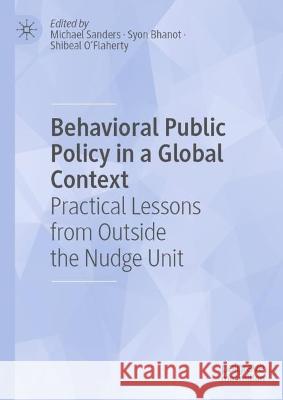
Michael Sanders; Syon Bhanot; Shibeal O'Flaherty
Behavioral Public Policy in a Global Context: Practical Lessons from Outside the Nudge Unit Michael Sanders Syon Bhanot Shibeal O'Flaherty 9783031315084 Palgrave MacMillan - książkaWidoczna okładka, to zdjęcie poglądowe, a rzeczywista szata graficzna może różnić się od prezentowanej.

Behavioral Public Policy in a Global Context: Practical Lessons from Outside the Nudge Unit

ISBN-13: 9783031315084 / Angielski

Michael Sanders; Syon Bhanot; Shibeal O'Flaherty
cena 806,99 zł
(netto: 768,56 VAT:  5%)

Najniższa cena z 30 dni: 693,97 zł
Termin realizacji zamówienia:
ok. 22 dni roboczych
Bez gwarancji dostawy przed świętami

Darmowa dostawa!

The last ten years have seen an explosion in the use of behavioral science in fields like economics and public policy—often referred to as “Behavioral Insights.” Public servants, researchers, and others that make use of these approaches have embraced the idea that human beings are not completely “rational,” and that this lack of rationality leads them to make systematic errors in their everyday decision-making, and consequently leaves huge potential for government policy to be more effective if it incorporates a more realistic model of human behavior.It’s a small idea, but one which has had an outsized impact. A behavioral approach has been credited with issues related to the economy, education, medicine, among other fields: raising tax revenues, helping people get back into work, supporting them to do better in school, making them more likely to vote, and reducing unnecessary prescriptions of antibiotics. “Nudge” type interventions are also found to be highly cost-effective, increasing their appeal to governments.After ten years of the movement’s spread, there are now more than 200 institutions and “nudge units” around the world. However, the question of how one builds a successful behavioral science team is one that remains to the most part unanswered.This book includes chapters written by some of the world’s leading behavioral scientists and academics on their tips for success, and more importantly, the lessons learned on incorporating behavioral science across far-ranging economic and policy issues.


The last ten years have seen an explosion in the use of behavioral science in fields like economics and public policy—often referred to as “Behavioral Insights.” Public servants, researchers, and others that make use of these approaches have embraced the idea that human beings are not completely “rational,” and that this lack of rationality leads them to make systematic errors in their everyday decision-making, and consequently leaves huge potential for government policy to be more effective if it incorporates a more realistic model of human behavior. It’s a small idea, but one which has had an outsized impact. A behavioral approach has been credited with issues related to the economy, education, medicine, among other fields: raising tax revenues, helping people get back into work, supporting them to do better in school, making them more likely to vote, and reducing unnecessary prescriptions of antibiotics. “Nudge” type interventions are also found to be highly cost-effective, increasing their appeal to governments. After ten years of the movement’s spread, there are now more than 200 institutions and “nudge units” around the world. However, the question of how one builds a successful behavioral science team is one that remains to the most part unanswered. This book includes chapters written by some of the world’s leading behavioral scientists and academics on their tips for success, and more importantly, the lessons learned on incorporating behavioral science across far-ranging economic and policy issues.

Kategorie:
Nauka, Ekonomia i biznes
Kategorie BISAC:
Business & Economics > Organizational Behavior
Political Science > Public Policy - General
Psychology > Applied Psychology
Wydawca:
Palgrave MacMillan
Język:
Angielski
ISBN-13:
9783031315084

Foreword by David Halpern.- Chapter 1: Introduction.- Section 1: Central Teams.- Chapter 2: From innovative to imperative: Evolving the application of behavioral science in the Government of Canada.- Chapter 3: Ten Years of Ireland’s Behavioural Research Unit.- Section 2: Line departments.- Chapter 4: Learning by Doing: Designing and Testing Behavioral Interventions to Improve Labor Programs.- Chapter 5: Launching the first federal effort to apply behavioral science to U.S. human services programs.- Chapter 6: Designing for social impact: Behavioral science field studies to improve economic mobility.- Chapter 7: The World's first Government Behavioural Insights Team dedicated to Public Health: Ten Lessons Learned over a Decade of Experience.- Chapter 8: Blending Backgrounds: Building Behavioral Insights at the U.S. IRS.- Section 3: The Global South.- Chapter 9: Reflections from Ideas 42’s economic justice team.- Chapter 10: MineduLab, the innovation laboratory for a cost-effective educational policy in Peru.- Chapter 11: Lessons Learned from Applying Behavioral Science in the Middle East.- Chapter 12: Improving Lives in Latin America and the Caribbean.- Chapter 13: Behavioural Insights in South Africa – a view from the Global South, learning, growing, and evolving.- Chapter 14: Expanding beyond nudge: Experiences applying behavioral science for comprehensive social change.- Section 4: Going Local.- Chapter 15: Doing Behavioural Science in the Eternal City: The Case of R².- Chapter 16: Nudging United States Local Government to What Works.- Chapter 17: Putting Behavioral Science to Work in The City of Brotherly Love and Sisterly Affection: The Philadelphia Behavioral Science Initiative.- Section 5: Going Meta.- Chapter 18: The evolution of a rigorous multi-disciplinary behavioural team: lessons from financial regulation in the UK.- Chapter 19: eMBeDding Behavioral Sciences in International Development.- Chapter 20: Behavioural and Cultural Insights for better health: the BCI Unit at WHO Regional Office for Europe.- Chapter 21: Embedding Behavioural Science into the work of the United Nations.- Section 6: Outside Government.- Chapter 22: The Megastudy Approach for Changing Behavior at Scale.- Chapter 23: The Busara Center: Letters To Our Past.- Chapter 24: Inside Out: BCG’s Path to Applying and Embedding Behavioral Science


Michael Sanders is Professor of Public Policy and Director of the Experimental Government Team in the Policy Institute at King’s College London. He was Chief Executive of What Works for Children’s Social Care, and was Chief Scientist of the Behavioral Insights Team, the world's first "nudge unit." He is coauthor of Social Butterflies: Reclaiming the Positive Power of Our Social Networks.

Syon Bhanot is Associate Professor of Economics at Swarthmore College. His research focuses on using experimental methods to test behavioral science insights in public policy contexts. He regularly publishes his work in peer-reviewed journals across the social sciences and is a frequent commentator for major media outlets.

Shibeal O’Flaherty is a Ph.D. Candidate in Public Policy at King’s College London. Her research focuses on applying behavioral science to improve welfare across a range of policy areas, including workplace wellbeing, access to benefits and programs, and sustainability.

“This book is essential reading for anyone interested in understanding, joining, or building an institution that applies lessons from behavioral science to public policy.”

—Katherine L. Milkman, James G. Dinan Professor, Wharton School, The University of Pennsylvania and Co-Director, The Behavior Change for Good Initiative

Behavioral science draws on research from across the social and natural sciences, and it has consistently shown that humans are not always rational. This insight has reshaped multiple fields, including economics, political science, and law. Since the early 2000s, the application of behavioral science to public policy has also grown exponentially. Policymakers and practitioners now regularly use behavioral science to rethink how they develop programs and solve social problems. The impact has been far-reaching; behavioral science has transformed how we think about the economy, public health, education, and beyond. In practice, behavioral insights have been used to raise tax revenues, help people access social welfare program benefits and employment opportunities, increase voter turnout, boost medication adherence, and more.

There are now hundreds of entities – international organizations, governments, business, and nonprofits – building and investing in internal behavioral science teams. Unfortunately, most of the hard work of putting these teams together and applying behavioral science insights happens “behind the scenes.” This book unearths key stories and insights from pioneers in applied behavioral science.

Michael Sanders is Professor of Public Policy and Director of the Experimental Government Team in the Policy Institute at King’s College London. He was founding Chief Executive of What Works for Children’s Social Care and the first Chief Scientist of the Behavioral Insights Team, the world's first "nudge unit."

Syon Bhanot is Associate Professor of Economics at Swarthmore College. His research focuses on using experimental methods to test behavioral science ideas in public policy contexts, with a focus on public health, prosocial behavior, and public administration.

Shibeal O’Flaherty is a Ph.D. Candidate in Public Policy at King’s College London. Her research focuses on applying behavioral science to improve welfare across a range of policy areas, including workplace wellbeing, access to benefits and programs, and sustainability.


Udostępnij

Facebook - konto krainaksiazek.pl


Opinie o Krainaksiazek.pl na Opineo.pl

Partner Mybenefit

Krainaksiazek.pl w programie rzetelna firma Krainaksiaze.pl - płatności przez paypal

Czytaj nas na:

Facebook - krainaksiazek.pl
  • książki na zamówienie
  • granty
  • książka na prezent
  • kontakt
  • pomoc
  • opinie
  • regulamin
  • polityka prywatności

Zobacz:

  • Księgarnia czeska

  • Wydawnictwo Książkowe Klimaty

1997-2025 DolnySlask.com Agencja Internetowa

© 1997-2022 krainaksiazek.pl
     
KONTAKT | REGULAMIN | POLITYKA PRYWATNOŚCI | USTAWIENIA PRYWATNOŚCI
Zobacz: Księgarnia Czeska | Wydawnictwo Książkowe Klimaty | Mapa strony | Lista autorów
KrainaKsiazek.PL - Księgarnia Internetowa

Polityka prywatnosci - link
Krainaksiazek.pl - płatnośc Przelewy24
Przechowalnia Przechowalnia




