• Wyszukiwanie zaawansowane
  • Kategorie
  • Kategorie BISAC
  • Książki na zamówienie
  • Promocje
  • Granty
  • Książka na prezent
  • Opinie
  • Pomoc
  • Załóż konto
  • Zaloguj się

Bayesian Models for Categorical Data » książka


zaloguj się | załóż konto
Logo Krainaksiazek.pl

koszyk

konto

szukaj
topmenu
Księgarnia internetowa
Szukaj
Książki na zamówienie
Promocje
Granty
Książka na prezent
Moje konto
Pomoc
 
 
Wyszukiwanie zaawansowane
Pusty koszyk
Bezpłatna dostawa dla zamówień powyżej 20 złBezpłatna dostawa dla zamówień powyżej 20 zł

Kategorie główne

• Nauka
 [2946600]
• Literatura piękna
 [1856966]

  więcej...
• Turystyka
 [72221]
• Informatyka
 [151456]
• Komiksy
 [35826]
• Encyklopedie
 [23190]
• Dziecięca
 [619653]
• Hobby
 [140543]
• AudioBooki
 [1577]
• Literatura faktu
 [228355]
• Muzyka CD
 [410]
• Słowniki
 [2874]
• Inne
 [445822]
• Kalendarze
 [1744]
• Podręczniki
 [167141]
• Poradniki
 [482898]
• Religia
 [510455]
• Czasopisma
 [526]
• Sport
 [61590]
• Sztuka
 [243598]
• CD, DVD, Video
 [3423]
• Technologie
 [219201]
• Zdrowie
 [101638]
• Książkowe Klimaty
 [124]
• Zabawki
 [2473]
• Puzzle, gry
 [3898]
• Literatura w języku ukraińskim
 [254]
• Art. papiernicze i szkolne
 [8170]
Kategorie szczegółowe BISAC

Bayesian Models for Categorical Data

ISBN-13: 9780470092378 / Angielski / Twarda / 2005 / 448 str.
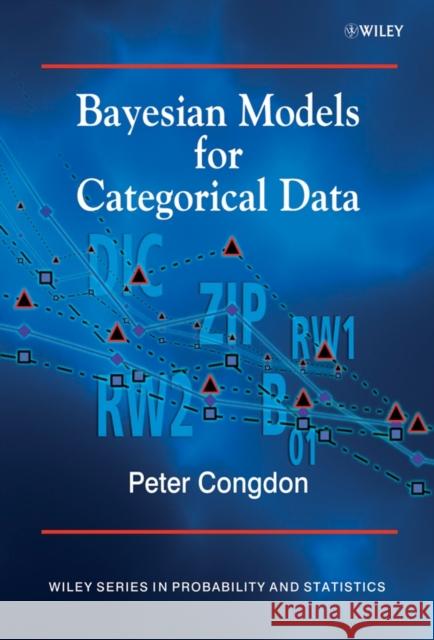
Peter Congdon
Bayesian Models for Categorical Data Peter Congdon 9780470092378 John Wiley & Sons - książkaWidoczna okładka, to zdjęcie poglądowe, a rzeczywista szata graficzna może różnić się od prezentowanej.

Bayesian Models for Categorical Data

ISBN-13: 9780470092378 / Angielski / Twarda / 2005 / 448 str.

Peter Congdon
cena 501,90 zł
(netto: 478,00 VAT:  5%)

Najniższa cena z 30 dni: 497,78 zł
Termin realizacji zamówienia:
ok. 30 dni roboczych
Bez gwarancji dostawy przed świętami

Darmowa dostawa!

The use of Bayesian methods for the analysis of data has grown substantially in areas as diverse as applied statistics, psychology, economics and medical science. Bayesian Methods for Categorical Data sets out to demystify modern Bayesian methods, making them accessible to students and researchers alike. Emphasizing the use of statistical computing and applied data analysis, this book provides a comprehensive introduction to Bayesian methods of categorical outcomes.
* Reviews recent Bayesian methodology for categorical outcomes (binary, count and multinomial data).
* Considers missing data models techniques and non-standard models (ZIP and negative binomial).
* Evaluates time series and spatio-temporal models for discrete data.
* Features discussion of univariate and multivariate techniques.
* Provides a set of downloadable worked examples with documented WinBUGS code, available from an ftp site.
The author's previous 2 bestselling titles provided a comprehensive introduction to the theory and application of Bayesian models. Bayesian Models for Categorical Data continues to build upon this foundation by developing their application to categorical, or discrete data - one of the most common types of data available. The author's clear and logical approach makes the book accessible to a wide range of students and practitioners, including those dealing with categorical data in medicine, sociology, psychology and epidemiology.


Kategorie:
Nauka, Matematyka
Kategorie BISAC:
Mathematics > Twierdzenie Bayesa
Wydawca:
John Wiley & Sons
Seria wydawnicza:
Wiley Series in Probability and Statistics
Język:
Angielski
ISBN-13:
9780470092378
Rok wydania:
2005
Numer serii:
000033279
Ilość stron:
448
Waga:
0.97 kg
Wymiary:
25.35 x 17.32 x 3.12
Oprawa:
Twarda
Wolumenów:
01
Dodatkowe informacje:
Bibliografia
Wydanie ilustrowane

"…a good book on the shelves of researchers in categorical data analysis." ( Technometrics, May 2007)

"…valuable for anyone interested in how Bayesian ideas apply in practice an should prove useful for anyone using the WINBUGS package for categorical data analysis." (Biometrics, March 2007)

"…an excellent resource for biostatisticians and medical researchers." (Doody′s Health Services)

"…perfectly suited as a reference for any practitioner….Congdon has done a laudable job of introducing jointly the concepts of categorical data and Bayesian analysis." (Journal of the American Statistical Association, June 2006)

"The author’s clear and logical approach makes the book accessible" (Zentralblatt MATH Volume 1079)

Preface.

Chapter 1 Principles of Bayesian Inference.

1.1 Bayesian updating.

1.2 MCMC techniques.

1.3 The basis for MCMC.

1.4 MCMC sampling algorithms.

1.5 MCMC convergence.

1.6 Competing models.

1.7 Setting priors.

1.8 The normal linear model and generalized linear models.

1.9 Data augmentation.

1.10 Identifiability.

1.11 Robustness and sensitivity.

1.12 Chapter themes.

References.

Chapter 2 Model Comparison and Choice.

2.1 Introduction: formal methods, predictive methods and penalized deviance criteria.

2.2 Formal Bayes model choice.

2.3 Marginal likelihood and Bayes factor approximations.

2.4 Predictive model choice and checking.

2.5 Posterior predictive checks.

2.6 Out–of–sample cross–validation.

2.7 Penalized deviances from a Bayes perspective.

2.8 Multimodel perspectives via parallel sampling.

2.9 Model probability estimates from parallel sampling.

2.10 Worked example.

References.

Chapter 3 Regression for Metric Outcomes.

3.1 Introduction: priors for the linear regression model.

3.2 Regression model choice and averaging based on predictor selection.

3.3 Robust regression methods: models for outliers.

3.4 Robust regression methods: models for skewness and heteroscedasticity.

3.5 Robustness via discrete mixture models.

3.6 Non–linear regression effects via splines and other basis functions.

3.7 Dynamic linear models and their application in non–parametric regression.

Exercises.

References.

Chapter 4; Models for Binary and Count Outcomes.

4.1 Introduction: discrete model likelihoods vs. data augmentation.

4.2 Estimation by data augmentation: the Albert–Chib method.

4.3 Model assessment: outlier detection and model checks.

4.4 Predictor selection in binary and count regression.

4.5 Contingency tables.

4.6 Semi–parametric and general additive models for binomial and count responses.

Exercises.

References.

Chapter 5 Further Questions in Binomial and Count Regression.

5.1 Generalizing the Poisson and binomial: overdispersion and robustness.

5.2 Continuous mixture models.

5.3 Discrete mixtures.

5.4 Hurdle and zero–inflated models.

5.5 Modelling the link function.

5.6 Multivariate outcomes.

Exercises.

References.

Chapter 6 Random Effect and Latent Variable Models for Multicategory Outcomes.

6.1 Multicategory data: level of observation and relations between categories.

6.2 Multinomial models for individual data: modelling choices.

6.3 Multinomial models for aggregated data: modelling contingency tables.

6.4 The multinomial probit.

6.5 Non–linear predictor effects.

6.6 Heterogeneity via the mixed logit.

6.7 Aggregate multicategory data: the multinomial–Dirichlet model and extensions.

6.8 Multinomial extra variation.

6.9 Latent class analysis.

Exercises.

References.

Chapter 7 Ordinal Regression.

7.1 Aspects and assumptions of ordinal data models.

7.2 Latent scale and data augmentation.

7.3 Assessing model assumptions: non–parametric ordinal regression and assessing ordinality.

7.4 Location–scale ordinal regression.

7.5 Structural interpretations with aggregated ordinal data.

7.6 Log–linear models for contingency tables with ordered categories.

7.7 Multivariate ordered outcomes.

Exercises.

References.

Chapter 8Discrete Spatial Data.

8.1 Introduction.

8.2 Univariate responses: the mixed ICAR model and extensions.

8.3 Spatial robustness.

8.4 Multivariate spatial priors.

8.5 Varying predictor effect models.

Exercises.

References.

Chapter 9 Time Series Models for Discrete Variables.

9.1 Introduction: time dependence in observations and latent data.

9.2 Observation–driven dependence.

9.3 Parameter–driven dependence via DLMs.

9.4 Parameter–driven dependence via autocorrelated error models.

9.5 Integer autoregressive models.

9.6 Hidden Markov models.

Exercises.

References.

Chapter 10 Hierarchical and Panel Data Models

10.1 Introduction: clustered data and general linear mixed models.

10.2 Hierarchical models for metric outcomes.

10.3 Hierarchical generalized linear models.

10.4 Random effects for crossed factors.

10.5 The general linear mixed model for panel data.

10.6 Conjugate panel models.

10.7 Growth curve analysis.

10.8 Multivariate panel data.

10.9 Robustness in panel and clustered data analysis.

10.10 APC and spatio–temporal models.

10.11 Space–time and spatial APC models.

Exercises.

References.

Chapter 11 Missing–Data Models.

11.1 Introduction: types of missing data.

11.2 Density mechanisms for missing data.

11.3 Auxiliary variables.

11.4 Predictors with missing values.

11.5 Multiple imputation.

11.6 Several responses with missing values.

11.7 Non–ignorable non–response models for survey tabulations.

11.8 Recent developments.

Exercises.

References.

Index.

Peter Congdon, Queen Mary, University of London, UK
Peter is the author of two best–selling Wiley books on Bayesian modelling – Bayesian Statistical Modelling, and Applied Bayesian Modelling.

The use of Bayesian methods for the analysis of data has grown substantially in areas as diverse as applied statistics, psychology, economics and medical science. Bayesian Methods for Categorical Data sets out to demystify modern Bayesian methods, making them accessible to students and researchers alike. Emphasizing the use of statistical computing and applied data analysis, this book provides a comprehensive introduction to Bayesian methods of categorical outcomes.

  • Reviews recent Bayesian methodology for categorical outcomes (binary, count and multinomial data).
  • Considers missing data models techniques and non–standard models (ZIP and negative binomial).
  • Evaluates time series and spatio–temporal models for discrete data.
  • Features discussion of univariate and multivariate techniques.
  • Provides a set of downloadable worked examples with documented WinBUGS code, available from an ftp site.

The author’s previous 2 bestselling titles provided a comprehensive introduction to the theory and application of Bayesian models. Bayesian Models for Categorical Data continues to build upon this foundation by developing their application to categorical, or discrete data – one of the most common types of data available. The author’s clear and logical approach makes the book accessible to a wide range of students and practitioners, including those dealing with categorical data in medicine, sociology, psychology and epidemiology.

Congdon, Peter Peter Congdon is Research Professor of Quantitativ... więcej >


Udostępnij

Facebook - konto krainaksiazek.pl


Opinie o Krainaksiazek.pl na Opineo.pl

Partner Mybenefit

Krainaksiazek.pl w programie rzetelna firma Krainaksiaze.pl - płatności przez paypal

Czytaj nas na:

Facebook - krainaksiazek.pl
  • książki na zamówienie
  • granty
  • książka na prezent
  • kontakt
  • pomoc
  • opinie
  • regulamin
  • polityka prywatności

Zobacz:

  • Księgarnia czeska

  • Wydawnictwo Książkowe Klimaty

1997-2025 DolnySlask.com Agencja Internetowa

© 1997-2022 krainaksiazek.pl
     
KONTAKT | REGULAMIN | POLITYKA PRYWATNOŚCI | USTAWIENIA PRYWATNOŚCI
Zobacz: Księgarnia Czeska | Wydawnictwo Książkowe Klimaty | Mapa strony | Lista autorów
KrainaKsiazek.PL - Księgarnia Internetowa

Polityka prywatnosci - link
Krainaksiazek.pl - płatnośc Przelewy24
Przechowalnia Przechowalnia




