• Wyszukiwanie zaawansowane
  • Kategorie
  • Kategorie BISAC
  • Książki na zamówienie
  • Promocje
  • Granty
  • Książka na prezent
  • Opinie
  • Pomoc
  • Załóż konto
  • Zaloguj się

Bad Programming Practices 101: Become a Better Coder by Learning How (Not) to Program » książka

zaloguj się | załóż konto
Logo Krainaksiazek.pl

koszyk

konto

szukaj
topmenu
Księgarnia internetowa
Szukaj
Książki na zamówienie
Promocje
Granty
Książka na prezent
Moje konto
Pomoc
 
 
Wyszukiwanie zaawansowane
Pusty koszyk
Bezpłatna dostawa dla zamówień powyżej 20 złBezpłatna dostawa dla zamówień powyżej 20 zł

Kategorie główne

• Nauka
 [2946350]
• Literatura piękna
 [1816154]

  więcej...
• Turystyka
 [70666]
• Informatyka
 [151172]
• Komiksy
 [35576]
• Encyklopedie
 [23172]
• Dziecięca
 [611458]
• Hobby
 [135995]
• AudioBooki
 [1726]
• Literatura faktu
 [225763]
• Muzyka CD
 [378]
• Słowniki
 [2917]
• Inne
 [444280]
• Kalendarze
 [1179]
• Podręczniki
 [166508]
• Poradniki
 [469467]
• Religia
 [507199]
• Czasopisma
 [496]
• Sport
 [61352]
• Sztuka
 [242330]
• CD, DVD, Video
 [3348]
• Technologie
 [219391]
• Zdrowie
 [98638]
• Książkowe Klimaty
 [124]
• Zabawki
 [2382]
• Puzzle, gry
 [3525]
• Literatura w języku ukraińskim
 [259]
• Art. papiernicze i szkolne
 [7107]
Kategorie szczegółowe BISAC

Bad Programming Practices 101: Become a Better Coder by Learning How (Not) to Program

ISBN-13: 9781484234105 / Angielski / Miękka / 2018 / 221 str.
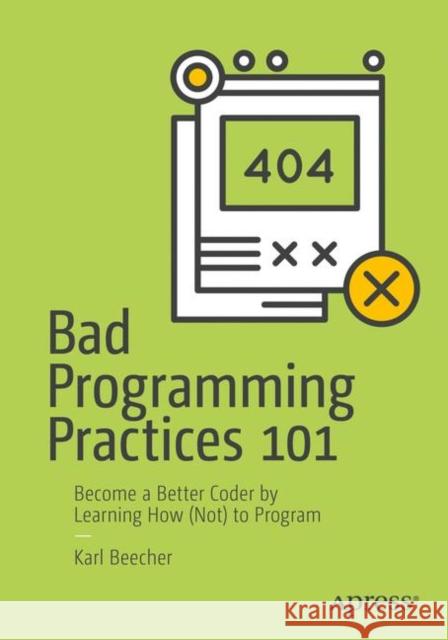
Karl Beecher
Bad Programming Practices 101: Become a Better Coder by Learning How (Not) to Program Beecher, Karl 9781484234105 Apress - książkaWidoczna okładka, to zdjęcie poglądowe, a rzeczywista szata graficzna może różnić się od prezentowanej.

Bad Programming Practices 101: Become a Better Coder by Learning How (Not) to Program

ISBN-13: 9781484234105 / Angielski / Miękka / 2018 / 221 str.

Karl Beecher
cena 181,11
(netto: 172,49 VAT:  5%)

Najniższa cena z 30 dni: 173,46
Termin realizacji zamówienia:
ok. 16-18 dni roboczych.

Darmowa dostawa!
Kategorie:
Informatyka, Bazy danych
Kategorie BISAC:
Computers > Programming - General
Computers > Software Development & Engineering - General
Computers > Languages - General
Wydawca:
Apress
Język:
Angielski
ISBN-13:
9781484234105
Rok wydania:
2018
Ilość stron:
221
Waga:
0.43 kg
Wymiary:
25.4 x 17.78 x 1.32
Oprawa:
Miękka
Wolumenów:
01
Dodatkowe informacje:
Bibliografia
Glosariusz/słownik
Wydanie ilustrowane

"Beecher focuses on poor coding practices that frequently creep into programmers' code. He crams 11 chapters of well-illustrated, well-documented examples of bad programming practices into just over 200 pages. ... The book has a well-constructed index and an excellent bibliography. Readers are urged to use the bibliography to review and reacquaint themselves with many excellent traditional references. ... Summing Up: Recommended. Upper-division undergraduates through faculty and professionals." (J. Beidler, Choice, Vol. 56 (03), November, 2018)
"I liked the book in a way that it was written as a comic book, which was easy to read. Some programming traps were well-described. The book is written in Java, but the code snippets are understandable for anyone, who is programming." (Vitosh, vitoshacademy.com, June, 2018)

Chapter 1: Fundamentals of Badness
How best to approach programming, in particular how to learn it, how to choose your tools wisely, and how to
think of programming as problem solving.
 Bad ways to learn programming
 Bad tooling
 Bad ways to approach a solution (or: programming is really problem-solving)
Chapter 2: Layout and Structure
Show the reader the consequences of a program’s appearance and overall structure.
 Make indentation and spacing poor and inconsistent
 Avoid structured programming, use lots of gotos
 Nest deeply - programmers like solving intricate puzzles
 Have lots of paths through a subroutine
 Clutter the code with extraneous tokens
 Avoid comments - code should be hard to read!
Chapter 3: Variables
Explain poor use of variables in programs.
 Use obscure names - thinking up meaningful labels isn't worth the effort
 Consider declaration a waste of time
 Use global variables
 Thoroughly abuse the type system
Chapter 4: Conditionals
Discuss bad habits and common mistakes when using conditionals.
 Use long, complex expressions
 Forget the else clause - the computer will figure it out
 Mix up nominal cases with errors cases
 Make sure the cases overlap or have gaps
Chapter 5: Loops
Discuss bad habits and common mistakes when using loops.
 Make 'em looooong!
 Give loops lots of exit points
 Avoid iterators - loop counters help make code convoluted and insecure
 Infinite loops are fun
Chapter 6: Subroutines
Show the consequences of poorly-written subroutines.
 Write monolithic programs - after all, someone else will do the maintenance
 Make subroutines long and complex
 Use lots of local variables
 Use inconsistent return values to keep your colleagues on their toes
Chapter 7: Error-handling
Explain how poor error-handling makes for unstable programs.
 Never check inputs - users don't make mistakes
 Don't handle errors - just assume everything will always go well
 Don't check for null pointers
 If you must check values, do it as late as possible (a.k.a. defensive programming is for wimps)
Chapter 8: Modules
Discuss bad practices to follow when dividing a large program into pieces.
 Make modules big and hefty
 Ensure they expose their inner workings
 Give them rigid designs to prevent others from writing their pesky extensions
 Make them specific to one problem - why should others benefit from your work?
 Import all the things!
Chapter 9: Objects
Discuss bad practices related specifically to object-oriented programming.
 Expose a class's internals - why should we have secrets?
 Put unrelated stuff together
 Objects are not independent - make them follow orders
 Keep coupling tight
 Favour deep inheritance hierarchies
 Avoid polymorphism - abstract code is harder to 'get' than abstract art
 Give classes multiple parents (a.k.a. classes shouldn't reproduce asexually)
Chapter 10: Bugs and debugging
Show how to carry out ineffectual and inadequate ways to locate bugs and mitigate their effects.
 Write really unfriendly error messages - users shouldn't understand them anyway
 Don't discriminate between exception types
 Litter code with print messages
 Don't use debug levels
Chapter 11: Testing
Show how to carry out ineffectual and inadequate testing.
 Ignore the requirements when testing
 Leave testing until the very end
 Keep code coverage low
 Testing once is enough
 Avoid test automation tools

Karl Beecher is a British writer, software developer and teacher based in Berlin, Germany. He specializes in taking meaty, complex ideas and presenting them in ways that are easy to understand.


This book takes a humorous slant on the programming practice manual by reversing the usual approach: under the pretence of teaching you how to become the world’s worst programmer who generally causes chaos, the book teaches you how to avoid the kind of bad habits that introduce bugs or cause code contributions to be rejected.

Why be a code monkey when you can be a chaos monkey? OK, so you want to become a terrible programmer. You want to write code that gets vigorously rejected in review. You look forward to reading feedback plastered in comments like "WTF???". Even better, you fantasize about your bug-ridden changes sneaking through and causing untold chaos in the codebase. You want to build a reputation as someone who writes creaky, messy, error-prone garbage that frustrates your colleagues. Bad Programming Practices 101 will help you achieve that goal a whole lot quicker by teaching you an array of bad habits that will allow you to cause maximum chaos.

Alternatively, you could use this book to identify those bad habits and learn to avoid them. The bad practices are organised into topics that form the basis of programming (layout, variables, loops, modules, and so on). It's been remarked that to become a good programmer, you must first write 10,000 lines of bad code to get it all out of your system. This book is aimed at programmers who have so far written only a small portion of that. By learning about poor programming habits, you will learn good practices. In addition, you will find out the motivation behind each practice, so you can learn why it is considered good and not simply get a list of rules.

You will:
  • Become a better coder by learning how (not) to program
  • Choose your tools wisely
  • Think of programming as problem solving
  • Discover the consequences of a program’s appearance and overall structure
  • Explain poor use of variables in programs
  • Avoid bad habits and common mistakes when using conditionals and loops
  • See how poor error-handling makes for unstable programs
  • Sidestep bad practices related specifically to object-oriented programming
  • Mitigate the effects of ineffectual and inadequate bug location and testing


Udostępnij

Facebook - konto krainaksiazek.pl


Opinie o Krainaksiazek.pl na Opineo.pl

Partner Mybenefit

Krainaksiazek.pl w programie rzetelna firma Krainaksiaze.pl - płatności przez paypal

Czytaj nas na:

Facebook - krainaksiazek.pl
  • książki na zamówienie
  • granty
  • książka na prezent
  • kontakt
  • pomoc
  • opinie
  • regulamin
  • polityka prywatności

Zobacz:

  • Księgarnia czeska

  • Wydawnictwo Książkowe Klimaty

1997-2026 DolnySlask.com Agencja Internetowa

© 1997-2022 krainaksiazek.pl
     
KONTAKT | REGULAMIN | POLITYKA PRYWATNOŚCI | USTAWIENIA PRYWATNOŚCI
Zobacz: Księgarnia Czeska | Wydawnictwo Książkowe Klimaty | Mapa strony | Lista autorów
KrainaKsiazek.PL - Księgarnia Internetowa

Polityka prywatnosci - link
Krainaksiazek.pl - płatnośc Przelewy24
Przechowalnia Przechowalnia








