• Wyszukiwanie zaawansowane
  • Kategorie
  • Kategorie BISAC
  • Książki na zamówienie
  • Promocje
  • Granty
  • Książka na prezent
  • Opinie
  • Pomoc
  • Załóż konto
  • Zaloguj się

Backstage Leadership: The Invisible Work of Highly Effective Leaders » książka


zaloguj się | załóż konto
Logo Krainaksiazek.pl

koszyk

konto

szukaj
topmenu
Księgarnia internetowa
Szukaj
Książki na zamówienie
Promocje
Granty
Książka na prezent
Moje konto
Pomoc
 
 
Wyszukiwanie zaawansowane
Pusty koszyk
Bezpłatna dostawa dla zamówień powyżej 20 złBezpłatna dostawa dla zamówień powyżej 20 zł

Kategorie główne

• Nauka
 [2944077]
• Literatura piękna
 [1814251]

  więcej...
• Turystyka
 [70679]
• Informatyka
 [151074]
• Komiksy
 [35590]
• Encyklopedie
 [23169]
• Dziecięca
 [611005]
• Hobby
 [136031]
• AudioBooki
 [1718]
• Literatura faktu
 [225599]
• Muzyka CD
 [379]
• Słowniki
 [2916]
• Inne
 [443741]
• Kalendarze
 [1187]
• Podręczniki
 [166463]
• Poradniki
 [469211]
• Religia
 [506887]
• Czasopisma
 [481]
• Sport
 [61343]
• Sztuka
 [242115]
• CD, DVD, Video
 [3348]
• Technologie
 [219293]
• Zdrowie
 [98602]
• Książkowe Klimaty
 [124]
• Zabawki
 [2385]
• Puzzle, gry
 [3504]
• Literatura w języku ukraińskim
 [260]
• Art. papiernicze i szkolne
 [7151]
Kategorie szczegółowe BISAC

Backstage Leadership: The Invisible Work of Highly Effective Leaders

ISBN-13: 9783030361709 / Angielski / Twarda / 2020 / 274 str.
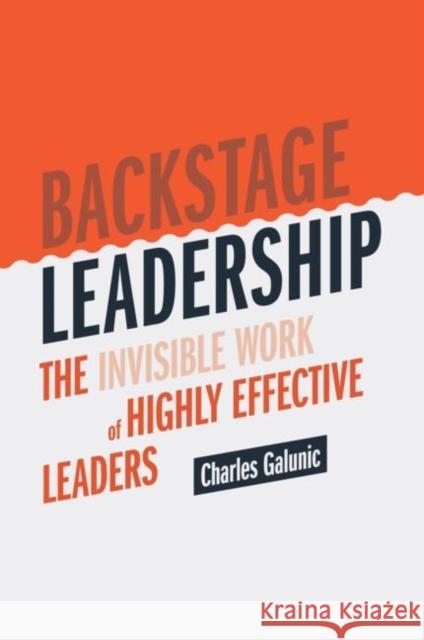
Charles Galunic
Backstage Leadership: The Invisible Work of Highly Effective Leaders Galunic, Charles 9783030361709 Springer Nature Switzerland AG - książkaWidoczna okładka, to zdjęcie poglądowe, a rzeczywista szata graficzna może różnić się od prezentowanej.

Backstage Leadership: The Invisible Work of Highly Effective Leaders

ISBN-13: 9783030361709 / Angielski / Twarda / 2020 / 274 str.

Charles Galunic
cena 160,99
(netto: 153,32 VAT:  5%)

Najniższa cena z 30 dni: 146,48
Termin realizacji zamówienia:
ok. 22 dni roboczych.

Darmowa dostawa!
Kategorie:
Nauka, Polityka
Kategorie BISAC:
Business & Economics > Zarządzenie i techniki zarządzania
Business & Economics > Management Science
Business & Economics > Strategia biznesowa
Wydawca:
Springer Nature Switzerland AG
Język:
Angielski
ISBN-13:
9783030361709
Rok wydania:
2020
Wydanie:
2020
Ilość stron:
274
Waga:
0.59 kg
Wymiary:
23.62 x 19.56 x 2.03
Oprawa:
Twarda
Wolumenów:
01


(Chapter 1) Introduction: The Silent Work of Effective Leadership
o This chapter lays out the main arguments of the book and provides an overview of
the chapters. What does it mean to do “back-stage” leadership work, and how is it
different from “front-stage” work?


(Chapter 2) Tracking Storms: The Sense-making Work of Leadership
o Companies operate in ecosystems, but these ecosystems are less like quiet meadows
than fast moving rivers. New technologies, new tastes, new competitors, and so on,
emerge frequently. Companies need systems to track these changes, to see the
storms before they become hurricanes. The tension that must be managed is between
a broad, general scanning of the environment (which must be linked-up to senior
decision makers) and narrowly selecting a small set of issues that matter to company
competitive advantage.

o Takeaways: Readers will understand better why tracking storms can be so difficult for many
leaders and organizations (e.g., misguided notions of the level at which this occurs, plus the
time-horizon of incentives and issues of “absorptive capacity”). Readers will gain ideas for
building processes that overcome these filters (e.g., lowering the fear of failure must come
early, in the “hunches” employees are encouraged to follow) and, vitally, linking-up the
scanning with the strategic decision making.

(Chapter 3) Building Commitment to Strategy: The Political Work of Leadership
o Leaders must be able to mobilize people towards new strategic directions, and this
work cannot be reduced to edicts or impassioned pleas. They need to think about the
process of herding clever and concerned individuals to some new future. They need
to manage the tensions between a model that is relatively democratic and open and
one that is relatively closed and requires sweeping political action.

o Takeaways: Two processes must be examined here- one that is relatively more democratic
and open, and so more likely to secure authentic commitment from people (e.g., one based
on Procedural Justice and fair process leadership ideas) but also one that is “realpolitik”
and pragmatic, that aims to secure “enough votes” to mobilize action. Here the backstage
work of leadership is clearly political, but in such a way that it does not turn to
Machiavellian games and their harmful consequences. This work of leadership will be
informed by the substantial literature on power and change agency in organizations and
provide leaders some integrated ideas on managing with “soft” power.

(Chapter 4) Balancing Autonomy and Integration: The Structural Work of Leadership
o Leaders understand the value of autonomy—as a powerful motivator and as a way to
ensure focus through transparency and accountability, and so the popularity of such
models today as Agile Teams and Lean Start-up. But at the same time they need to
consider the trade-offs of too much autonomy (redundancies, lost economies of
scale) and therefore build bridging structures. The main tension is between
autonomy and integration.

o Takeaways: Readers will understand a fundamental and pervasive undercurrent or force in
business development: moments of divergence and moments of convergence. These
undercurrents signal two ways in which leaders need to think about architecting the
organization: one involves relatively more autonomy and space for exploring (and we can
look at this in the digitization efforts of companies today) and the other involves combining
efforts and focusing on efficiencies, as industries converge on dominant designs. We will
examine what this means for organization structures and processes (e.g., the ambidextrous
organization). For example, this will include a close look at matrix organizations and the
role of the leader, a way of working that I describe as “the good referee.”

(Chapter 5) Building Community: The Cultural Work of Leadership
o Perhaps no work is more important, and no type of work is more “back-stage” and
architectural, than the work of shaping the organizational culture. This is a sort of
“climax” for the book. This is a very difficult topic for leaders to cope with, and we
will need the foundations of the previous chapters to show the levers for this work.
Culture is also inherently prone to tensions. This is because there are likely to be
trade-offs and inconsistencies between some of the values that companies target—as
anybody who has been told to seek “profitable growth” or “creativity but with
efficiency” or “speed and safety” will understand. Part of what it means to shape
culture is to ensure that people understand priorities and the “real” drivers of
behaviour.

o Takeaways: Cultural work is made possible only once leaders have grasped a seemingly
straightforward but crucial insight: shaping culture is done indirectly. That is, culture
cannot really be changed directly, at least not practically and within a modern organization,
as opposed to a kleptocractic state (direct culture change amounts to either “preaching,”
and usually heavy coercion, or firing and replacing everyone in the company). I will share
with them a practical model for thinking about culture (especially how to “diagnosis”
culture) and then ideas on how to shape culture. Repetition, consistency, and a powerful
narrative will be important features of that work.

(Chapter 6) Developing Talent and Capabilities: The Coaching Work of Leadership
o Leaders need to spend time on the talent pipeline of the company, and always in
conjunction with the critical capabilities and knowledge bases that the firm requires
(present and future). By “coaching work” we mean the background work of finding
and developing the “best” players for the company (rather than the direct work of
“coaching” in the sense of pep-talks and immediate player psychology). A key
tension here is the time horizon for capability development- near-term versus longterm.

o Takeaways: A key issue in this type of work is to take seriously the conjunction “and”
between “talent” and “capability.” Encouraging leaders to just develop their talent is about
as obvious (and dull) as encouraging an Olympic athlete to eat well. It is also potentially
misunderstood. Leaders may believe it is just about asking HR to find clever people and
treat them well. Instead, I want readers to think about capabilities and talent in conjunction.
Capabilities in strategy are the skills and routines that set your company apart (now or in
the future). The talent development I emphasize in this chapter is in relation to those
capabilities (short term and long term). Take for example the remarkable success of
Barcelona football club. That success is not rooted in just “great talent” (amazing athletes
who are paid well and adored) but the development of that talent towards a specific playing
style (capability, or in this case the “tiki-taka” style that they developed and which is
embedded in their youth academy). It is this conjunction of talent and capability that is
important. This chapter is about keeping these two things aligned, and the leaders work in
guiding these processes (not just HR).

(Chapter 7) Back to the Front: The Direct Work of Leadership
o Once we have gained some safe distance from the familiar harbours of more popular
leadership models, it is time to come clean, or at least to emphasize again that
“direct” front-stage leadership is not wrong, only that it needs to be balanced with
back-stage work. In this chapter the idea is to summarize some of the powerful ideas
on direct leadership behaviour and its development (e.g., the coaching craze). The
natural place to start is of course with the leader herself. The tension to be balanced
at this junction of the book is between the front-stage work of leadership and all of
the back-stage work that has been presented. If you spend too much time “frontstage,”
you may become intoxicated with that presence. Similarly, if you spend too
much time “back-stage,” you may become camera shy.

o Takeaways: The starting point I envision for this chapter involves looking back at the
responses I have had from my executive students and classes over the years to a simple (and
wide-open) question: “Think about some of the most impactful leaders in your life. What are
the traits and characteristics of these, most effective leaders?” I have seen many responses,
but a good deal of consistency over the years, and especially in the front-stage work leaders.
The idea is to thoughtfully go through some of the most common answers, unpack them, and
see what they imply for the front-stage work of leadership.

(Chapter 8) The Leaders New Work
o This is the concluding chapter and would, first of all, take a more philosophical view
on the topic, pulling together the implications for management development,
training, research, and business schools (if not also primary and secondary school
education). Most importantly, this chapter will summarize the essence of “backstage”
leadership, and the mindset and discipline it requires.

Charles Galunic is a Professor of Organisational Behaviour and the Aviva Chaired Professor of Leadership and Responsibility at INSEAD. He directs one of INSEAD’s flagship Executive Education programs, The Transition to General Management Programme (TGM) and has been a pioneer of several courses including the core EMBA course on Leading People and Organisations. He also teaches in a variety of INSEAD Executive Education programmes, both in Fontainebleau and in Asia, and has been recognized often for his teaching excellence.

He has published in various academic and practitioner-oriented journals, including the Journal of Managerial and Decision Economics, Administrative Science Quarterly, Academy of Management Journal, Organisation Science, Strategic Management Journal, Harvard Business Review, and Research in Organisational Behaviour. He has also worked with numerous companies and executives, across various industries and continents, in order to help them develop their senior leadership skills and solve pressing cultural challenges in practical ways.


Most of us would recognize a star leader by their charisma, emotional intelligence and public communication prowess. What is truly impressive but often overlooked is the silent work of leadership that garners real results. Exercising influence in a complex and global organization – whilst also shaping and executing strategies across borders in a disruptive age – is the true mark of success as a leader. Backstage Leadership takes a comprehensive look at the background processes that leaders must master in order to shape the culture, direction and capability of a successful company. With an emphasis on strategy, the author provides an integrated toolkit for developing your knowledge and skills as a ‘backstage leader.’ You will learn how to:

  •   Mobilize people towards new strategic directions
  •   Scan your business environment for threats and disruptive forces
  •   Diagnose and help to shape the culture of your organization
  •   Develop talent and capabilities towards a specific goal.

Focusing on the key and consistent underlying processes of leadership, this book is essential reading for managers who wish to bring focus and coherence to their leadership role and integrate themselves within the engine of the organization.




Udostępnij

Facebook - konto krainaksiazek.pl


Opinie o Krainaksiazek.pl na Opineo.pl

Partner Mybenefit

Krainaksiazek.pl w programie rzetelna firma Krainaksiaze.pl - płatności przez paypal

Czytaj nas na:

Facebook - krainaksiazek.pl
  • książki na zamówienie
  • granty
  • książka na prezent
  • kontakt
  • pomoc
  • opinie
  • regulamin
  • polityka prywatności

Zobacz:

  • Księgarnia czeska

  • Wydawnictwo Książkowe Klimaty

1997-2026 DolnySlask.com Agencja Internetowa

© 1997-2022 krainaksiazek.pl
     
KONTAKT | REGULAMIN | POLITYKA PRYWATNOŚCI | USTAWIENIA PRYWATNOŚCI
Zobacz: Księgarnia Czeska | Wydawnictwo Książkowe Klimaty | Mapa strony | Lista autorów
KrainaKsiazek.PL - Księgarnia Internetowa

Polityka prywatnosci - link
Krainaksiazek.pl - płatnośc Przelewy24
Przechowalnia Przechowalnia




