• Wyszukiwanie zaawansowane
  • Kategorie
  • Kategorie BISAC
  • Książki na zamówienie
  • Promocje
  • Granty
  • Książka na prezent
  • Opinie
  • Pomoc
  • Załóż konto
  • Zaloguj się

Bacillus Thuringiensis Biotechnology » książka


zaloguj się | załóż konto
Logo Krainaksiazek.pl

koszyk

konto

szukaj
topmenu
Księgarnia internetowa
Szukaj
Książki na zamówienie
Promocje
Granty
Książka na prezent
Moje konto
Pomoc
 
 
Wyszukiwanie zaawansowane
Pusty koszyk
Bezpłatna dostawa dla zamówień powyżej 20 złBezpłatna dostawa dla zamówień powyżej 20 zł

Kategorie główne

• Nauka
 [2944077]
• Literatura piękna
 [1814251]

  więcej...
• Turystyka
 [70679]
• Informatyka
 [151074]
• Komiksy
 [35590]
• Encyklopedie
 [23169]
• Dziecięca
 [611005]
• Hobby
 [136031]
• AudioBooki
 [1718]
• Literatura faktu
 [225599]
• Muzyka CD
 [379]
• Słowniki
 [2916]
• Inne
 [443741]
• Kalendarze
 [1187]
• Podręczniki
 [166463]
• Poradniki
 [469211]
• Religia
 [506887]
• Czasopisma
 [481]
• Sport
 [61343]
• Sztuka
 [242115]
• CD, DVD, Video
 [3348]
• Technologie
 [219293]
• Zdrowie
 [98602]
• Książkowe Klimaty
 [124]
• Zabawki
 [2385]
• Puzzle, gry
 [3504]
• Literatura w języku ukraińskim
 [260]
• Art. papiernicze i szkolne
 [7151]
Kategorie szczegółowe BISAC

Bacillus Thuringiensis Biotechnology

ISBN-13: 9789400799509 / Angielski / Miękka / 2014 / 392 str.
Estibaliz Sansinenea
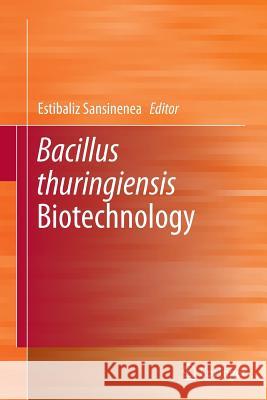
Bacillus Thuringiensis Biotechnology Sansinenea, Estibaliz 9789400799509 Springer - książkaWidoczna okładka, to zdjęcie poglądowe, a rzeczywista szata graficzna może różnić się od prezentowanej.

Bacillus Thuringiensis Biotechnology

ISBN-13: 9789400799509 / Angielski / Miękka / 2014 / 392 str.

Estibaliz Sansinenea
cena 1006,38
(netto: 958,46 VAT:  5%)

Najniższa cena z 30 dni: 963,86
Termin realizacji zamówienia:
ok. 22 dni roboczych.

Darmowa dostawa!
inne wydania

Bacillus thuringiensis (Bt) has been used as a biopesticide in agriculture, forestry and mosquito control because of its advantages of specific toxicity against target insects, lack of polluting residues and safety to non-target organisms. The insecticidal properties of this bacterium are due to insecticidal proteins produced during sporulation. Despite these ecological benefits, the use of Bt biopesticides has lagged behind the synthetic chemicals. Genetic improvement of Bt natural strains, in particular Bt recombination, offers a promising means of improving efficacy and cost-effectiveness of Bt-based bioinsecticide products to develop new biotechnological applications. On the other hand, the different Bacillus species have important biotechnological applications; one of them is carried out by producing secondary metabolites, which are the study object of natural product chemistry. The amazing structural variability of these compounds has attracted the curiosity of chemists and the biological activities possessed by natural products have inspired the pharmaceutical industry to search for lead structures in microbial extracts. Screening of microbial extracts reveals the large structural diversity of natural compounds with broad biological activities, such as antimicrobial, antiviral, immunosuppressive, and antitumor activities that enable the bacterium to survive in its natural environment. These findings widen the target range of Bacillus spp., in special B. thuringiensis, besides insecticidal activity and help people to better understand its role in soil ecosystem.


Kategorie:
Nauka, Biologia i przyroda
Kategorie BISAC:
Science > Biotechnology
Technology & Engineering > Agriculture - General
Science > Biologia i przyroda
Wydawca:
Springer
Język:
Angielski
ISBN-13:
9789400799509
Rok wydania:
2014
Wydanie:
2012
Ilość stron:
392
Waga:
0.62 kg
Wymiary:
23.5 x 15.5
Oprawa:
Miękka
Wolumenów:
01
Dodatkowe informacje:
Bibliografia
Wydanie ilustrowane

Index Of Contributors.- Preface.- PART I BACILLUS THURINGIENSIS: AN ENVIRONMENTALLY SAFETY ALTERNATIVE.- 1 Discovery and description of Bacillus thuringiensis.- 1 .1 Introduction.-  1.2 A brief History and Discovery of Bacillus thuringiensis.- 1.3 A Description of B. thuringiensis.- 1.4 Conclusions.- References.- 2 Bacillus thuringiensis applications in agriculture.- 2.1 Introduction.- 2.2 Methods of application of Bt and its products in agriculture.- 2.3 Advantages of using Bt products over chemical agents in agricultural  practices.- 2.4 Threat to continuous use of Bt as biological control agent.- 2.5 Strategies to ensure continuing use of Bt and its products in agriculture.- References.- 3 Risk Assessment of Bt Transgenic Crops.- 3.1 Introduction.- 3.2 Perceived risks with Bt transgenic crops.- 3.3 Risk analysis of Bt transgenic crops.- 3.4 Oversight of Bt Transgenic crops.- 3.5 Conclusion and Future Prospects.- References.- 4 Use and efficacy of Bt compared to less environmentally safe alternatives .- 4.1 Biopesticide Classification.- 4.2 Biopesticide Market Survey.- 4.3 Use of Bt in IPM.- 4.4 Use and Efficacy of Bt.- References.-  5 Protein Engineering of Bacillus thuringiensis δ-Endotoxins .- 5.1 Introduction.- 5.2 Protein Engineering of Bt δ-endotoxins.- 5.3 Conclusions.- 5.4 Perspectives.- References.- PART II  GENETICS OF BACILLUS THURINGIENSIS.-  6 Evolution of the Bacillus cereus group.- 6.1 The Bacillus cereus group.- 6.2 B. cereus group phylogeny.- 6.3 Bacillus cereus group genome sequencing.- 6.4 Bacillus cereus group bacteria – pathogens and symbionts.- 6.5 What distinguishes the species in the B. cereus group?.- 6.6 Importance of plasmids to B. cereus group biology.- References.- 7 Bacillus thuringiensis genetics and phages - from transduction and sequencing to recombineering .- 7.1 Introduction: a dramatic story of the Bacillus cereus genetics.- 7.2 Phage-mediated gene transduction.- 7.3 Phage-mediated gene transduction in the B. cereus group.- 7.4 Recombineering perspectives for the B. cereus group.- References.-  8 Conjugation in Bacillus thuringiensis: insights into the plasmids exchange process.- 8.1 Introduction.- 8.2  Conjugation as a tool to understand the ecology of B. cereus group.- 8.3 Conclusion and Perspectives.- References.- 9  Shuttle vectors of Bacillus thuringiensis .- 9.1 Introduction.- 9.2 Plasmids in Bacillus thuringiensis.- 9.3 Shuttle vectors of Bacillus thuringiensis.- 9.4 Transformation of Bacillus thuringiensis.- References.-  10 Construction and application in plasmid vectors of Bacillus cereus group .- 10.1 Introduction.- 10.2 Shuttle plasmid vectors in the B. cereus group.- 10.3 Integration vectors in the B. cereus group.- 10.4 Resolution vectors in the B. cereus group.- 10.5 High-effective expression vectors in the B. cereus group.- 10.6 Conclusion.- References.-  11 Recombination in Bacillus thuringiensis.- 11.1 Introduction.- 11.2 Site Specific Recombination in B. thuringiensis.- 11.3 Homologous Recombination in B. thuringiensis.- 11.4 Conclusion.- References.-  12 Genetic improvement of Bt strains and development of novel biopesticides.- 12.1 Introduction.- 12.2 Discovery of new Bt strains harbouring novel cry genes.- 12.3 Engineering of novel Cry proteins.- 12.4 Construction of new Bt strains by conjugation.- 12.5 Expression of Bt cry genes in heterologous microbial hosts.- 12.6 Development of recombinant Bt strains.- 12.7 Development of asporogenic Bt strains.- 12.8 Concluding remarks.- References.- PART III BT AS BIOPESTICIDE: APPLICATIONS IN BIOTECHNOLOGY.-  13 Genetically Modified Bacillus thuringiensis Biopesticides .- 13.1 Introduction.- 13.2 Strategies for constructing genetically modified Bt strains for engineered biopesticide development.- 13.3 Bt engineered strains with high toxicity or broader insecticidal spectrum.- 13.4 Multifunctional Bt engineered strains.- 13.5 Genetically modified Bt strains with delayed pest resistance.- References.- 14 Bacillus thuringiensis Recombinant Insecticidal Protein Production.- 14.1 Introduction.- 14.2 Pesticidal Protein Expression in Gram Negative Hosts.- 14.3 Pesticidal Protein Expression in B. thuringiensis.- 14.4 Bacterial expression applications summary.- 14.5 Expression in Transgenic Plants.- 14.6 Plant Expression Summary.- 14.7 Conclusion.- Bibliography.- 15 Bt crops: past and future .- 15.1 Introduction.- 15.2 Developments conducive to Bt crops.- 15.3 Commercialization and performance of “first generation” Bt crops.- 15.4 Risks associated with the use of Bt crops.- 15.5 “Second” and “third” generation Bt crops.- 15.6 Conclusions and future prospects.- References.- 16 A Review of the Food Safety of Bt Crops.- 16.1 Background.- 16.2 Regulatory guidance for the safety assessment of Cry proteins.- 16.3 The Species-specific acute mode of action of Cry proteins.- 16.4 Potential digestibility of Cry proteins.- 16.5 Toxicology testing of Cry proteins.- 16.6 Assessment of food processing on Cry protein biological activity.- 16.7 Human dietary exposure assessment for Cry proteins in Bt crops.- 16.8 Toxicology feeding studies in rodents fed Bt crops.- 16.9 Food and Feed Safety Benefits of Bt Crops.- 16.10 Conclusions.- References.- PART IV OTHER BACILLUS SPECIES IN BIOTECHNOLOGY.- 17 The most important Bacillus species in biotechnology.- 17.1 Introduction.- 17.2 Most important biotechnological applications of Bacillus species.- 17.3 Conclusions and perspectives.- References.-  18 Secondary metabolites of Bacillus: potentials in biotechnology.- 18.1 Introduction.- 18.2 The most important secondary metabolites of Bacillus species.- 18.3 Other metabolites and activities of Bacillus species.- 18.4 Secondary metabolites from marine Bacilli.- 18.5 Safety evaluation and risk assessment.- 18.6 Conclusion and perspectives.- References.- 19 Future challenges and prospects of Bacillus thuringiensis.- 19.1 Introduction.- 19.2 Chitinases of B. thuringiensis in environment and food industry.- 19.3 Bacteriocins of Bacillus thuringiensis.- References.   


Bacillus thuringiensis (Bt) has been used as a biopesticide in agriculture, forestry and mosquito control because of its advantages of specific toxicity against target insects, lack of polluting residues and safety to non-target organisms. The insecticidal properties of this bacterium are due to insecticidal proteins produced during sporulation. Despite these ecological benefits, the use of Bt biopesticides has lagged behind the synthetic chemicals. Genetic improvement of Bt natural strains, in particular Bt recombination, offers a promising means of improving efficacy and cost-effectiveness of Bt-based bioinsecticide products to develop new biotechnological applications. On the other hand, the different Bacillus species have important biotechnological applications; one of them is carried out by producing secondary metabolites, which are the study object of natural product chemistry. The amazing structural variability of these compounds has attracted the curiosity of chemists and the biological activities possessed by natural products have inspired the pharmaceutical industry to search for lead structures in microbial extracts. Screening of microbial extracts reveals the large structural diversity of natural compounds with broad biological activities, such as antimicrobial, antiviral, immunosuppressive, and antitumor activities that enable the bacterium to survive in its natural environment. These findings widen the target range of Bacillus spp., in special B. thuringiensis, besides insecticidal activity and help people to better understand its role in soil ecosystem.




Udostępnij

Facebook - konto krainaksiazek.pl


Opinie o Krainaksiazek.pl na Opineo.pl

Partner Mybenefit

Krainaksiazek.pl w programie rzetelna firma Krainaksiaze.pl - płatności przez paypal

Czytaj nas na:

Facebook - krainaksiazek.pl
  • książki na zamówienie
  • granty
  • książka na prezent
  • kontakt
  • pomoc
  • opinie
  • regulamin
  • polityka prywatności

Zobacz:

  • Księgarnia czeska

  • Wydawnictwo Książkowe Klimaty

1997-2026 DolnySlask.com Agencja Internetowa

© 1997-2022 krainaksiazek.pl
     
KONTAKT | REGULAMIN | POLITYKA PRYWATNOŚCI | USTAWIENIA PRYWATNOŚCI
Zobacz: Księgarnia Czeska | Wydawnictwo Książkowe Klimaty | Mapa strony | Lista autorów
KrainaKsiazek.PL - Księgarnia Internetowa

Polityka prywatnosci - link
Krainaksiazek.pl - płatnośc Przelewy24
Przechowalnia Przechowalnia




