• Wyszukiwanie zaawansowane
  • Kategorie
  • Kategorie BISAC
  • Książki na zamówienie
  • Promocje
  • Granty
  • Książka na prezent
  • Opinie
  • Pomoc
  • Załóż konto
  • Zaloguj się

Avian Desert Predators » książka


zaloguj się | załóż konto
Logo Krainaksiazek.pl

koszyk

konto

szukaj
topmenu
Księgarnia internetowa
Szukaj
Książki na zamówienie
Promocje
Granty
Książka na prezent
Moje konto
Pomoc
 
 
Wyszukiwanie zaawansowane
Pusty koszyk
Bezpłatna dostawa dla zamówień powyżej 20 złBezpłatna dostawa dla zamówień powyżej 20 zł

Kategorie główne

• Nauka
 [2946912]
• Literatura piękna
 [1852311]

  więcej...
• Turystyka
 [71421]
• Informatyka
 [150889]
• Komiksy
 [35717]
• Encyklopedie
 [23177]
• Dziecięca
 [617324]
• Hobby
 [138808]
• AudioBooki
 [1671]
• Literatura faktu
 [228371]
• Muzyka CD
 [400]
• Słowniki
 [2841]
• Inne
 [445428]
• Kalendarze
 [1545]
• Podręczniki
 [166819]
• Poradniki
 [480180]
• Religia
 [510412]
• Czasopisma
 [525]
• Sport
 [61271]
• Sztuka
 [242929]
• CD, DVD, Video
 [3371]
• Technologie
 [219258]
• Zdrowie
 [100961]
• Książkowe Klimaty
 [124]
• Zabawki
 [2341]
• Puzzle, gry
 [3766]
• Literatura w języku ukraińskim
 [255]
• Art. papiernicze i szkolne
 [7810]
Kategorie szczegółowe BISAC

Avian Desert Predators

ISBN-13: 9783642643675 / Angielski / Miękka / 2011 / 128 str.
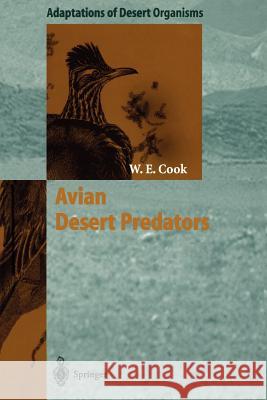
William E. Cook
Avian Desert Predators William E. Cook 9783642643675 Springer - książkaWidoczna okładka, to zdjęcie poglądowe, a rzeczywista szata graficzna może różnić się od prezentowanej.

Avian Desert Predators

ISBN-13: 9783642643675 / Angielski / Miękka / 2011 / 128 str.

William E. Cook
cena 403,47
(netto: 384,26 VAT:  5%)

Najniższa cena z 30 dni: 385,52
Termin realizacji zamówienia:
ok. 22 dni roboczych
Bez gwarancji dostawy przed świętami

Darmowa dostawa!

Birds are not particularly well suited to desert life. Unlike mammals, they are generally active during the day and do not usually go underground to escape the intense desert heat. Among the few types of birds that have successfully invaded the desert ecosystem are the predators. Many species of hawks, owls, roadrunners, vultures, and shrikes survive very well in deserts. What attributes make this group especially suited to desert life? How have they augmented their abilities to cope with the harsh constraints imposed by the desert habitat? These are among the issues explored in this new volume, which brings together much of the current research on adaptations of avian desert predators.


Kategorie:
Nauka, Biologia i przyroda
Kategorie BISAC:
Nature > Birdwatching Guides
Science > Zoologia i nauki o zwierzętach
Science > Life Sciences - Ecology
Wydawca:
Springer
Seria wydawnicza:
Adaptations of Desert Organisms
Język:
Angielski
ISBN-13:
9783642643675
Rok wydania:
2011
Wydanie:
Softcover Repri
Numer serii:
000034705
Ilość stron:
128
Waga:
0.23 kg
Wymiary:
23.5 x 15.5
Oprawa:
Miękka
Wolumenów:
01

1 Introduction.- 1.1 The Desert Environment.- 1.2 Temperature Regulation in Desert Birds.- 1.2.1 Physiological Cooling.- 1.2.2 Behavioral Cooling.- 1.2.3 Pigmentation.- 1.3 Advantages of a Carnivorous Diet for Desert Survival.- 1.4 Water Conservation in Desert Birds.- 1.4.1 Water Conservation in the Respiratory System.- 1.4.2 Water Conservation in the Kidney.- 1.4.3 Water Conservation in the Digestive System.- 1.4.4 Breeding Cycle Adjusted to Rainfall.- 2 Vultures.- 2.1 Predatory Behavior in Vultures.- 2.1.1 The Desert Scavenger Niche.- 2.1.2 Do Vultures Hunt by Smell or Sight?.- 2.1.3 Nasal Epithelium.- 2.1.4 Defense.- 2.1.5 Breeding Timed to Food Availability.- 2.2 Temperature Regulation in Vultures.- 2.2.1 Soaring as a Means of Temperature Regulation.- 2.2.2 Heat Dissipation and Associated Behavior.- 2.2.3 Legs as Sites of Temperature Regulation.- 2.2.4 Hyperthermia.- 2.2.5 Physiological Adaptations for Heat Conservation.- 2.2.6 Behavioral Modifications for Heat Conservation.- 2.3 Water Conservation in Vultures.- 2.3.1 Sources of Water.- 2.3.2 Water Loss Through Evaporation.- 3 Hawks and Allies.- 3.1 Predatory Behavior in Hawks and Allies.- 3.1.1 Euryphagy.- 3.1.2 Agility and Diverse Hunting Strategies.- 3.1.3 Cooperative Hunting.- 3.1.4 Hunting Open Areas.- 3.1.5 Hunting from the Ground.- 3.1.6 Hunting at Waterholes.- 3.1.7 Predator and Prey Conspicuousness.- 3.2 Breeding Behavior in Hawks and Allies.- 3.2.1 Breeding Biology Adapted to Predatory Behavior.- 3.2.2 Breeding Season.- 3.2.3 Cooperative Breeding.- 3.2.4 Population Size Regulation.- 3.3 Temperature Regulation in Hawks and Allies.- 3.3.1 Behavioral Adaptations.- 3.3.2 Physiological Adaptations.- 3.3.3 Morphological Adaptations.- 3.4 Water Conservation in Hawks and Allies.- 3.4.1 Carnivorous Diet.- 3.4.2 Physiology of Water Conservation.- 3.4.3 Water Conservation During Breeding.- 4 Roadrunners.- 4.1 Predatory Behavior in Roadrunners.- 4.1.1 Diurnal Activity.- 4.1.2 Euryphagy.- 4.1.3 Camouflage and Terrestrial Hunting.- 4.1.4 Prey Selection.- 4.2 Temperature Regulation in Roadrunners.- 4.2.1 Adaptations for Warming.- 4.2.1.1 Sunbathing.- 4.2.1.2 Hypothermia.- 4.2.2 Adaptations for Cooling.- 4.2.2.1 Legs as Thermoregulators.- 4.2.2.2 Hyperthermia.- 4.2.2.3 Panting.- 4.2.2.4 Guiar Flutter.- 4.2.2.5 Evaporation from the Skin.- 4.2.2.6 Rete Mirabile Ophthalmicum.- 4.3 Water Conservation in Roadrunners.- 4.3.1 Sources of Water.- 4.3.2 Water Loss Through Evaporation.- 4.3.3 Adaptations for Water Conservation.- 4.3.3.1 Water Conservation in the Kidney.- 4.3.3.2 Water Conservation in the Digestive System.- 4.3.3.3 Salt Excretion.- 4.3.3.4 Water Conservation in the Respiratory System.- 4.3.3.5 Water Conservation in the Reproductive Cycle.- 5 Owls.- 5.1 Predatory Adaptations in Owls.- 5.1.1 Nocturnal Species.- 5.1.2 Crepuscular Species.- 5.1.3 Diurnal Species.- 5.1.4 Antipredator Adaptations.- 5.2 Temperature Regulations in Owls.- 5.2.1 Adaptations for Warming.- 5.2.1.1 Insulation.- 5.2.1.2 Migration.- 5.2.1.3 Hypothermia.- 5.2.1.4 Sunbathing.- 5.2.2 Adaptations for Cooling.- 5.2.2.1 Plumage Modifications to Retard Heat Gain.- 5.2.2.2 Behavioral Modifications to Retard Heat Gain.- 5.2.2.3 Basal Metabolism.- 5.2.2.4 Thermoneutral Zone.- 5.2.2.5 Hyperthermia.- 5.2.2.6 Evaporative Cooling.- 5.2.2.7 Heat Radiation.- 5.3 Water Conservation in Owls.- 5.3.1 Sources of Water.- 5.3.1.1 Free Water.- 5.3.1.2 Water-Rich Food.- 5.3.1.3 Metabolic Water.- 5.3.2 Water Conservation in the Excretory and Digestive Systems.- 5.3.3 Water Conservation in the Respiratory System.- 5.3.4 Water Conservation in the Integument.- 5.3.5 Water Conservation in the Breeding Cycle.- 6 Shrikes.- 6.1 Predatory Behavior in Shrikes.- 6.1.1 Hunting Strategy.- 6.1.2 Euryphagy.- 6.1.3 Prey Selection.- 6.1.4 Territorial Behavior.- 6.2 Breeding Behavior in Shrikes.- 6.2.1 Cooperative Breeding.- 6.2.2 Effect of Rain on Breeding.- 6.2.3 Nest Building.- 6.2.4 Early Departure from Nest.- 6.3 Temperature Regulation in Shrikes.- 6.4 Water Conservation in Shrikes.- Acknowledgements.- References.- Species Index.

Only few birds are capable of survival in deserts. The renowned ornithologist William E. Cook describes how various birds of prey cope with heat and drought through morphological, physiological, as well as behavioral adaptations.


Udostępnij

Facebook - konto krainaksiazek.pl


Opinie o Krainaksiazek.pl na Opineo.pl

Partner Mybenefit

Krainaksiazek.pl w programie rzetelna firma Krainaksiaze.pl - płatności przez paypal

Czytaj nas na:

Facebook - krainaksiazek.pl
  • książki na zamówienie
  • granty
  • książka na prezent
  • kontakt
  • pomoc
  • opinie
  • regulamin
  • polityka prywatności

Zobacz:

  • Księgarnia czeska

  • Wydawnictwo Książkowe Klimaty

1997-2025 DolnySlask.com Agencja Internetowa

© 1997-2022 krainaksiazek.pl
     
KONTAKT | REGULAMIN | POLITYKA PRYWATNOŚCI | USTAWIENIA PRYWATNOŚCI
Zobacz: Księgarnia Czeska | Wydawnictwo Książkowe Klimaty | Mapa strony | Lista autorów
KrainaKsiazek.PL - Księgarnia Internetowa

Polityka prywatnosci - link
Krainaksiazek.pl - płatnośc Przelewy24
Przechowalnia Przechowalnia






