• Wyszukiwanie zaawansowane
  • Kategorie
  • Kategorie BISAC
  • Książki na zamówienie
  • Promocje
  • Granty
  • Książka na prezent
  • Opinie
  • Pomoc
  • Załóż konto
  • Zaloguj się

Averting Disaster Before It Strikes: How to Make Sure Your Subordinates Warn You While There is Still Time to Act » książka


zaloguj się | załóż konto
Logo Krainaksiazek.pl

koszyk

konto

szukaj
topmenu
Księgarnia internetowa
Szukaj
Książki na zamówienie
Promocje
Granty
Książka na prezent
Moje konto
Pomoc
 
 
Wyszukiwanie zaawansowane
Pusty koszyk
Bezpłatna dostawa dla zamówień powyżej 20 złBezpłatna dostawa dla zamówień powyżej 20 zł

Kategorie główne

• Nauka
 [2946912]
• Literatura piękna
 [1852311]

  więcej...
• Turystyka
 [71421]
• Informatyka
 [150889]
• Komiksy
 [35717]
• Encyklopedie
 [23177]
• Dziecięca
 [617324]
• Hobby
 [138808]
• AudioBooki
 [1671]
• Literatura faktu
 [228371]
• Muzyka CD
 [400]
• Słowniki
 [2841]
• Inne
 [445428]
• Kalendarze
 [1545]
• Podręczniki
 [166819]
• Poradniki
 [480180]
• Religia
 [510412]
• Czasopisma
 [525]
• Sport
 [61271]
• Sztuka
 [242929]
• CD, DVD, Video
 [3371]
• Technologie
 [219258]
• Zdrowie
 [100961]
• Książkowe Klimaty
 [124]
• Zabawki
 [2341]
• Puzzle, gry
 [3766]
• Literatura w języku ukraińskim
 [255]
• Art. papiernicze i szkolne
 [7810]
Kategorie szczegółowe BISAC

Averting Disaster Before It Strikes: How to Make Sure Your Subordinates Warn You While There is Still Time to Act

ISBN-13: 9783031307713 / Angielski
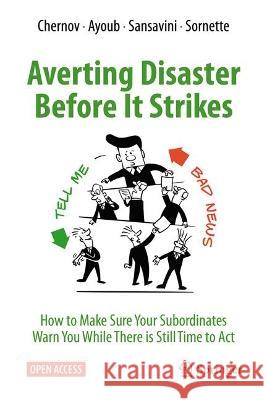
Dmitry Chernov; Ali Ayoub; Giovanni Sansavini
Averting Disaster Before It Strikes: How to Make Sure Your Subordinates Warn You While There is Still Time to Act Dmitry Chernov Ali Ayoub Giovanni Sansavini 9783031307713 Springer - książkaWidoczna okładka, to zdjęcie poglądowe, a rzeczywista szata graficzna może różnić się od prezentowanej.

Averting Disaster Before It Strikes: How to Make Sure Your Subordinates Warn You While There is Still Time to Act

ISBN-13: 9783031307713 / Angielski

Dmitry Chernov; Ali Ayoub; Giovanni Sansavini
cena 201,72
(netto: 192,11 VAT:  5%)

Najniższa cena z 30 dni: 192,74
Termin realizacji zamówienia:
ok. 22 dni roboczych
Bez gwarancji dostawy przed świętami

Darmowa dostawa!
inne wydania

Some of the major industrial disasters could have been prevented. When the facts of what happened are established, their stories share a common thread: before things spiralled out of control, there were workers at the affected sites who knew that the situation was dangerous, and could become catastrophic unless immediate action was taken. But tragically, nobody dared to tell the decision-makers who could have authorized that action. With no idea of the risks they were taking, the people in charge continued as normal… and disaster struck. Because vital information about risks could not flow freely from the shop floor to the director’s office, the crucial decisions were not made in time. This observation has been documented in the following major technological accidents: Challenger space shuttle explosion (USA, 1986); Chernobyl nuclear plant disaster (USSR, 1986); Deepwater Horizon oil spill (USA, 2010); Fukushima-1 nuclear power plant disaster (Japan, 2011); and numerous other industrial disasters. After accidents like these, losses and costs for dealing with the consequences are often hundreds — or even thousands — of times greater than the finances that would have been required to deal with the risks when they were first recognized.This handbook is about how to transform the way large critical infrastructure companies communicate about safety and technological risks. It aims to support senior managers to get the information they need from their subordinates concerning the risks they are facing, in order to prevent accidents before it is too late.The recommendations in this handbook are based on interviews with 100 executives at various levels, working in 65 critical infrastructure companies around the world, in power, oil and gas, metals, chemicals and petrochemicals, mining and other industries.The recommendations of these leaders were also tested in the pilot project, in an industrial company which is the world leader in its sector. More than 400 managers at various levels of the corporate hierarchy, and employees at several of the company’s industrial plants, took part in the project.This open access handbook is written for the owners, senior managers, and industrial safety directors of critical infrastructure companies.


Some of the major industrial disasters could have been prevented. When the facts of what happened are established, their stories share a common thread: before things spiralled out of control, there were workers at the affected sites who knew that the situation was dangerous, and could become catastrophic unless immediate action was taken. But tragically, nobody dared to tell the decision-makers who could have authorized that action. With no idea of the risks they were taking, the people in charge continued as normal… and disaster struck. Because vital information about risks could not flow freely from the shop floor to the director’s office, the crucial decisions were not made in time. This observation has been documented in the following major technological accidents: Challenger space shuttle explosion (USA, 1986); Chernobyl nuclear plant disaster (USSR, 1986); Deepwater Horizon oil spill (USA, 2010); Fukushima-1 nuclear power plant disaster (Japan, 2011); and numerous other industrial disasters. After accidents like these, losses and costs for dealing with the consequences are often hundreds — or even thousands — of times greater than the finances that would have been required to deal with the risks when they were first recognized.This handbook is about how to transform the way large critical infrastructure companies communicate about safety and technological risks. It aims to support senior managers to get the information they need from their subordinates concerning the risks they are facing, in order to prevent accidents before it is too late.
The recommendations in this handbook are based on interviews with 100 executives at various levels, working in 65 critical infrastructure companies around the world, in power, oil and gas, metals, chemicals and petrochemicals, mining and other industries.
The recommendations of these leaders were also tested in the pilot project, in an industrial company which is the world leader in its sector. More than 400 managers at various levels of the corporate hierarchy, and employees at several of the company’s industrial plants, took part in the project.
This open access handbook is written for the owners, senior managers, and industrial safety directors of critical infrastructure companies. 

Kategorie:
Nauka, Ekonomia i biznes
Kategorie BISAC:
Business & Economics > Insurance - Risk Assessment & Management
Psychology > Industrial & Organizational Psychology
Business & Economics > Zarządzenie i techniki zarządzania
Wydawca:
Springer
Język:
Angielski
ISBN-13:
9783031307713

Introduction.- The reason of the concealment.- Top 10 recommendations.- Results of the pilot project.- Discussion.

Dr. Dmitry Chernov is a senior researcher at the Chair of Reliability and Risk Engineering at the Swiss Federal Institute of Technology in Zurich (ETH Zurich). He has more than 15 years of experience as a crisis communication and disaster management consultant for large corporate clients working in oil and gas, electric power, metals and mining, chemical, telecommunication, transport, utilities, retail manufacturing, etc. He first recognized the importance of intra-organizational risk concealment in 2007 during one of his seminars for a critical infrastructure company. Since then, he has focused on researching solutions to improve intra-organizational risk communication, in order to enable timely decision-making before and during industrial disasters. Additional information: www.riskcommunication.info/en 

Dr. Didier Sornette is Chair Professor and co-Dean of the Institute of Risk Analysis, Prediction and Management (Risks-X) at the Southern University of Science and Technology (SUSTech) Shenzhen, China. He is professor emeritus of ETH Zurich since 31st July 2022, where he was a founding member of the Risk Center at ETH Zurich. Since 1s August 2022, he has taken an active role in the private sector, applying his energy to develop socially important business products associated to earthquake forecasts and financial crises, as well as in medical applications. He is a Fellow of the American Association for the Advancement of Science, a member of the Swiss Academy of Engineering Sciences and of the Academia Europaea. He uses rigorous data-driven mathematical statistical analyses combined with nonlinear multi-variable dynamical models with positive and negative feedbacks to study the predictability and control of crises and extreme events in complex systems, with applications to all domains of science and practice.

Dr. Giovanni Sansavini is an associate professor of Reliability and Risk Engineering at the Institute of Energy and Process Engineering, ETH Zurich. Currently, he is the chairperson of the ETH Risk Center and of the Technical Committee on Critical Infrastructures of the European Safety and Reliability Association (ESRA). His research focuses on the development of hybrid analytical and computational tools suitable for analyzing and simulating failure behaviors of engineered complex systems, with focus on physically networked critical infrastructures and sustainable energy systems. He aims to quantitatively define reliability, vulnerability, resilience and risk within these systems using a computational approach based on physical system modeling, advanced Monte Carlo simulation, soft computing techniques and optimization.

Dr. Ali Ayoub is a postdoctoral researcher at the Department of Nuclear Science and Engineering at the Massachusetts Institute of Technology. He received his Ph.D. and M.Sc. in nuclear engineering from the ETH Zurich after finishing his undergraduate training at the American University of Beirut. Dr. Ayoub is a member of the European Commission ESReDA “Risk, knowledge, and management” project group. Besides his interests in tackling the problems of risk communication and risk information transmission in critical industries, his research interests include: risk analysis and nuclear safety, uncertainty quantification and model-data integration, atmospheric dispersion, resilience engineering and timely decision-making.

Some of the major industrial disasters could have been prevented. When the facts of what happened are established, their stories share a common thread: before things spiralled out of control, there were workers at the affected sites who knew that the situation was dangerous, and could become catastrophic unless immediate action was taken. But tragically, nobody dared to tell the decision-makers who could have authorized that action. With no idea of the risks they were taking, the people in charge continued as normal… and disaster struck. Because vital information about risks could not flow freely from the shop floor to the director’s office, the crucial decisions were not made in time. This observation has been documented in the following major technological accidents: Challenger space shuttle explosion (USA, 1986); Chernobyl nuclear plant disaster (USSR, 1986); Deepwater Horizon oil spill (USA, 2010); Fukushima-1 nuclear power plant disaster (Japan, 2011); and numerous other industrial disasters. After accidents like these, losses and costs for dealing with the consequences are often hundreds — or even thousands — of times greater than the finances that would have been required to deal with the risks when they were first recognized.

This handbook is about how to transform the way large critical infrastructure companies communicate about safety and technological risks. It aims to support senior managers to get the information they need from their subordinates concerning the risks they are facing, in order to prevent accidents before it is too late.

The recommendations in this handbook are based on interviews with 100 executives at various levels, working in 65 critical infrastructure companies around the world, in power, oil and gas, metals, chemicals and petrochemicals, mining and other industries.

The recommendations of these leaders were also tested in the pilot project, in an industrial company which is the world leader in its sector. More than 400 managers at various levels of the corporate hierarchy, and employees at several of the company’s industrial plants, took part in the project.

This open access handbook is written for the owners, senior managers, and industrial safety directors of critical infrastructure companies. 



Udostępnij

Facebook - konto krainaksiazek.pl


Opinie o Krainaksiazek.pl na Opineo.pl

Partner Mybenefit

Krainaksiazek.pl w programie rzetelna firma Krainaksiaze.pl - płatności przez paypal

Czytaj nas na:

Facebook - krainaksiazek.pl
  • książki na zamówienie
  • granty
  • książka na prezent
  • kontakt
  • pomoc
  • opinie
  • regulamin
  • polityka prywatności

Zobacz:

  • Księgarnia czeska

  • Wydawnictwo Książkowe Klimaty

1997-2025 DolnySlask.com Agencja Internetowa

© 1997-2022 krainaksiazek.pl
     
KONTAKT | REGULAMIN | POLITYKA PRYWATNOŚCI | USTAWIENIA PRYWATNOŚCI
Zobacz: Księgarnia Czeska | Wydawnictwo Książkowe Klimaty | Mapa strony | Lista autorów
KrainaKsiazek.PL - Księgarnia Internetowa

Polityka prywatnosci - link
Krainaksiazek.pl - płatnośc Przelewy24
Przechowalnia Przechowalnia



