• Wyszukiwanie zaawansowane
  • Kategorie
  • Kategorie BISAC
  • Książki na zamówienie
  • Promocje
  • Granty
  • Książka na prezent
  • Opinie
  • Pomoc
  • Załóż konto
  • Zaloguj się

Autonomous and Autonomic Systems: With Applications to NASA Intelligent Spacecraft Operations and Exploration Systems » książka


zaloguj się | załóż konto
Logo Krainaksiazek.pl

koszyk

konto

szukaj
topmenu
Księgarnia internetowa
Szukaj
Książki na zamówienie
Promocje
Granty
Książka na prezent
Moje konto
Pomoc
 
 
Wyszukiwanie zaawansowane
Pusty koszyk
Bezpłatna dostawa dla zamówień powyżej 20 złBezpłatna dostawa dla zamówień powyżej 20 zł

Kategorie główne

• Nauka
 [2949965]
• Literatura piękna
 [1857847]

  więcej...
• Turystyka
 [70818]
• Informatyka
 [151303]
• Komiksy
 [35733]
• Encyklopedie
 [23180]
• Dziecięca
 [617748]
• Hobby
 [139972]
• AudioBooki
 [1650]
• Literatura faktu
 [228361]
• Muzyka CD
 [398]
• Słowniki
 [2862]
• Inne
 [444732]
• Kalendarze
 [1620]
• Podręczniki
 [167233]
• Poradniki
 [482388]
• Religia
 [509867]
• Czasopisma
 [533]
• Sport
 [61361]
• Sztuka
 [243125]
• CD, DVD, Video
 [3451]
• Technologie
 [219309]
• Zdrowie
 [101347]
• Książkowe Klimaty
 [123]
• Zabawki
 [2362]
• Puzzle, gry
 [3791]
• Literatura w języku ukraińskim
 [253]
• Art. papiernicze i szkolne
 [7933]
Kategorie szczegółowe BISAC

Autonomous and Autonomic Systems: With Applications to NASA Intelligent Spacecraft Operations and Exploration Systems

ISBN-13: 9781447125266 / Angielski / Miękka / 2012 / 289 str.
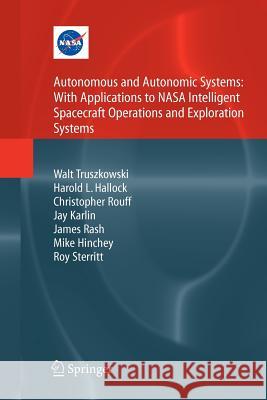
Walt Truszkowski; Harold Hallock; Christopher Rouff
Autonomous and Autonomic Systems: With Applications to NASA Intelligent Spacecraft Operations and Exploration Systems Walt Truszkowski Harold Hallock Christopher Rouff 9781447125266 Springer - książkaWidoczna okładka, to zdjęcie poglądowe, a rzeczywista szata graficzna może różnić się od prezentowanej.

Autonomous and Autonomic Systems: With Applications to NASA Intelligent Spacecraft Operations and Exploration Systems

ISBN-13: 9781447125266 / Angielski / Miękka / 2012 / 289 str.

Walt Truszkowski; Harold Hallock; Christopher Rouff
cena 887,69
(netto: 845,42 VAT:  5%)

Najniższa cena z 30 dni: 848,19
Termin realizacji zamówienia:
ok. 22 dni roboczych
Bez gwarancji dostawy przed świętami

Darmowa dostawa!

In the early 1990s, NASA Goddard Space Flight Center started researching and developing autonomous and autonomic ground and spacecraft control systems for future NASA missions. This research started by experimenting with and developing expert systems to automate ground station software and reduce the number of people needed to control a spacecraft. This was followed by research into agent-based technology to develop autonomous ground c- trol and spacecraft. Research into this area has now evolved into using the concepts of autonomic systems to make future space missions self-managing and giving them a high degree of survivability in the harsh environments in which they operate. This book describes much of the results of this research. In addition, it aimstodiscusstheneededsoftwaretomakefutureNASAspacemissionsmore completelyautonomousandautonomic.Thecoreofthesoftwareforthesenew missions has been written for other applications or is being applied gradually in current missions, or is in current development. It is intended that this book should document how NASA missions are becoming more autonomous and autonomic and should point to the way of making future missions highly - tonomous and autonomic. What is not covered is the supporting hardware of these missions or the intricate software that implements orbit and at- tude determination, on-board resource allocation, or planning and scheduling (though we refer to these technologies and give references for the interested reader).


Kategorie:
Technologie
Kategorie BISAC:
Technology & Engineering > Aeronautics & Astronautics
Computers > Artificial Intelligence - General
Computers > Computer Simulation
Wydawca:
Springer
Seria wydawnicza:
NASA Monographs in Systems and Software Engineering
Język:
Angielski
ISBN-13:
9781447125266
Rok wydania:
2012
Wydanie:
2010
Ilość stron:
289
Waga:
0.47 kg
Wymiary:
23.5 x 15.5
Oprawa:
Miękka
Wolumenów:
01
Dodatkowe informacje:
Glosariusz/słownik

From the reviews:

"Truszkowski (NASA Goddard Space Flight Center) and colleagues have documented how NASA missions have become and will become more autonomous and automatic. ... The authors present several top-level examples along with ... helpful flowcharts. ... A thorough glossary and nearly 200 references provide a good basis for diving into more depth with other resources. This book would be a start for someone who is developing autonomous and automatic systems. ... Summing Up: Recommended. Professional audiences." (D. B. Spencer, Choice, Vol. 47 (11), July, 2010)

Part I Background.- Introduction.- Direction of New Space Missions.- Automation vs. Autonomy Systems.- Autonomy vs. Automation.- Autonomicity vs. Autonomy.- Using Autonomy to Reduce the Cost of Missions.- Multi-Spacecraft Missions.- Communications Delays.- Interaction of Spacecraft.- Adjustable and Mixed Autonomy.- Agent Technologies.- Summary.- Overview of Flight and Ground Software.- Ground System Software.-Planning and Scheduling.- Command Loading.- Science Schedule Execution.- Science Support Activity Execution.- Onboard Engineering Support Activities.- Downlinked Data Capture.- Performance Monitoring.- Fault Diagnosis.- Fault Correction.- Downlinked Data Archiving.- Engineering Data Analysis/Calibration.- Flight Software (FSW).- Attitude Determination and Control, Sensor Calibration, Orbit Determination, Propulsion.- Executive and Task Management, Time Management, Command Processing, Engineering and Science Data Storage and Handling, Communications.- Electrical Power Management, Thermal Management, SI Commanding, SI Data Processing.- Data Monitoring, Fault Detection and Correction.- Safemode.- Flight vs. Ground Implementation.- Flight Autonomy Evolution.- Reasons for Flight Autonomy.- Satisfying Mission Objectives.- Satisfying Spacecraft Infrastructure Needs.- Satisfying Operations Staff Needs.- Brief History of Existing Flight Autonomy Capabilities.- 1970s and Prior Spacecraft.- 1980s Spacecraft.- 1990s Spacecraft.- Current Spacecraft.- Flight Autonomy Capabilities of the Future.- Current Levels of Flight Automation/Autonomy.- Ground Autonomy Evolution.- Agent-based Flight Operations Associate.- A Basic Agent Model in AFLOAT.- Implementation Architecture For ALFOAT Prototype.- The Human Computer Interface in AFLOAT.- Inter-agent Communications in AFLOAT.- Lights Out Ground Operations System.-The LOGOS Architecture.- An Example Scenario.- Agent Concept Testbed.-Overview of the ACT Agent Architecture.- Architecture Components.- Dataflow Between Components.- ACT Operational Scenario.- Verification & Correctness.- Part II Technology.- Core Technologies for Developing Autonomous and Autonomic Systems.- Plan Technologies.- Planners.- Collaborative Languages.- Reasoning with Partial Information.- Fuzzy Logic.- Bayesian Reasoning.- Learning Technologies.- Artificial Neural Networks.- Genetic Algorithms and Programming.- Act Technologies.- Perception Technologies.- Sensing.- Image and Signal Processing.- Data Fusion.- Testing Technologies.- Software Simulation Environments.-Simulation Libraries.- Simulation Servers.- Networked Simualtion Environments.- Agent-based Spacecraft Autonomy Design Concepts.- High Level Design Features.- Remote Agent Functionality.- Spacecraft Enabling Technologies.- AI Enabling Methodologies.- Advantages of Remote Agent Design.- Mission Types for Remote Agents.-Cooperative Autonomy.- Need for Cooperative Autonomy in Space Missions.- Quantities of Science Data.- Complexity of Scientific Instruments.- Increased Number of Spacecraft.- General Model of Cooperative Autonomy.- Autonomous Agents.- Agent Cooperation.- Cooperative Actions.- Spacecraft Mission Management.- Science Planning.- Mission Planning.- Sequence Planning.- Command Sequencer.- Science Data Processing.- Spacecraft Mission Viewed as Cooperative Autonomy.- Expanded Spacecraft Mission Model.- Analysis of Spacecraft Mission Model.- Improvements to Spacecraft Mission Execution.- An Example of Cooperative Autonomy: Virtual Platform.- Virtual Platforms under Current Environment.- Virtual Platforms with Advanced Automation.- Examples of Cooperative Autonomy.-The Mobile Robot Laboratory at Georgia Tech.- Cooperative Distributed Problem Solving Research Group at the University of Maine.- Knowledge Sharing Effort.- DIS and HLA.- IBM Aglets.- Autonomic Systems.- Overview of Autonomic Systems.- What are Autonomic Systems?.- Autonomic Properties.- Necessary Constructs.- Evolution versus Revolution.- State of the Art Research.- Machine Design.- Prediction and Optimization.- Knowledge Capture and Representation.- Monitoring and Root Cause Analysis.- Legacy Systems and Automatic Environments.- Space Systems.- Agents for Autonomic Systems.- Policy Based Management.- Related Initiatives.- Related Paradigms.- Research and Technology Transfer Issues.- Part III Applications.- Autonomy in Spacecraft Constellations.- Introduction.- Constellations Overview.- Advantages of Constellations.- Cost Savings.- Coordinated Science.- Applying Autonomy and Auntonomicity to Constellations.- Ground-based Constellation Autonomy.- Space-based Autonomy for Constellations.- Autonomicity in Constellations.- Intelligent Agents in Spacecraft Agents.- Multi-Agent Based Organizations for Satellites.- NASA Constellations.- Grand View.- Agent Development.- Ground-based Autonomy.- Space-based Autonomy.- Swarms in Space Missions.- Introduction to Swarms.- Swarm Technologies at NASA.- Other Applications of Swarms.- Autonomicity in Swarm Missions.- Software Development of Swarms.- Programming Techniques and Tools.- Verification.- Future Swarm Concepts.- Concluding Remarks.- Appendix A:Attitude and Orbit Determination and Control.- Appendix B:Operational Scenarios and Agent Interactions.- Onboard Remote Agent Interaction Scenario.- Space-to-ground Dialogue Scenario.- Ground-to-space Dialogue Scenario.- Spacecraft Constellation Interactions Scenario.- Agent-based Satellite Constellation Control Scenario.- Scenario Issues.- Acronyms.- Glossary.- References.- Index

Technologies enabling autonomous and autonomic behaviors of spacecraft have steadily progressed, but, as argued in this book, need to be extended much farther to enable success of the most advanced un-crewed space-mission concepts in the future.

This book describes these technologies and their relevance not only for NASA space missions that have flown, but also for advanced future mission concepts. Early parts of the book present general background information on space missions that have flown, including mission design and operations, followed by descriptions of future mission concepts, all in relation to autonomy and autonomic capabilities.

Readers will find chapters on flight and ground software and evolution of flight and ground autonomy, as well as chapters on technologies for developing autonomic systems, agent-based autonomy, cooperative autonomy, constellation missions, and swarm missions. One appendix covers spacecraft attitude and orbit determination and control, and a second appendix describes operational scenarios supported by agent interactions.

No specialized background is needed to absorb the material in this book. The material is relevant to students in aerospace science or engineering, and is a useful source of supplementary material for more advanced engineering courses.


Udostępnij

Facebook - konto krainaksiazek.pl


Opinie o Krainaksiazek.pl na Opineo.pl

Partner Mybenefit

Krainaksiazek.pl w programie rzetelna firma Krainaksiaze.pl - płatności przez paypal

Czytaj nas na:

Facebook - krainaksiazek.pl
  • książki na zamówienie
  • granty
  • książka na prezent
  • kontakt
  • pomoc
  • opinie
  • regulamin
  • polityka prywatności

Zobacz:

  • Księgarnia czeska

  • Wydawnictwo Książkowe Klimaty

1997-2025 DolnySlask.com Agencja Internetowa

© 1997-2022 krainaksiazek.pl
     
KONTAKT | REGULAMIN | POLITYKA PRYWATNOŚCI | USTAWIENIA PRYWATNOŚCI
Zobacz: Księgarnia Czeska | Wydawnictwo Książkowe Klimaty | Mapa strony | Lista autorów
KrainaKsiazek.PL - Księgarnia Internetowa

Polityka prywatnosci - link
Krainaksiazek.pl - płatnośc Przelewy24
Przechowalnia Przechowalnia





