• Wyszukiwanie zaawansowane
  • Kategorie
  • Kategorie BISAC
  • Książki na zamówienie
  • Promocje
  • Granty
  • Książka na prezent
  • Opinie
  • Pomoc
  • Załóż konto
  • Zaloguj się

Autonomous Trajectory Planning and Guidance Control for Launch Vehicles » książka


zaloguj się | załóż konto
Logo Krainaksiazek.pl

koszyk

konto

szukaj
topmenu
Księgarnia internetowa
Szukaj
Książki na zamówienie
Promocje
Granty
Książka na prezent
Moje konto
Pomoc
 
 
Wyszukiwanie zaawansowane
Pusty koszyk
Bezpłatna dostawa dla zamówień powyżej 20 złBezpłatna dostawa dla zamówień powyżej 20 zł

Kategorie główne

• Nauka
 [2949965]
• Literatura piękna
 [1857847]

  więcej...
• Turystyka
 [70818]
• Informatyka
 [151303]
• Komiksy
 [35733]
• Encyklopedie
 [23180]
• Dziecięca
 [617748]
• Hobby
 [139972]
• AudioBooki
 [1650]
• Literatura faktu
 [228361]
• Muzyka CD
 [398]
• Słowniki
 [2862]
• Inne
 [444732]
• Kalendarze
 [1620]
• Podręczniki
 [167233]
• Poradniki
 [482388]
• Religia
 [509867]
• Czasopisma
 [533]
• Sport
 [61361]
• Sztuka
 [243125]
• CD, DVD, Video
 [3451]
• Technologie
 [219309]
• Zdrowie
 [101347]
• Książkowe Klimaty
 [123]
• Zabawki
 [2362]
• Puzzle, gry
 [3791]
• Literatura w języku ukraińskim
 [253]
• Art. papiernicze i szkolne
 [7933]
Kategorie szczegółowe BISAC

Autonomous Trajectory Planning and Guidance Control for Launch Vehicles

ISBN-13: 9789819906123 / Angielski
Zhengyu Song; Dangjun Zhao; Stephan Theil
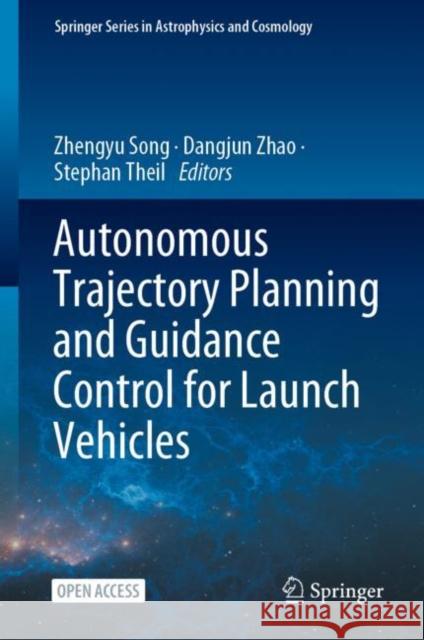
Autonomous Trajectory Planning and Guidance Control for Launch Vehicles Zhengyu Song Dangjun Zhao Stephan Theil 9789819906123 Springer - książkaWidoczna okładka, to zdjęcie poglądowe, a rzeczywista szata graficzna może różnić się od prezentowanej.

Autonomous Trajectory Planning and Guidance Control for Launch Vehicles

ISBN-13: 9789819906123 / Angielski

Zhengyu Song; Dangjun Zhao; Stephan Theil
cena 201,72 zł
(netto: 192,11 VAT:  5%)

Najniższa cena z 30 dni: 192,74 zł
Termin realizacji zamówienia:
ok. 22 dni roboczych
Bez gwarancji dostawy przed świętami

Darmowa dostawa!
inne wydania

This open access book highlights the autonomous and intelligent flight control of future launch vehicles for improving flight autonomy to plan ascent and descent trajectories onboard, and autonomously handle unexpected events or failures during the flight.Since the beginning of the twenty-first century, space launch activities worldwide have grown vigorously. Meanwhile, commercial launches also account for the booming trend. Unfortunately, the risk of space launches still exists and is gradually increasing in line with the rapidly rising launch activities and commercial rockets. In the history of space launches, propulsion and control systems are the two main contributors to launch failures. With the development of information technologies, the increase of the functional density of hardware products, the application of redundant or fault-tolerant solutions, and the improvement of the testability of avionics, the launch losses caused by control systems exhibit a downward trend, and the failures induced by propulsion systems become the focus of attention. Under these failures, the autonomous planning and guidance control may save the missions.This book focuses on the latest progress of relevant projects and academic studies of autonomous guidance, especially on some advanced methods which can be potentially real-time implemented in the future control system of launch vehicles. In Chapter 1, the prospect and technical challenges are summarized by reviewing the development of launch vehicles.  Chapters 2 to 4 mainly focus on the flight in the ascent phase, in which the autonomous guidance is mainly reflected in the online planning. Chapters 5 and 6 mainly discuss the powered descent guidance technologies. Finally, since aerodynamic uncertainties exert a significant impact on the performance of the ascent / landing guidance control systems, the estimation of aerodynamic parameters, which are helpful to improve flight autonomy, is discussed in Chapter 7.The book serves as a valuable reference for researchers and engineers working on launch vehicles. It is also a timely source of information for graduate students interested in the subject.


This open access book highlights the autonomous and intelligent flight control of future launch vehicles for improving flight autonomy to plan ascent and descent trajectories onboard, and autonomously handle unexpected events or failures during the flight. Since the beginning of the twenty-first century, space launch activities worldwide have grown vigorously. Meanwhile, commercial launches also account for the booming trend. Unfortunately, the risk of space launches still exists and is gradually increasing in line with the rapidly rising launch activities and commercial rockets. In the history of space launches, propulsion and control systems are the two main contributors to launch failures. With the development of information technologies, the increase of the functional density of hardware products, the application of redundant or fault-tolerant solutions, and the improvement of the testability of avionics, the launch losses caused by control systems exhibit a downward trend, and the failures induced by propulsion systems become the focus of attention. Under these failures, the autonomous planning and guidance control may save the missions. This book focuses on the latest progress of relevant projects and academic studies of autonomous guidance, especially on some advanced methods which can be potentially real-time implemented in the future control system of launch vehicles. In Chapter 1, the prospect and technical challenges are summarized by reviewing the development of launch vehicles.  Chapters 2 to 4 mainly focus on the flight in the ascent phase, in which the autonomous guidance is mainly reflected in the online planning. Chapters 5 and 6 mainly discuss the powered descent guidance technologies. Finally, since aerodynamic uncertainties exert a significant impact on the performance of the ascent / landing guidance control systems, the estimation of aerodynamic parameters, which are helpful to improve flight autonomy, is discussed in Chapter 7.  The book serves as a valuable reference for researchers and engineers working on launch vehicles. It is also a timely source of information for graduate students interested in the subject.  

Kategorie:
Nauka, Fizyka
Kategorie BISAC:
Science > Astronomia, przestrzeń i czas
Technology & Engineering > Aeronautics & Astronautics
Technology & Engineering > Automation
Wydawca:
Springer
Seria wydawnicza:
Springer Astrophysics and Cosmology
Język:
Angielski
ISBN-13:
9789819906123

Introduction

1 Review, Prospect and Technical Challenge of Launch Vehicle
2 Autonomous Guidance Control for Ascent Flight
3 Ascent Predictive Guidance for Thrust Drop Fault of Launch Vehicles Using Improved GS-MPSP
4 Birkhoff pseudospectral method and convex programming for trajectory optimization
5 Autonomous Descent Guidance via Sequential Pseudospectral Convex Programming
6 Simultaneous trajectory optimization for adaptive powered descent
7 Aerodynamic Parameter Estimation for Launch Vehicles
Conclusion

Detailed ToC in manuscript attached. 

Zhengyu Song

Dr. Zhengyu Song is a research fellow of China Academy of Launch Vehicle Technology. He is also an adjunct professor of the College of Control Science and Engineering, Zhejiang University, China. In 2016, he was elected an academician of the International Academy of Astronautics. He is currently the chief designer of China's Long March-8 Launch Vehicle. His research interests include autonomous and intelligent flight system design of launch vehicles.


Dangjun Zhao

Dangjun Zhao is currently a professor in the School of Automation, Central South University, China.  He received his Ph.D. in control science and engineering from Huazhong University of Science and Technology, Wuhan, China, in 2011. His research interests include intelligent perception, optimal control of spacecrafts, and unmanned system.


Stephan Theil

Dr. Stephan Theil is the head of GNC Systems department at DLR's Institute of Space Systems. He is a recognized expert in the field of spacecraft guidance, navigation, and control (GNC) and has been conducting research in spacecraft GNC for more than 25 years. He has led and worked on many projects in the areas of technologies for optical navigation of landing probes on moons, Mars, and asteroids; hybrid navigation for space transportation applications; and guidance and control for entry, descent and landing.

He has also authored and contributed to 140 publications in different fields of spacecraft GNC. As a recognized expert, he was appointed as a co-chair and chair of the Technical Committee on GNC of the Council of European Aerospace Societies (CEAS) from 2011 to 2019, a field editor for GNC of the CEAS Space Journal as well as technical committee member for the CEAS Specialist Conference on Guidance, Navigation & Control and the International ESA Conference on Guidance and Navigation Control Systems.

Additionally, Dr. Theil has taught several courses on space flight mechanics and GNC at the University of Bremen since 2001. He has supervised more than 60 Master’s and 15 Ph.D. students.

This open access book highlights the autonomous and intelligent flight control of future launch vehicles for improving flight autonomy to plan ascent and descent trajectories onboard, and autonomously handle unexpected events or failures during the flight.


Since the beginning of the twenty-first century, space launch activities worldwide have grown vigorously. Meanwhile, commercial launches also account for the booming trend. Unfortunately, the risk of space launches still exists and is gradually increasing in line with the rapidly rising launch activities and commercial rockets. In the history of space launches, propulsion and control systems are the two main contributors to launch failures. With the development of information technologies, the increase of the functional density of hardware products, the application of redundant or fault-tolerant solutions, and the improvement of the testability of avionics, the launch losses caused by control systems exhibit a downward trend, and the failures induced by propulsion systems become the focus of attention. Under these failures, the autunomous planning and guidance control may save the missions.


This book focuses on the latest progress of relevant projects and academic studies of autonomous guidance, especially on some advanced methods which can be potentially real-time implemented in the future control system of launch vehicles. In Chapter 1, the prospect and technical challenges are summarized by reviewing the development of launch vehicles.  Chapters 2 to 4 mainly focus on the flight in the ascent phase, in which the autonomous guidance is mainly reflected in the online planning. Chapters 5 and 6 mainly discuss the powered descent guidance technologies. Finally, since aerodynamic uncertainties exert a significant impact on the performance of the ascent / landing guidance control systems, the estimation of aerodynamic parameters, which are helpful to improve flight autonomy, is discussed in Chapter 7.


The book serves as a valuable reference for researchers and engineers working on launch vehicles. It is also a timely source of information for graduate students interested in the subject. 



Udostępnij

Facebook - konto krainaksiazek.pl


Opinie o Krainaksiazek.pl na Opineo.pl

Partner Mybenefit

Krainaksiazek.pl w programie rzetelna firma Krainaksiaze.pl - płatności przez paypal

Czytaj nas na:

Facebook - krainaksiazek.pl
  • książki na zamówienie
  • granty
  • książka na prezent
  • kontakt
  • pomoc
  • opinie
  • regulamin
  • polityka prywatności

Zobacz:

  • Księgarnia czeska

  • Wydawnictwo Książkowe Klimaty

1997-2025 DolnySlask.com Agencja Internetowa

© 1997-2022 krainaksiazek.pl
     
KONTAKT | REGULAMIN | POLITYKA PRYWATNOŚCI | USTAWIENIA PRYWATNOŚCI
Zobacz: Księgarnia Czeska | Wydawnictwo Książkowe Klimaty | Mapa strony | Lista autorów
KrainaKsiazek.PL - Księgarnia Internetowa

Polityka prywatnosci - link
Krainaksiazek.pl - płatnośc Przelewy24
Przechowalnia Przechowalnia



