• Wyszukiwanie zaawansowane
  • Kategorie
  • Kategorie BISAC
  • Książki na zamówienie
  • Promocje
  • Granty
  • Książka na prezent
  • Opinie
  • Pomoc
  • Załóż konto
  • Zaloguj się

Autonomous Microwave Circuits » książka

zaloguj się | załóż konto
Logo Krainaksiazek.pl

koszyk

konto

szukaj
topmenu
Księgarnia internetowa
Szukaj
Książki na zamówienie
Promocje
Granty
Książka na prezent
Moje konto
Pomoc
 
 
Wyszukiwanie zaawansowane
Pusty koszyk
Bezpłatna dostawa dla zamówień powyżej 20 złBezpłatna dostawa dla zamówień powyżej 20 zł

Kategorie główne

• Nauka
 [2949965]
• Literatura piękna
 [1857847]

  więcej...
• Turystyka
 [70818]
• Informatyka
 [151303]
• Komiksy
 [35733]
• Encyklopedie
 [23180]
• Dziecięca
 [617748]
• Hobby
 [139972]
• AudioBooki
 [1650]
• Literatura faktu
 [228361]
• Muzyka CD
 [398]
• Słowniki
 [2862]
• Inne
 [444732]
• Kalendarze
 [1620]
• Podręczniki
 [167233]
• Poradniki
 [482388]
• Religia
 [509867]
• Czasopisma
 [533]
• Sport
 [61361]
• Sztuka
 [243125]
• CD, DVD, Video
 [3451]
• Technologie
 [219309]
• Zdrowie
 [101347]
• Książkowe Klimaty
 [123]
• Zabawki
 [2362]
• Puzzle, gry
 [3791]
• Literatura w języku ukraińskim
 [253]
• Art. papiernicze i szkolne
 [7933]
Kategorie szczegółowe BISAC

Autonomous Microwave Circuits

ISBN-13: 9780470050743 / Angielski / Twarda / 2009 / 704 str.
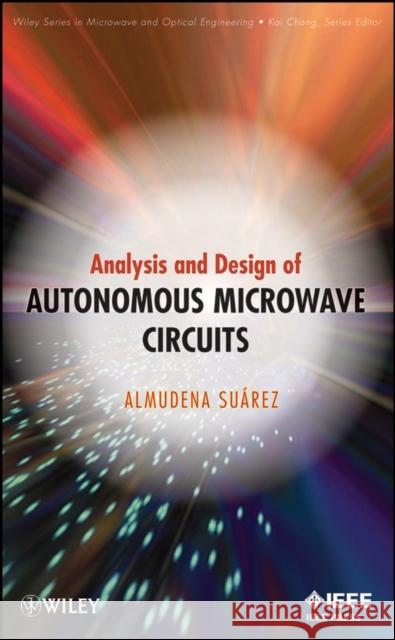
Almudena Suarez
Autonomous Microwave Circuits Suarez, Almudena 9780470050743 IEEE Computer Society Press - książkaWidoczna okładka, to zdjęcie poglądowe, a rzeczywista szata graficzna może różnić się od prezentowanej.

Autonomous Microwave Circuits

ISBN-13: 9780470050743 / Angielski / Twarda / 2009 / 704 str.

Almudena Suarez
cena 867,48 zł
(netto: 826,17 VAT:  5%)

Najniższa cena z 30 dni: 858,61 zł
Termin realizacji zamówienia:
ok. 30 dni roboczych
Bez gwarancji dostawy przed świętami

Darmowa dostawa!

Presents simulation techniques that substantially increase designers' control over the oscillationin autonomous circuits This book facilitates a sound understanding of the free-running oscillation mechanism, the start-up from the noise level, and the establishment of the steady-state oscillation. It deals with the operation principles and main characteristics of free-running and injection-locked oscillators, coupled oscillators, and parametric frequency dividers. Analysis and Design of Autonomous Microwave Circuits provides:

  • An exploration of the main nonlinear-analysis methods, with emphasis on harmonic balance and envelope transient methods
  • Techniques for the efficient simulation of the most common autonomous regimes
  • A presentation and comparison of the main stability-analysis methods in the frequency domain
  • A detailed examination of the instabilization mechanisms that delimit the operation bands of autonomous circuits
  • Coverage of techniques used to eliminate common types of undesired behavior, such as spurious oscillations, hysteresis, and chaos
  • A thorough presentation of the oscillator phase noise
  • A comparison of the main methodologies of phase-noise analysis
  • Techniques for autonomous circuit optimization, based on harmonic balance
  • A consideration of different design objectives: presetting the oscillation frequency and output power, increasing efficiency, modifying the transient duration, and imposing operation bands
Analysis and Design of Autonomous Microwave Circuits is a valuable resource for microwave designers, oscillator designers, and graduate students in RF microwave design.

Kategorie:
Technologie
Kategorie BISAC:
Technology & Engineering > Microwaves
Technology & Engineering > Electronics - Circuits - General
Wydawca:
IEEE Computer Society Press
Seria wydawnicza:
Wiley Series in Microwave and Optical Engineering
Język:
Angielski
ISBN-13:
9780470050743
Rok wydania:
2009
Numer serii:
000210177
Ilość stron:
704
Waga:
1.03 kg
Wymiary:
23.11 x 16.26 x 3.81
Oprawa:
Twarda
Wolumenów:
01

Preface.

1. Oscillator Dynamics.

1.1. Introduction.

1.2. Operational Principle of Free–Running Oscillators.

1.3. Impedance–Admittance Analysis of an Oscillator.

1.4. Frequency–Domain Formulation of an Oscillator Circuit.

1.5. Oscillator Dynamics.

1.6. Phase Noise.

2. Phase Noise.

2.1. Introduction.

2.2. Random Variable and random Processes.

2.3. Noise Sources in Electronic Circuits.

2.4. Derivation of the Oscillator Noise Spectrum Using Time–Domain Analysis.

2.5. Frequency–Domain Analysis of a Noisy Oscillator.

3. Bifurcation Analysis.

3.1. Introduction.

3.2. Representation of Solutions.

3.3. Bifurcations.

4. Injected Oscillators and Frequency Dividers.

4.1. Introduction.

4.2. Injection–Locked Oscillators.

4.3. Frequency Dividers.

4.4. Subharmonically and Ultrasubharmonically Injection–Locked Oscillators.

4.5. Self–Oscillating  Mixers.

5. Nonlinear Circuit Simulation.

5.1. Introduction.

5.2. Time–Domain Integration.

5.3. Fast Time–Domain Techniques.

5.4. Harmonic Balance.

5.5. Harmonic Balance Analysis of Autonomous and Synchronized Circuit.

5.6. Envelope Transient.

5.7. Conversion Matrix Approach.

6. Stability Analysis Using Harmonic Balance.

6.1. Introduction.

6.2. Local Stability Analysis.

6.3. Stability Analysis of Free–Running Oscillators.

6.4. Solution Curves Versus a Circuit Parameter.

6.5.Global Stability Analysis.

6.6. Bifurcation Synthesis and Control.

7. Noise Analysis Using Harmonic Balance.

7.1. Introduction.

7.2. Noise in Semiconductor Devices.

7.3. Decoupled Analysis of Phase and Amplitude Perturbations in a Harmonic Balance System.

7.4. Coupled Phase and Amplitude Noise Calculation.

7.5. Carrier Modulation Approach.

7.6. Conversion Matrix Approach.

7.7. Noise in Synchronized Oscillators.

8. Harmonic Balance Techniques for Oscillator Design.

8.1. Introduction.

8.2. Oscillator Synthesis.

8.3. Design of Voltage–Controlled Oscillators.

8.4. Maximization of Oscillator Efficiency.

8.5. Control of Oscillator Transients.

8.6. Phase Noise Reduction.

9. Stabilization Techniques for Phase Noise Reduction.

9.1. Introduction.

9.2. Self–Injection Topology.

9.3. Use of High–Q Resonators.

9.4. Stabilization Loop.

9.5. Transistor–Based Oscillators.

10. Coupled–Oscillator Systems.

10.1. Introduction.

10.2. Oscillator Systems with Global Coupling.

10.3. Coupled–Oscillator Systems for Beam Steering.

11. Simulation Techniques for Frequency–Divider Design.

11.1. Introduction.

11.2. Types of frequency dividers.

11.3. Design of Transistor–Based Regenerative Frequency Dividers.

11.4. Design of Harmonic Injection Dividers.

11.5. Extension of the Techniques to Subharmonic Injection Oscillators.

12. Circuit Stabilization.

12.1. Introduction.

12.2. Unstable Class AB Amplifier Using Power Combiners.

12.3. Unstable Class E/F Amplifier.

12.4. Unstable Class E Amplifier.

12.5. Stabilization of Oscillator Circuits.

12.6. Stabilization of Multifunction MMIC Chips.

Index.

Almudena Suárez, PhD, is a Full Professor at the University of Cantabria, Spain, and a member of its Communications Engineering Department since 1993. She coauthored the book Stability Analysis of Nonlinear Microwave Circuits and contributed two articles to the Encyclopedia of RF and Microwave Engineering (Wiley). Professor Suárez has published dozens of papers in international journals and has been the leading researcher in several R&D projects. Her areas of interest include the nonlinear design of microwave circuits and, especially, stability and phase–noise analysis. She is a Distinguished Microwave Lecturer of IEEE.

Presents simulation techniques that substantially increase designers′ control over the oscillationin autonomous circuits

This book facilitates a sound understanding of the free–running oscillation mechanism, the start–up from the noise level, and the establishment of the steady–state oscillation. It deals with the operation principles and main characteristics of free–running and injection–locked oscillators, coupled oscillators, and parametric frequency dividers.

Analysis and Design of Autonomous Microwave Circuits provides:

  • An exploration of the main nonlinear–analysis methods, with emphasis on harmonic balance and envelope transient methods

  • Techniques for the efficient simulation of the most common autonomous regimes

  • A presentation and comparison of the main stability–analysis methods in the frequency domain

  • A detailed examination of the instabilization mechanisms that delimit the operation bands of autonomous circuits

  • Coverage of techniques used to eliminate common types of undesired behavior, such as spurious oscillations, hysteresis, and chaos

  • A thorough presentation of the oscillator phase noise

  • A comparison of the main methodologies of phase–noise analysis

  • Techniques for autonomous circuit optimization, based on harmonic balance

  • A consideration of different design objectives: presetting the oscillation frequency and output power, increasing efficiency, modifying the transient duration, and imposing operation bands


Analysis and Design of Autonomous Microwave Circuits is a valuable resource for microwave designers, oscillator designers, and graduate students in RF microwave design.


Udostępnij

Facebook - konto krainaksiazek.pl


Opinie o Krainaksiazek.pl na Opineo.pl

Partner Mybenefit

Krainaksiazek.pl w programie rzetelna firma Krainaksiaze.pl - płatności przez paypal

Czytaj nas na:

Facebook - krainaksiazek.pl
  • książki na zamówienie
  • granty
  • książka na prezent
  • kontakt
  • pomoc
  • opinie
  • regulamin
  • polityka prywatności

Zobacz:

  • Księgarnia czeska

  • Wydawnictwo Książkowe Klimaty

1997-2025 DolnySlask.com Agencja Internetowa

© 1997-2022 krainaksiazek.pl
     
KONTAKT | REGULAMIN | POLITYKA PRYWATNOŚCI | USTAWIENIA PRYWATNOŚCI
Zobacz: Księgarnia Czeska | Wydawnictwo Książkowe Klimaty | Mapa strony | Lista autorów
KrainaKsiazek.PL - Księgarnia Internetowa

Polityka prywatnosci - link
Krainaksiazek.pl - płatnośc Przelewy24
Przechowalnia Przechowalnia






