Atlas ICBM Missile Weapon System Technical Manual » książka





Atlas ICBM Missile Weapon System Technical Manual
ISBN-13: 9781937684907 / Angielski / Miękka / 2011 / 592 str.
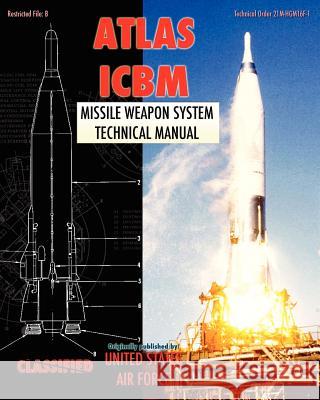
Atlas ICBM Missile Weapon System Technical Manual
ISBN-13: 9781937684907 / Angielski / Miękka / 2011 / 592 str.
(netto: 179,32 VAT: 5%)
Najniższa cena z 30 dni: 187,24
ok. 16-18 dni roboczych.
Darmowa dostawa!
The first ICBM to be developed and deployed by the United States, the Atlas had a range of 5500 nautical miles and could achieve a speed of 15,500 mph. Depending on configuration, it could be equipped with either a W-49 (1.45 megaton) or W-38 (4.5 megaton) thermonuclear warhead. The Atlas' development can be traced to a series of research and development studies performed in the wake of WWII by the Convair company. These led to the company winning a contract in 1951 for a long range missile. The three-engine XSM-65A design that eventually emerged featured a thin skin, inflated by internal fuel pressure like a balloon, and had "one and a half" stages. In this configuration, both the main booster and sustainer engines ignited at lift-off, with the boosters dropped in flight. (This unique feature was intended to make certain the sustainer engine could fire at high altitudes, something later determined to not be a problem). The missile burned kerosene and liquid oxygen fuel, and relied on a radio-command / inertial guidance system. After some teething problems including the loss of the prototype Atlas, the missile flew successfully on December 17, 1957. A little under two years later, the first USAF Atlas ICBM squadron consisting of three missiles on unprotected pads was activated at Vandenburg AFB. Subsequent deployments featured hardened "coffins" in which the missile would be stored horizontally. After a launch order was issued, the Atlas would be raised, fueled, and launched - a hazardous process that took about fifteen minutes. The system's inherent vulnerability and long reaction time eventually led the Air Force to construct silos similar to those used with the Titan I, which lowered the response time considerably. The use of volatile fuel mixtures in the confined silo environment proved to be extremely dangerous however, and led to four catastrophic accidents. As second generation missiles came on the scene such as the Titan II and Minuteman, Atlas became obsolete. By April 1965, all Atlas ICBMs were phased out. At the peak 129 of the missiles were deployed, and nearly 350 were built during the program. Many of these would be recycled as launch vehicles for satellites. Notably, members of the Atlas family placed four of America's Mercury astronauts in orbit. Created by the Air Force for the men who stood "on alert" with the Atlas, this technical manual contains descriptions of the HGM-16F missile, launch complex, handling and transport, checkout and launch operations, emergency procedures, and more. Originally restricted, it has been declassified and is reprinted here in book form. Some portions have been reformatted, but care has been taken to preserve the integrity of the text.
The first ICBM to be developed and deployed by the United States, the Atlas had a range of 5500 nautical miles and could achieve a speed of 15,500 mph. Depending on configuration, it could be equipped with either a W-49 (1.45 megaton) or W-38 (4.5 megaton) thermonuclear warhead. The Atlas development can be traced to a series of research and development studies performed in the wake of WWII by the Convair company. These led to the company winning a contract in 1951 for a long range missile. The three-engine XSM-65A design that eventually emerged featured a thin skin, inflated by internal fuel pressure like a balloon, and had "one and a half" stages. In this configuration, both the main booster and sustainer engines ignited at lift-off, with the boosters dropped in flight. (This unique feature was intended to make certain the sustainer engine could fire at high altitudes, something later determined to not be a problem). The missile burned kerosene and liquid oxygen fuel, and relied on a radio-command / inertial guidance system. After some teething problems including the loss of the prototype Atlas, the missile flew successfully on December 17, 1957. A little under two years later,the first USAF Atlas ICBM squadron consisting of three missiles on unprotected pads was activated at Vandenburg AFB. Subsequent deployments featured hardened "coffins" in which the missile would be stored horizontally. After a launch order was issued, the Atlas would be raised, fueled, and launched - a hazardous process that took about fifteen minutes. The systems inherent vulnerability and long reaction time eventually led the Air Force to construct silos similar to those used with the Titan I, which lowered the response time considerably. The use of volatile fuel mixtures in the confined silo environment proved to be extremely dangerous however, and led to four catastrophic accidents. As second generation missiles came on the scene such as the Titan II and Minuteman, Atlas became obsolete. By April 1965, all Atlas ICBMs were phased out. At the peak 129 of the missiles were deployed, and nearly 350 were built during the program. Many of these would be recycled as launch vehicles for satellites. Notably, members of the Atlas family placed four of Americas Mercury astronauts in orbit.Created by the Air Force for the men who stood "on alert" with the Atlas, this technical manual contains descriptions of the HGM-16F missile, launch complex, handling and transport, checkout and launch operations, emergency procedures, and more. Originally restricted, it has been declassified and is reprinted here in book form. Some portions have been reformatted, but care has been taken to preserve the integrity of the text.




Czytaj nas na:
KrainaKsiazek.PL - Księgarnia Internetowa


