• Wyszukiwanie zaawansowane
  • Kategorie
  • Kategorie BISAC
  • Książki na zamówienie
  • Promocje
  • Granty
  • Książka na prezent
  • Opinie
  • Pomoc
  • Załóż konto
  • Zaloguj się

Astronomy Explained » książka


zaloguj się | załóż konto
Logo Krainaksiazek.pl

koszyk

konto

szukaj
topmenu
Księgarnia internetowa
Szukaj
Książki na zamówienie
Promocje
Granty
Książka na prezent
Moje konto
Pomoc
 
 
Wyszukiwanie zaawansowane
Pusty koszyk
Bezpłatna dostawa dla zamówień powyżej 20 złBezpłatna dostawa dla zamówień powyżej 20 zł

Kategorie główne

• Nauka
 [2946912]
• Literatura piękna
 [1852311]

  więcej...
• Turystyka
 [71421]
• Informatyka
 [150889]
• Komiksy
 [35717]
• Encyklopedie
 [23177]
• Dziecięca
 [617324]
• Hobby
 [138808]
• AudioBooki
 [1671]
• Literatura faktu
 [228371]
• Muzyka CD
 [400]
• Słowniki
 [2841]
• Inne
 [445428]
• Kalendarze
 [1545]
• Podręczniki
 [166819]
• Poradniki
 [480180]
• Religia
 [510412]
• Czasopisma
 [525]
• Sport
 [61271]
• Sztuka
 [242929]
• CD, DVD, Video
 [3371]
• Technologie
 [219258]
• Zdrowie
 [100961]
• Książkowe Klimaty
 [124]
• Zabawki
 [2341]
• Puzzle, gry
 [3766]
• Literatura w języku ukraińskim
 [255]
• Art. papiernicze i szkolne
 [7810]
Kategorie szczegółowe BISAC

Astronomy Explained

ISBN-13: 9783540761365 / Angielski / Miękka / 1997 / 330 str.
Gerald North
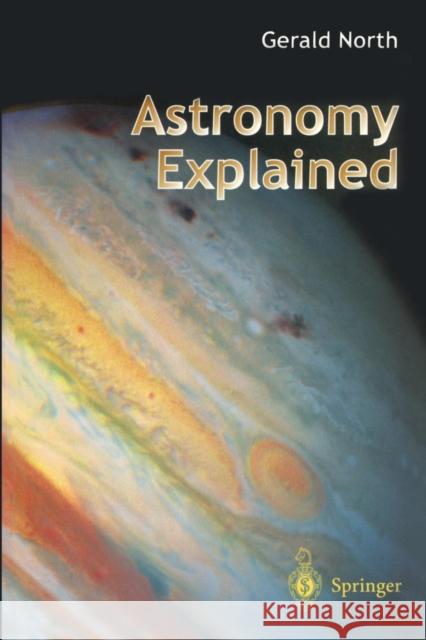
Astronomy Explained Gerald North   9783540761365 Springer-Verlag Berlin and Heidelberg GmbH &  - książkaWidoczna okładka, to zdjęcie poglądowe, a rzeczywista szata graficzna może różnić się od prezentowanej.

Astronomy Explained

ISBN-13: 9783540761365 / Angielski / Miękka / 1997 / 330 str.

Gerald North
cena 201,72
(netto: 192,11 VAT:  5%)

Najniższa cena z 30 dni: 192,74
Termin realizacji zamówienia:
ok. 22 dni roboczych
Bez gwarancji dostawy przed świętami

Darmowa dostawa!

Every year large numbers of people take up the study of astronomy, mostly at amateur level. There are plenty of elementary books on the market, full of colourful photographs, but lacking in proper explanations of how and why things are as they are. Many people eventually wish to go beyond the 'coffee-table book' stage and study this fascinating subject in greater depth. This book is written for them. In addition, many people sit for public examinations in this subject each year and this book is also intended to be of use to them. All the topics from the GCSE syllabus are covered here, with sample questions at the end of each chapter. Astronomy Explained provides a comprehensive treatment of the subject in more depth than is usually found in elementary works, and will be of interest to both amateur astronomers and students of astronomy.


Kategorie:
Nauka, Fizyka
Kategorie BISAC:
Science > Astronomia, przestrzeń i czas
Science > Astrofizyka
Wydawca:
Springer-Verlag Berlin and Heidelberg GmbH &
Język:
Angielski
ISBN-13:
9783540761365
Rok wydania:
1997
Wydanie:
1997
Ilość stron:
330
Waga:
0.64 kg
Wymiary:
23.55 x 15.77 x 1.88
Oprawa:
Miękka
Wolumenów:
01
Dodatkowe informacje:
Glosariusz/słownik
Wydanie ilustrowane

"Since this book has been on my shelf, I have used it as a first port of call when I needed a concise explanation of a topic. I have yet to have to put it down and use another text." Astronomy Now

1 The Celestial Sphere.- 1.1 The Concept of the Celestial Sphere.- 1.2 Latitude and Longitude.- 1.3 Declination and Right Ascension.- 1.4 The Altitude of the Celestial Equator and Poles.- 1.5 The Starry Vault.- 1.6 A Better Definition of Right Ascension.- 1.7 To Calculate the Maximum Altitude of a Star.- 1.8 Circumpolar Stars.- 1.9 Stars that Never Rise.- 1.10 Azimuth.- 1.11 The Earth in Space.- 1.12 The Seasons.- 1.13 The Moon and the Celestial Sphere.- 1.14 The Solar System and the Celestial Sphere.- 1.15 Stellar Motions.- 1.16 Precession.- Questions.- 2 The Earth and Time.- 2.1 The Shape and Size of the Earth.- 2.2 The Earth in the Solar System.- 2.3 The Structure of the Earth.- 2.4 The Surface Conditions on the Earth.- 2.5 The Atmosphere of the Earth.- 2.6 The Ionosphere.- 2.7 The Terrestrial Magnetosphere.- 2.8 The Van Allen Radiation Zones.- 2.9 The Aurorae.- 2.10 The Need for Time Measurement.- 2.11 Calendars.- 2.12 The Solar Day.- 2.13 Universal Time.- 2.14 Time Zones.- 2.15 Hour Angle.- 2.16 The Sidereal Day.- 2.17 A Fundamental Equation.- 2.18 The Measurement of Time.- Questions.- 3 The Telescope.- 3.1 Chromatic Aberration.- 3.2 The Achromatic Objective.- 3.3 Light Grasp and Resolving power.- 3.4 Eyepieces and Magnification.- 3.5 The Effects of Magnification on the Image.- 3.6 The Limitations Caused by the Earth’s Atmosphere.- 3.7 The Reflecting Telescope.- 3.8 Spherical Aberration.- 3.9 The Development of the Reflector.- 3.10 Telescope Mountings.- 3.11 The Schmidt Camera.- Questions.- 4 Modern Developments in Instrumentation.- 4.1 The Photographic Plate.- 4.2 The Photomultiplier.- 4.3 Electronic Imaging.- 4.4 Getting More Resolution.- 4.5 The Latest Generation of Optical Telescopes.- 4.6 The Radio Telescope.- 4.7 Astronomy at Other Wavelengths.- 4.8 Astronomy Above the Ground.- Questions.- 5 Gravitation.- 5.1 Kepler’s Laws of Planetary Motion.- 5.2 Newton’s Law of Gravitation.- 5.3 Circular Motion.- 5.4 Mathematical Derivation of Kepler’s Third law.- 5.5 Two-Body Orbiting Systems.- 5.6 The Tides.- 5.7 The Measurement of the Astronomical Unit.- 5.8 The Earth’s Gravitational Field.- 5.9 The Acceleration Due to Gravity.- 5.10 Rockets and Satellites.- Questions.- 6 The Moon.- 6.1 The Nature and Origin of the Moon.- 6.2 The Orbit and Phases of the Moon.- 6.3 Lunar Eclipses.- 6.4 The Saros.- 6.5 Libration.- 6.6 The Measurement of the Moon’s Distance.- 6.7 The Selenographers.- 6.8 Lunar Probes and Man on the Moon.- 6.9 The Moon’s Appearance.- 6.10 Surface Conditions.- 6.11 The Structure and Evolution of the Moon.- 6.12 Transient Lunar Phenomena.- Questions.- 7 The Inferior Planets.- 7.1 Stellar and Planetary Brightnesses.- 7.2 The Orbit and Phases of Mercury.- 7.3 Mercury’s Telescopic Appearance.- 7.4 The Rotation Rate of Mercury.- 7.5 Mariner 10.- 7.6 Comparison Between Mercury and the Moon.- 7.7 The Caloris Basin.- 7.8 The Surface Conditions on Mercury.- 7.9 The Orbit and Phases of Venus.- 7.10 Venus’s Telescopic Appearance.- 7.11 The Size and Nature of Venus.- 7.12 Spacecraft to Venus.- 7.13 Venus — a Volcanic Planet.- 7.14 Magellan and Yet More Mysteries.- 7.15 The Earth and Venus — Worlds Apart.- 7.16 The Greenhouse Effect — a Difference in Evolution.- Questions.- 8 The Planet Mars.- 8.1 Oppositions.- 8.2 The Path of Mars Across the Celestial Sphere.- 8.3 The Telescopic Appearance of Mars.- 8.4 The Martian Atmosphere.- 8.5 The Canals of Mars.- 8.6 Early Space Probes to Mars.- 8.7 Later Space Probes to Mars.- 8.8 Vikings to Mars.- 8.9 Life on Mars.- 8.10 Phobos and Deimos.- Questions.- 9 The Planet Jupiter.- 9.1 The Telescopic Appearance of Jupiter.- 9.2 Transient Features.- 9.3 The Great Red Spot.- 9.4 Pioneers 10 and 11.- 9.5 The Voyager Missions.- 9.6 Collision with a Comet.- 9.7 Galileo Enters the Jovian Atmosphere.- 9.8 The Structure of Jupiter.- 9.9 Jupiter’s Magnetosphere.- 9.10 Radiation Belts.- 9.11 Radio Emissions.- 9.12 The Satellites.- 9.13 Io.- 9.14 Europa.- 9.15 Ganymede.- 9.16 Callisto.- 9.17 The Rings of Jupiter.- Questions.- 10 The Planet Saturn.- 10.1 The Telescopic Appearance of Saturn.- 10.2 Spacecraft to Saturn.- 10.3 The Atmosphere of Saturn.- 10.4 The Structure of Saturn.- 10.5 Saturn’s Magnetosphere.- 10.6 The Rings of Saturn.- 10.7 Voyager — a Detailed Look at the Rings.- 10.8 The Formation of Planetary Rings.- 10.9 The Satellites of Saturn.- 10.10 Titan.- Questions.- 11 The Twilight Zone of the Solar System.- 11.1 The Planet Uranus.- 11.2 Voyager to Uranus.- 11.3 The Satellites of Uranus.- 11.4 The Planet Neptune.- 11.5 Voyager at Neptune.- 11.6 Neptune’s Rings and Satellites.- 11.7 The Planet Pluto.- Questions.- 12 The Debris of the Solar System.- 12.1 The Formation of the Solar System.- 12.2 Planetary Cratering.- 12.3 Bode’s Law.- 12.4 The Celestial Police.- 12.5 The Asteroids.- 12.6 Meteors.- 12.7 Meteorites.- 12.8 The Breakdown of Bode’s Law.- Questions.- 13 The Comets.- 13.1 Comet Orbits.- 13.2 The Structure of a Comet.- 13.3 A Comet’s tail.- 13.4 The Hydrogen Cloud.- 13.5 A Comet’s Coma.- 13.6 A Comet’s Nucleus.- 13.7 Cometary Debris.- 13.8 Spacecraft to Halley’s Comet.- 13.9 The Origins of the Comets.- Questions.- 14 The Sun.- 14.1 The Size and Composition of the Sun.- 14.2 The Absolute Scale of Temperature.- 14.3 The Structure of the Sun.- 14.4 Solar Eclipses.- 14.5 The Photosphere.- 14.6 The Solar Magnetosphere.- 14.7 The Sun’s Internal Rotation.- 14.8 Sunspots and Faculae.- 14.9 The Chromosphere.- 14.10 Prominences and Filaments.- 14.11 The Solar Corona.- 14.12 Solar Flares and the Solar Wind.- 14.13 The Sun’s Energy Source.- Questions.- 15 Electromagnetic Radiation.- 15.1 The Electromagnetic Spectrum.- 15.2 Black-Body Radiation.- 15.3 The Beginnings of Spectroscopy.- 15.4 The Production of Spectra.- 15.5 Types of Spectra.- 15.6 The Development of Astronomical Spectroscopy.- 15.7 Modern Spectroscopy.- Questions.- 16 The Star.- 16.1 The Natures and Brightnesses of the Stars.- 16.2 The Distances of the Stars.- 16.3 Absolute Magnitude and Distance Modulus.- 16.4 Star Colours.- 16.5 The Constellations.- 16.6 Stellar Spectra.- 16.7 The Sun — a Star Among Stars.- 16.8 The Hertzsprung-Russell Diagram.- 16.9 The Motions of the Stars.- 16.10 Binary Stars and Stellar Masses.- Questions.- 17 Gas, Dust, Stars and Variable Stars.- 17.1 When Astronomers Got It Wrong.- 17.2 The Interstellar Medium.- 17.3 Gaseous Nebulae.- 17.4 Stellar Birthplaces.- 17.5 Stellar Birth and Infancy.- 17.6 Extrinsic Variable Stars.- 17.7 Intrinsic Variable Stars.- 17.8 Shells Around Stars.- Questions.- 18 Stellar Evolution.- 18.1 The Main Sequence Phase.- 18.2 The Fate of a Low-Mass Star.- 18.3 The Evolution of a Star Like the Sun.- 18.4 The Evolution of a Massive Star.- 18.5 Neutron Stars.- 18.6 The Evolution of Binary Star Systems.- Questions.- 19 Brown Dwarfs and Extra-solar Planets.- 19.1 Early Mistakes.- 19.2 HD.- 19.3 A Definite Brown Dwarf.- 19.4 PSR.- 19.5 51 Pegasi.- 19.6 47 Ursae Majoris.- 19.7 70 Virginis.- 19.8 Rho Cancri.- 19.9 Lalande.- Questions.- >20 Violent Stars.- 20.1 Novae.- 20.2 Supernovae.- 20.3 Stellar Populations.- 20.4 Black Holes.- Questions.- 21 The Galaxies.- 21.1 The Shape and Size of Our Galaxy.- 21.2 Other Galaxies.- 21.3 The Structure of Our Galaxy.- 21.4 Galactic, Morphology.- 21.5 The Formation and Evolution of Galaxies.- 21.6 Groups of Galaxies.- 21.7 The Expansion of the Universe.- Questions.- 22 Quasars, Active Galaxies and Cosmology.- 22.1 Quasars.- 22.2 Active Galaxies.- 22.3 Black Holes, Accretion Disks, Jets and Cosmic Chameleons.- 22.4 Cosmology.- 22.5 Where Will It All End.- Questions.- Glossary of Terms.- Answers to the Numerical 1.1 Questions.


Udostępnij

Facebook - konto krainaksiazek.pl


Opinie o Krainaksiazek.pl na Opineo.pl

Partner Mybenefit

Krainaksiazek.pl w programie rzetelna firma Krainaksiaze.pl - płatności przez paypal

Czytaj nas na:

Facebook - krainaksiazek.pl
  • książki na zamówienie
  • granty
  • książka na prezent
  • kontakt
  • pomoc
  • opinie
  • regulamin
  • polityka prywatności

Zobacz:

  • Księgarnia czeska

  • Wydawnictwo Książkowe Klimaty

1997-2025 DolnySlask.com Agencja Internetowa

© 1997-2022 krainaksiazek.pl
     
KONTAKT | REGULAMIN | POLITYKA PRYWATNOŚCI | USTAWIENIA PRYWATNOŚCI
Zobacz: Księgarnia Czeska | Wydawnictwo Książkowe Klimaty | Mapa strony | Lista autorów
KrainaKsiazek.PL - Księgarnia Internetowa

Polityka prywatnosci - link
Krainaksiazek.pl - płatnośc Przelewy24
Przechowalnia Przechowalnia





