• Wyszukiwanie zaawansowane
  • Kategorie
  • Kategorie BISAC
  • Książki na zamówienie
  • Promocje
  • Granty
  • Książka na prezent
  • Opinie
  • Pomoc
  • Załóż konto
  • Zaloguj się

Astronomical Origins of Life: Steps Towards Panspermia » książka


zaloguj się | załóż konto
Logo Krainaksiazek.pl

koszyk

konto

szukaj
topmenu
Księgarnia internetowa
Szukaj
Książki na zamówienie
Promocje
Granty
Książka na prezent
Moje konto
Pomoc
 
 
Wyszukiwanie zaawansowane
Pusty koszyk
Bezpłatna dostawa dla zamówień powyżej 20 złBezpłatna dostawa dla zamówień powyżej 20 zł

Kategorie główne

• Nauka
 [2946912]
• Literatura piękna
 [1852311]

  więcej...
• Turystyka
 [71421]
• Informatyka
 [150889]
• Komiksy
 [35717]
• Encyklopedie
 [23177]
• Dziecięca
 [617324]
• Hobby
 [138808]
• AudioBooki
 [1671]
• Literatura faktu
 [228371]
• Muzyka CD
 [400]
• Słowniki
 [2841]
• Inne
 [445428]
• Kalendarze
 [1545]
• Podręczniki
 [166819]
• Poradniki
 [480180]
• Religia
 [510412]
• Czasopisma
 [525]
• Sport
 [61271]
• Sztuka
 [242929]
• CD, DVD, Video
 [3371]
• Technologie
 [219258]
• Zdrowie
 [100961]
• Książkowe Klimaty
 [124]
• Zabawki
 [2341]
• Puzzle, gry
 [3766]
• Literatura w języku ukraińskim
 [255]
• Art. papiernicze i szkolne
 [7810]
Kategorie szczegółowe BISAC

Astronomical Origins of Life: Steps Towards Panspermia

ISBN-13: 9780792360810 / Angielski / Twarda / 2000 / 381 str.
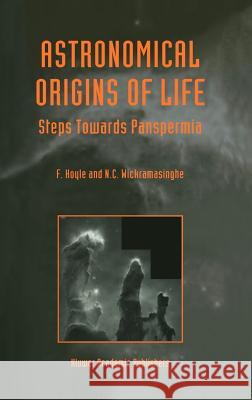
Sir Fred Hoyle;Hoyle; B. Hoyle
Astronomical Origins of Life: Steps Towards Panspermia Hoyle, B. 9780792360810 Kluwer Academic Publishers - książkaWidoczna okładka, to zdjęcie poglądowe, a rzeczywista szata graficzna może różnić się od prezentowanej.

Astronomical Origins of Life: Steps Towards Panspermia

ISBN-13: 9780792360810 / Angielski / Twarda / 2000 / 381 str.

Sir Fred Hoyle;Hoyle; B. Hoyle
cena 603,81
(netto: 575,06 VAT:  5%)

Najniższa cena z 30 dni: 578,30
Termin realizacji zamówienia:
ok. 22 dni roboczych
Bez gwarancji dostawy przed świętami

Darmowa dostawa!

Living material contains about twenty different sorts of atom combined into a set of relatively simple molecules. Astrobiologists tend to believe that abiotic mater ial will give rise to life in any place where these molecules exist in appreciable abundances and where physical conditions approximate to those occurring here on Earth. We think this popular view is wrong, for it is not the existence of the building blocks of life that is crucial but the exceedingly complicated structures in which they are arranged in living forms. The probability of arriving at biologically significant arrangements is so very small that only by calling on the resources of the whole universe does there seem to be any possibility of life originating, a conclusion that requires life on the Earth to be a minute component of a universal system. Some think that the hugely improbable transition from non-living to living mat ter can be achieved by dividing the transition into many small steps, calling on a so-called 'evolutionary' process to bridge the small steps one by one. This claim turns on semantic arguments which seek to replace the probability for the whole chain by the sum of the individual probabilities of the many steps, instead of by their product. This is an error well known to those bookies who are accustomed to taking bets on the stacking of horse races. But we did not begin our investigation from this point of view."


Kategorie:
Nauka, Fizyka
Kategorie BISAC:
Science > Life Sciences - Evolution
Science > Astronomia, przestrzeń i czas
Science > Mikrobiologia
Wydawca:
Kluwer Academic Publishers
Język:
Angielski
ISBN-13:
9780792360810
Rok wydania:
2000
Ilość stron:
381
Waga:
0.82 kg
Wymiary:
24.74 x 16.36 x 2.18
Oprawa:
Twarda
Wolumenów:
01
Dodatkowe informacje:
Bibliografia
Wydanie ilustrowane

Preface. Panspermia 2000. Part 1: General Considerations. 1.1. On a possibly fundamental principle in Chemistry as viewed in a cosmogonic context. 1.2. Biological activity in the early solar system in its outer regions. 1.3. An object within a particle of extraterrestrial origin compared with an object of presumed terrestrial origin. 1.4. The viability with respect to temperature of micro-organisms incident on the Earth's atmosphere. 1.5. A laboratory experiment with relevance to the survival of micro-organisms entering a planetary atmosphere. 1.6. Biological Evolution. 1.7. Metallic particles in astronomy. 1.8. The Universe and Life: Deductions from the weak Anthropic Principle. 1.9. Miller Urey synthesis in the nuclei of galaxies. Part 2: Cosmic Organic Polymers. 2.1. Formaldehyde polymers in interstellar space. 2.2. Formaldehyde polymers in comets. 2.3. Composition of cometary dust: the case against silicates. 2.4. Primitive grain clumps and organic compounds in carbonaceous chondrites. 2.5. Spectroscopic evidence for interstallar grain clumps in meteoritic inclusions. 2.6. Calculations of infrared fluxes from galactic sources for a polysaccharide grain model. Part 3: Cosmic Micro-Organisms: Infrared Characterisation. 3.1. Infrared spectroscopy of micro-organisms near 3,4lambdam in relation to geology and astronomy. 3.2. Infrared spectroscopy over the 2.9-3.9 lambdam waveband in biochemistry and astronomy. 3.3. 2.8-3.6lambdam spectra of micro-organisms with varying H2O ice content. 3.4. Organo-siliceous biomolecules and the infrared spectrum of the Trapezium nebula. 3.5. The spectroscopic identification of interstellar grains. 3.6. The availability of phosphorus in the bacterial model of interstellar grains. 3.7. Diatoms on Earth, Comets, Europa and in interstellar space. 3.8. A Diatom model of dust in the Trapezium nebula. 3.9. Infrared evidence for panspermia: An update. Part 4: Evidence from Interstellar Extinction. 4.1. On the nature of interstellar grains. 4.2. A model for interstellar extinction. 4.3. Ultraviolet absorbance of presumably interstellar bacteria and related matters. 4.4. The case against graphite particles in interstellar space. Part 5: Biogenic Aromatic Molecules in Space. 5.1. Organic molecules in interstellar dus: a possible spectral signature at &mgr;2200A? 5.2. Identification of the &mgr;2200A interstellar absorption feature. 5.3. A unified model for the 3.28µm emission and the 2200A interstellar extinction feasture. 5.4. Aromatic hydrocarbons in very small interstellar grains. 5.5. An integrated 2.5-12.5&lgr;m emission spectrum of naturally occurring aromatic molecules. 5.6. Biofluorescence and the extended red emission in astrophysical sources. Part 6: Comets and Life. 6.1. Comets, Ice Ages and ecological catastrophes. 6.2. Comets &endash; A vehicle for panspermia. 6.3. Some predictions on the nature of Comet Halley. 6.4. A model for the 2-4 µm spectrum of Comet Halley. 6.5. Modelling the 5-30µm spectrum of Comet Halley. 6.6. Very small dust particles (VSDP's) in Comet C/1996B2 (Hyakuta

Hoyle, Fred, Sir Cosmologist... więcej >


Udostępnij

Facebook - konto krainaksiazek.pl


Opinie o Krainaksiazek.pl na Opineo.pl

Partner Mybenefit

Krainaksiazek.pl w programie rzetelna firma Krainaksiaze.pl - płatności przez paypal

Czytaj nas na:

Facebook - krainaksiazek.pl
  • książki na zamówienie
  • granty
  • książka na prezent
  • kontakt
  • pomoc
  • opinie
  • regulamin
  • polityka prywatności

Zobacz:

  • Księgarnia czeska

  • Wydawnictwo Książkowe Klimaty

1997-2025 DolnySlask.com Agencja Internetowa

© 1997-2022 krainaksiazek.pl
     
KONTAKT | REGULAMIN | POLITYKA PRYWATNOŚCI | USTAWIENIA PRYWATNOŚCI
Zobacz: Księgarnia Czeska | Wydawnictwo Książkowe Klimaty | Mapa strony | Lista autorów
KrainaKsiazek.PL - Księgarnia Internetowa

Polityka prywatnosci - link
Krainaksiazek.pl - płatnośc Przelewy24
Przechowalnia Przechowalnia





