• Wyszukiwanie zaawansowane
  • Kategorie
  • Kategorie BISAC
  • Książki na zamówienie
  • Promocje
  • Granty
  • Książka na prezent
  • Opinie
  • Pomoc
  • Załóż konto
  • Zaloguj się

Artistic Judgement: A Framework for Philosophical Aesthetics » książka


zaloguj się | załóż konto
Logo Krainaksiazek.pl

koszyk

konto

szukaj
topmenu
Księgarnia internetowa
Szukaj
Książki na zamówienie
Promocje
Granty
Książka na prezent
Moje konto
Pomoc
 
 
Wyszukiwanie zaawansowane
Pusty koszyk
Bezpłatna dostawa dla zamówień powyżej 20 złBezpłatna dostawa dla zamówień powyżej 20 zł

Kategorie główne

• Nauka
 [2949965]
• Literatura piękna
 [1857847]

  więcej...
• Turystyka
 [70818]
• Informatyka
 [151303]
• Komiksy
 [35733]
• Encyklopedie
 [23180]
• Dziecięca
 [617748]
• Hobby
 [139972]
• AudioBooki
 [1650]
• Literatura faktu
 [228361]
• Muzyka CD
 [398]
• Słowniki
 [2862]
• Inne
 [444732]
• Kalendarze
 [1620]
• Podręczniki
 [167233]
• Poradniki
 [482388]
• Religia
 [509867]
• Czasopisma
 [533]
• Sport
 [61361]
• Sztuka
 [243125]
• CD, DVD, Video
 [3451]
• Technologie
 [219309]
• Zdrowie
 [101347]
• Książkowe Klimaty
 [123]
• Zabawki
 [2362]
• Puzzle, gry
 [3791]
• Literatura w języku ukraińskim
 [253]
• Art. papiernicze i szkolne
 [7933]
Kategorie szczegółowe BISAC

Artistic Judgement: A Framework for Philosophical Aesthetics

ISBN-13: 9789400700307 / Angielski / Twarda / 2011 / 196 str.
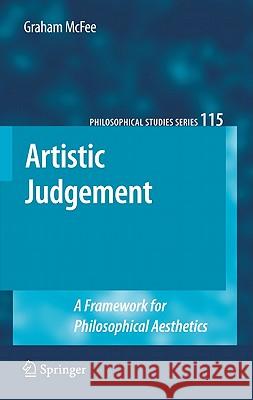
Graham McFee
Artistic Judgement: A Framework for Philosophical Aesthetics McFee, Graham 9789400700307 Not Avail - książkaWidoczna okładka, to zdjęcie poglądowe, a rzeczywista szata graficzna może różnić się od prezentowanej.

Artistic Judgement: A Framework for Philosophical Aesthetics

ISBN-13: 9789400700307 / Angielski / Twarda / 2011 / 196 str.

Graham McFee
cena 403,47 zł
(netto: 384,26 VAT:  5%)

Najniższa cena z 30 dni: 385,52 zł
Termin realizacji zamówienia:
ok. 22 dni roboczych
Bez gwarancji dostawy przed świętami

Darmowa dostawa!
inne wydania

Artistic Judgement sketches a framework for an account of art suitable to philosophical aesthetics. It stresses differences between artworks and other things; and locates the understanding of artworks both in a narrative of the history of art and in the institutional practices of the art world. Hence its distinctiveness lies in its strong account of the difference between, on the one hand, the judgement and appreciation of art and, on the other, the judgement and appreciation of all the other things in which we take an aesthetic interest. For only by acknowledging this contrast can one do justice to the importance regularly ascribed to art. The contrast is explained by appealing to an occasion-sensitive account of understanding, drawn from Charles Travis directly, but with Gordon Baker (and Wittgenstein) as also proximate rather than remote. On this basis, it argues, first, that we need to offer accounts of key topics only as far as questions might be raised in respect of them (hence, not exceptionlessly); and, second, that we should therefore defend the view that the meaning of artworks can be changed by later events (the historical character of art, or forward retroactivism) and that art has an institutional character, understood broadly on the lines of Terry Diffey's Republic of Art. Besides providing a general framework, Artistic Judgement also explores the applications of the ideas to specific artworks or classes of them.


Kategorie:
Nauka, Filozofia
Kategorie BISAC:
Philosophy > Estetyka
Art > General
Wydawca:
Not Avail
Seria wydawnicza:
Philosophical Studies
Język:
Angielski
ISBN-13:
9789400700307
Rok wydania:
2011
Wydanie:
2011
Numer serii:
000082113
Ilość stron:
196
Waga:
0.50 kg
Wymiary:
23.39 x 15.6 x 1.6
Oprawa:
Twarda
Wolumenów:
01
Dodatkowe informacje:
Wydanie ilustrowane

From the reviews:

"As its title promises, Artistic Judgment: A Framework for Philosophical Aesthetics develops a theoretical account of the nature of philosophical aesthetics, and, within that framework, addresses some important issues in the philosophy of art, all focally related to artistic judgement. ... in the present philosophical context, readers who are not sympathetic to Wittgensteinian approaches to aesthetics, as well as those who are, should read this extremely interesting book." (Thomas Adajian, British Journal of Aesthetics, Vol. 51 (4), October, 2011)

Preface.- Chapter One: The Artistic and The Aesthetic: A Distinction Considered. - 1.1 A crucial distinction.- 1.2 Transfiguration and artistic properties- 1.3 Some corollaries of the distinction.- 1.4 Contrasting views of the aesthetic.- 1.5 The artistic as sensuous?- 1.6 The ‘ambiguity’ of artistic properties.- 1.7 An example: the case of Marla.- 1.8 Exploring the contrast: methodology.- 1.9 Outline of this work.- 1.10 On not defining art.- Chapter Two: Art, Meaning and Occasion-Sensitivity.- 2.1 Meaning meaning.- 2.2 Exceptions (a): dealing with defeasibility.- 2.3 Exceptions (b): disambiguation?- 2.4 An occasion-sensitive view of meaning and understanding.- 2.5 Contextualism in philosophical aesthetics.- 2.6 Competent judges.- 2.7 Meaning, explaining, and artistic properties.- 2.8 Meaning, explanation and content.- 2.9 The context of philosophical aesthetics.- Chapter Three: Art and Life-Issues: Meeting Counter-Cases.- 3.1 Artistic value and life-issues.- 3.2 Life-issues connection to artworks?- 3.3 The importance of life-issues.- 3.4. Learning from art?- 3.5 Art and moral value: moderate moralism, ethicism.- 3.6 A seven-part strategy.- 3.7 Literary value and moral understanding: Nussbaum.- 3.8 A conflict between morality and art?- 3.9 Conclusion.- Chapter Four: Intention, Authorship and Artistic Realism.- 4.1 The intention of the artist.- 4.2 Excursus: Hypothetical intentionalism and its discontents.- 4.3 The embodiment of artistic meaning.- 4.4 Making meaning: the concept “art”.- 4.5 Making sense: ‘history of production’.- 4.6 Response-reliance and artistic properties.- 4.7 Understanding and criticism.- 4.8 Criticism and inference.- 4.9 The ‘reality’ of artistic properties.- Chapter Five: The Historical Character of Art.- 5.1 Precursors and the past.- 5.2 Art, change of meaning and standard historicism.- 5.3 Forward retroactivism, and the threat of misperception.- 5.4 Are these genuine properties?- 5.5 Reasons and ‘new evidence’.- 5.6 Are these new properties?- 5.7 Making sense of the past.- 5.8 Oeuvre, action and understanding.- 5.9 Genre and artistic intention.- 5.10 An argument against any historicism.- 5.11 Historical character and understanding — some realism.- Chapter Six: The Republic of Art: A Plausible Institutional Account of Art?- 6.1 The idea of an institutional concept.- 6.2 Sketch of an institutional account of art.- 6.3 A more plausible (than Dickie’s) account of art.- 6.4 Topics for criticism.- 6.5 Does Dickie’s later theory fare better?- 6.6 Wollheim’s criticism.- 6.7 Critical reflections.- 6.8 Can the institution be wrong?- 6.9 The Friends of Jones. 6.10 What the account offers. Chapter Seven: Conclusion.- 7.1 The framework: a summary.- 7.2 The aesthetic reconsidered.- 7.3 Envoi: The Muscular Aesthetic.

Graham McFee studied at the University of Keele, and at University College London (where he was supervised by Richard Wollheim). Having worked at the University of Brighton since 1974, he was inaugurated Professor of Philosophy there in 1995. Since 2004, he has divided his time between Brighton and California State University Fullerton. He was Vice President of the British Society for Aesthetics from 1999 to 2004. His main interests, outside aesthetics, lie in the philosophy of Wittgenstein and the philosophical study of sport.

Artistic Judgement sketches a framework for an account of art suitable to philosophical aesthetics. It stresses differences between artworks and other things; and locates the understanding of artworks both in a narrative of the history of art and in the institutional practices of the art world. Hence its distinctiveness lies in its strong account of the difference between, on the one hand, the judgement and appreciation of art and, on the other, the judgement and appreciation of all the other things in which we take an aesthetic interest. For only by acknowledging this contrast can one do justice to the importance regularly ascribed to art. The contrast is explained by appealing to an occasion-sensitive account of understanding, drawn from Charles Travis directly, but with Gordon Baker (and Wittgenstein) as also proximate rather than remote. On this basis, it argues, first, that we need to offer accounts of key topics only as far as questions might be raised in respect of them (hence, not exceptionlessly); and, second, that we should therefore defend the view that the meaning of artworks can be changed by later events (the historical character of art, or forward retroactivism) and that art has an institutional character, understood broadly on the lines of Terry Diffey’s Republic of Art. Besides providing a general framework, Artistic Judgement also explores the applications of the ideas to specific artworks or classes of them.




Udostępnij

Facebook - konto krainaksiazek.pl


Opinie o Krainaksiazek.pl na Opineo.pl

Partner Mybenefit

Krainaksiazek.pl w programie rzetelna firma Krainaksiaze.pl - płatności przez paypal

Czytaj nas na:

Facebook - krainaksiazek.pl
  • książki na zamówienie
  • granty
  • książka na prezent
  • kontakt
  • pomoc
  • opinie
  • regulamin
  • polityka prywatności

Zobacz:

  • Księgarnia czeska

  • Wydawnictwo Książkowe Klimaty

1997-2025 DolnySlask.com Agencja Internetowa

© 1997-2022 krainaksiazek.pl
     
KONTAKT | REGULAMIN | POLITYKA PRYWATNOŚCI | USTAWIENIA PRYWATNOŚCI
Zobacz: Księgarnia Czeska | Wydawnictwo Książkowe Klimaty | Mapa strony | Lista autorów
KrainaKsiazek.PL - Księgarnia Internetowa

Polityka prywatnosci - link
Krainaksiazek.pl - płatnośc Przelewy24
Przechowalnia Przechowalnia



