• Wyszukiwanie zaawansowane
  • Kategorie
  • Kategorie BISAC
  • Książki na zamówienie
  • Promocje
  • Granty
  • Książka na prezent
  • Opinie
  • Pomoc
  • Załóż konto
  • Zaloguj się

Artificial Intelligence, Learning and Computation in Economics and Finance » książka


zaloguj się | załóż konto
Logo Krainaksiazek.pl

koszyk

konto

szukaj
topmenu
Księgarnia internetowa
Szukaj
Książki na zamówienie
Promocje
Granty
Książka na prezent
Moje konto
Pomoc
 
 
Wyszukiwanie zaawansowane
Pusty koszyk
Bezpłatna dostawa dla zamówień powyżej 20 złBezpłatna dostawa dla zamówień powyżej 20 zł

Kategorie główne

• Nauka
 [2949965]
• Literatura piękna
 [1857847]

  więcej...
• Turystyka
 [70818]
• Informatyka
 [151303]
• Komiksy
 [35733]
• Encyklopedie
 [23180]
• Dziecięca
 [617748]
• Hobby
 [139972]
• AudioBooki
 [1650]
• Literatura faktu
 [228361]
• Muzyka CD
 [398]
• Słowniki
 [2862]
• Inne
 [444732]
• Kalendarze
 [1620]
• Podręczniki
 [167233]
• Poradniki
 [482388]
• Religia
 [509867]
• Czasopisma
 [533]
• Sport
 [61361]
• Sztuka
 [243125]
• CD, DVD, Video
 [3451]
• Technologie
 [219309]
• Zdrowie
 [101347]
• Książkowe Klimaty
 [123]
• Zabawki
 [2362]
• Puzzle, gry
 [3791]
• Literatura w języku ukraińskim
 [253]
• Art. papiernicze i szkolne
 [7933]
Kategorie szczegółowe BISAC

Artificial Intelligence, Learning and Computation in Economics and Finance

ISBN-13: 9783031152931 / Angielski / Twarda / 2023 / 325 str.
Ragupathy Venkatachalam
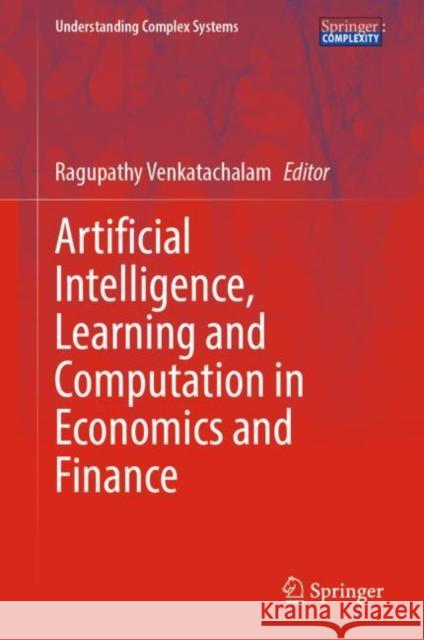
Artificial Intelligence, Learning and Computation in Economics and Finance Ragupathy Venkatachalam 9783031152931 Springer - książkaWidoczna okładka, to zdjęcie poglądowe, a rzeczywista szata graficzna może różnić się od prezentowanej.

Artificial Intelligence, Learning and Computation in Economics and Finance

ISBN-13: 9783031152931 / Angielski / Twarda / 2023 / 325 str.

Ragupathy Venkatachalam
cena 605,23 zł
(netto: 576,41 VAT:  5%)

Najniższa cena z 30 dni: 539,74 zł
Termin realizacji zamówienia:
ok. 22 dni roboczych
Bez gwarancji dostawy przed świętami

Darmowa dostawa!
inne wydania

This book presents frontier research on the use of computational methods to model complex interactions in economics and finance. Artificial Intelligence, Machine Learning and simulations offer effective means of analyzing and learning from large as well as new types of data. These computational tools have permeated various subfields of economics, finance, and also across different schools of economic thought. Through 16 chapters written by pioneers in economics, finance, computer science, psychology, complexity and statistics/econometrics, the book introduces their original research and presents the findings they have yielded.Theoretical and empirical studies featured in this book draw on a variety of approaches such as agent-based modeling, numerical simulations, computable economics, as well as employing tools from artificial intelligence and machine learning algorithms. The use of computational approaches to perform counterfactual thought experiments are also introduced, which help transcend the limits posed by traditional mathematical and statistical tools.The book also includes discussions on methodology, epistemology, history and issues concerning prediction, validation, and inference, all of which have become pertinent with the increasing use of computational approaches in economic analysis.


This book presents frontier research on the use of computational methods to model complex interactions in economics and finance. Artificial Intelligence, Machine Learning and simulations offer effective means of analyzing and learning from large as well as new types of data. These computational tools have permeated various subfields of economics, finance, and also across different schools of economic thought. Through 16 chapters written by pioneers in economics, finance, computer science, psychology, complexity and statistics/econometrics, the book introduces their original research and presents the findings they have yielded.Theoretical and empirical studies featured in this book draw on a variety of approaches such as agent-based modeling, numerical simulations, computable economics, as well as employing tools from artificial intelligence and machine learning algorithms. The use of computational approaches to perform counterfactual thought experiments are also introduced, which help transcend the limits posed by traditional mathematical and statistical tools.
The book also includes discussions on methodology, epistemology, history and issues concerning prediction, validation, and inference, all of which have become pertinent with the increasing use of computational approaches in economic analysis.



Kategorie:
Nauka
Kategorie BISAC:
Science > Fizyka matematyczna
Computers > Computer Science
Technology & Engineering > Engineering (General)
Wydawca:
Springer
Seria wydawnicza:
Understanding Complex Systems
Język:
Angielski
ISBN-13:
9783031152931
Rok wydania:
2023
Dostępne języki:
Numer serii:
000307910
Ilość stron:
325
Oprawa:
Twarda
Dodatkowe informacje:
Wydanie ilustrowane

Perspectives from the Development of Agent-based Modelling in Economics and Finance.- Towards a General Model of Financial Markets.- The U-Mart Futures Exchange Experiment and Her Institutional Design Historically Inherited.- A Bottom-Up Framework for Data-Driven Agent-Based Simulations.- Can News Networks and Topics Influence Assets Return and Volatility?.- Causal Inference and Agent-Based Models.- Finding the Human in Their Stories: Some Thoughts on Digital Humanities Tools.- Interdependence Overcomes the Limitations of Rational Theories of Collective Behavior: The Productivity of Patents by Nations.- Sand Castles and Financial Systems.-Estimation of Agent-Based Models via Approximate Bayesian Computation.- Unravelling Aspects of Decision Making Under Uncertainty.- Logic and Epistemology in Behavioral Economics.- Aggregate Investor Attention and Bitcoin Return: The Machine Learning Approach.- Information and Market Power: An Experimental Investigation into the Hayek Hypothesis.- Algorithmically Learning, Creatively and Intelligently to Play Games.- A Simonian Formalistic Perspective on Collaborative, Distributed Invention.- Modified Sraffan Schemes and Algorithmic Rational Agents.

Dr. Ragupathy Venkatachalam is a Senior Lecturer in Economics at the Institute of Management Studies, Goldsmiths, University of London. He obtained his Ph.D. from the University of Trento, Italy. He has previously taught economics at the Centre for Development Studies (India) and worked as a research fellow at the Artificial Intelligence Economics Research Center at the National Chengchi University (Taiwan). He serves as the co-editor of Economia Politica [Journal of Analytical and Institutional Economics].  His broad research areas include computable economics, economic dynamics, causal inference, discrimination and history of economic thought. He has published several peer-reviewed journal articles, book chapters and edited special issues on these areas. His research focuses on the algorithmic models of theorizing both at the micro- and macro-levels.


This book presents frontier research on the use of computational methods to model complex interactions in economics and finance. Artificial Intelligence, Machine Learning and simulations offer effective means of analyzing and learning from large as well as new types of data. These computational tools have permeated various subfields of economics, finance, and also across different schools of economic thought. Through 16 chapters written by pioneers in economics, finance, computer science, psychology, complexity and statistics/econometrics, the book introduces their original research and presents the findings they have yielded.

Theoretical and empirical studies featured in this book draw on a variety of approaches such as agent-based modeling, numerical simulations, computable economics, as well as employing tools from artificial intelligence and machine learning algorithms. The use of computational approaches to perform counterfactual thought experiments are also introduced, which help transcend the limits posed by traditional mathematical and statistical tools.

The book also includes discussions on methodology, epistemology, history and issues concerning prediction, validation, and inference, all of which have become pertinent with the increasing use of computational approaches in economic analysis.



Udostępnij

Facebook - konto krainaksiazek.pl


Opinie o Krainaksiazek.pl na Opineo.pl

Partner Mybenefit

Krainaksiazek.pl w programie rzetelna firma Krainaksiaze.pl - płatności przez paypal

Czytaj nas na:

Facebook - krainaksiazek.pl
  • książki na zamówienie
  • granty
  • książka na prezent
  • kontakt
  • pomoc
  • opinie
  • regulamin
  • polityka prywatności

Zobacz:

  • Księgarnia czeska

  • Wydawnictwo Książkowe Klimaty

1997-2025 DolnySlask.com Agencja Internetowa

© 1997-2022 krainaksiazek.pl
     
KONTAKT | REGULAMIN | POLITYKA PRYWATNOŚCI | USTAWIENIA PRYWATNOŚCI
Zobacz: Księgarnia Czeska | Wydawnictwo Książkowe Klimaty | Mapa strony | Lista autorów
KrainaKsiazek.PL - Księgarnia Internetowa

Polityka prywatnosci - link
Krainaksiazek.pl - płatnośc Przelewy24
Przechowalnia Przechowalnia



