• Wyszukiwanie zaawansowane
  • Kategorie
  • Kategorie BISAC
  • Książki na zamówienie
  • Promocje
  • Granty
  • Książka na prezent
  • Opinie
  • Pomoc
  • Załóż konto
  • Zaloguj się

Art Meets Mathematics in the Fourth Dimension » książka


zaloguj się | załóż konto
Logo Krainaksiazek.pl

koszyk

konto

szukaj
topmenu
Księgarnia internetowa
Szukaj
Książki na zamówienie
Promocje
Granty
Książka na prezent
Moje konto
Pomoc
 
 
Wyszukiwanie zaawansowane
Pusty koszyk
Bezpłatna dostawa dla zamówień powyżej 20 złBezpłatna dostawa dla zamówień powyżej 20 zł

Kategorie główne

• Nauka
 [2949524]
• Literatura piękna
 [1817948]

  więcej...
• Turystyka
 [70715]
• Informatyka
 [151291]
• Komiksy
 [35671]
• Encyklopedie
 [23176]
• Dziecięca
 [612440]
• Hobby
 [136066]
• AudioBooki
 [1740]
• Literatura faktu
 [226030]
• Muzyka CD
 [378]
• Słowniki
 [2918]
• Inne
 [445441]
• Kalendarze
 [1181]
• Podręczniki
 [166545]
• Poradniki
 [469898]
• Religia
 [508035]
• Czasopisma
 [502]
• Sport
 [61392]
• Sztuka
 [242759]
• CD, DVD, Video
 [3348]
• Technologie
 [219537]
• Zdrowie
 [98738]
• Książkowe Klimaty
 [124]
• Zabawki
 [2382]
• Puzzle, gry
 [3543]
• Literatura w języku ukraińskim
 [259]
• Art. papiernicze i szkolne
 [7107]
Kategorie szczegółowe BISAC

Art Meets Mathematics in the Fourth Dimension

ISBN-13: 9783319381046 / Angielski / Miękka / 2017 / 184 str.
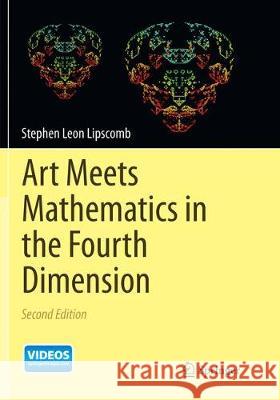
Stephen Leon Lipscomb
Art Meets Mathematics in the Fourth Dimension Stephen Leon Lipscomb 9783319381046 Springer - książkaWidoczna okładka, to zdjęcie poglądowe, a rzeczywista szata graficzna może różnić się od prezentowanej.

Art Meets Mathematics in the Fourth Dimension

ISBN-13: 9783319381046 / Angielski / Miękka / 2017 / 184 str.

Stephen Leon Lipscomb
cena 201,24 zł
(netto: 191,66 VAT:  5%)

Najniższa cena z 30 dni: 192,74 zł
Termin realizacji zamówienia:
ok. 16-18 dni roboczych.

Darmowa dostawa!

To see objects that live in the fourth dimension we humans would need to add a fourth dimension to our three-dimensional vision. An example of such an object that lives in the fourth dimension is a hyper-sphere or "3-sphere." The quest to imagine the elusive 3-sphere has deep historical roots: medieval poet Dante Alighieri used a 3-sphere to convey his allegorical vision of the Christian afterlife in his Divine Comedy. In 1917, Albert Einstein visualized the universe as a 3-sphere, describing this imagery as "the place where the reader's imagination boggles. Nobody can imagine this thing." Over time, however, understanding of the concept of a dimension evolved. By 2003, a researcher had successfully rendered into human vision the structure of a 4-web (think of an ever increasingly-dense spider's web). In this text, Stephen Lipscomb takes his innovative dimension theory research a step further, using the 4-web to reveal a new partial image of a 3-sphere. Illustrations support the reader's understanding of the mathematics behind this process. Lipscomb describes a computer program that can produce partial images of a 3-sphere and suggests methods of discerning other fourth-dimensional objects that may serve as the basis for future artwork.


Kategorie:
Nauka, Biologia i przyroda
Kategorie BISAC:
Mathematics > Matematyka stosowana
Mathematics > Topologia
Wydawca:
Springer
Język:
Angielski
ISBN-13:
9783319381046
Rok wydania:
2017
Wydanie:
Softcover Repri
Ilość stron:
184
Oprawa:
Miękka
Wolumenów:
01
Dodatkowe informacje:
Wydanie ilustrowane

1. 3-Sphere.- 2. Dante's 3-Sphere Universe.- 3. Einstein and the 3-Sphere.- 4. Einstein's Universe.- 5. Images of S1 and S2.- 6. Four-Web Graph Paper.- 7. The Partial Picture.- 8. Generating the Hyper-sphere Art.- 9. Prelude to Chapters 10 and 11.- 10. Great 2-Spheres.- 11. Images of Great 2-Spheres.- Appendix 1.- Appendix 2.- Appendix 3. Inside S3 and Questions.- Appendix 4. Mathematics and Art.

A graduate of Fairmont State University BA; West Virginia University MA, and the University of Virginia Ph.D., where the late G. T. Whyburn (past president of the AMS) was his advisor. And prior to Chairing the Department of Mathematics, Physics, and Computer Science at the University of Mary Washington, Lipscomb was a U. S. Navy senior mathematician involved with the Trident Missile system and served as Team Chair of an Operational Evaluation of the Tomahawk Missile system.

In the 1970s, the author solved a half-century old embedding problem in dimension theory. His solution, upon review by a Transactions of the American Mathematical Society (AMS) referee, was called “an outstanding contribution to dimension theory”. In 2009 the author’s feature article The Quest for Universal Spaces in Dimension Theory appeared in the December issue of the Notices of the AMS, and his book Fractals and Universal Spaces in Dimension Theory was published in the outstanding Springer Monographs in Mathematics Series. It turned out that the classical fractals known as Sierpiński’s triangle and cheese where corollary to the author’s solution. And at the beginning of the 21st Century, James Perry introduced another example (the 4-web) of the author’s construction that lived in the Fourth Dimension. Perry’s example is fundamental to this book.

During the 1990s, the author introduced an extension of Cauchy’s cycle notation in group theory to path notation in semi-group theory. He used his path notation to construct new semi-groups, e.g., the alternating semi-groups. By 1996, the author’s work with his path notation was documented by the AMS in Volume 46 Symmetric Inverse Semigroups of its prestigious Mathematical Surveys and Monographs Series.

Circa 2000 the author realized, because the triangle is the Holy Grail of strength design, that the 4-web would be ideal for practical applications. By 2005 he obtained a US patent and designed medical 4-web spine cages. Then Jessee Hunt created 4-Web, Inc., the cages eventually became FDA approved for human implantation, and the implants began in 2011.

To see objects that live in the fourth dimension we humans would need to add a fourth dimension to our three-dimensional vision. An example of such an object that lives in the fourth dimension is a hyper-sphere or “3-sphere”. The quest to imagine the elusive 3-sphere has deep historical roots: medieval poet Dante Alighieri, in his circa 1300 AD Divine Comedy, used a 3-sphere to convey his allegorical vision of the Christian afterlife. In 1917, Albert Einstein visualized the universe, at each instant in time, as a 3-sphere. He described his representation as “…the place where the reader’s imagination boggles. Nobody can imagine this thing.” Over time, however, our understanding of the concept of dimension evolved. By 2003, a researcher had successfully rendered into human vision the structure of a 4-web (think of an every increasingly-dense spider’s web). In this text Stephen Lipscomb takes his innovative dimension theory research a step further, using the 4-web to reveal a new partial image of a 3-sphere. Illustrations support the reader’s understanding of the mathematics behind this process. Lipscomb describes a computer program that can produce partial images of a 3-sphere and suggests methods of discerning other fourth-dimensional objects that may serve as the basis for future artwork. 

Reviews

The author’s notion of fractal-based computer art is fascinating-a clear expression of our technological age. With the color plates in this book and the available DVD animation the reader will not only substantiate this, but will also gain an intuitive sense about the nature of fractals and about the structure and origin of the 4-web. A.D. Parks, Ph.D., Principal Scientist, Head of Quantum Physics Group, Naval Surface Warfare Center, Dahlgren Virginia

Using numerous illustrations, the author discusses the idea of a fourth dimension. The new feature here is his use of an object that up until recently lived only in the fourth dimension. This book should become useful, educational, and widely-read. Gerald Edgar, Professor (Emeritus) of Mathematics, The Ohio State University 

I have read many books, but only a couple has been as suggestive in terms of connections between mathematics, art, and physics as this book. It will be exceptionally well received. John E. Gray, Senior Member of IEEE, Lead physicist (over 130 publications) 

An accessible yet rigorous treatment of recent mathematical research, this book is particularly valuable since its author developed these concepts originally. J. Larry Lehman, Professor of Mathematics, University of Mary Washington


Udostępnij

Facebook - konto krainaksiazek.pl


Opinie o Krainaksiazek.pl na Opineo.pl

Partner Mybenefit

Krainaksiazek.pl w programie rzetelna firma Krainaksiaze.pl - płatności przez paypal

Czytaj nas na:

Facebook - krainaksiazek.pl
  • książki na zamówienie
  • granty
  • książka na prezent
  • kontakt
  • pomoc
  • opinie
  • regulamin
  • polityka prywatności

Zobacz:

  • Księgarnia czeska

  • Wydawnictwo Książkowe Klimaty

1997-2026 DolnySlask.com Agencja Internetowa

© 1997-2022 krainaksiazek.pl
     
KONTAKT | REGULAMIN | POLITYKA PRYWATNOŚCI | USTAWIENIA PRYWATNOŚCI
Zobacz: Księgarnia Czeska | Wydawnictwo Książkowe Klimaty | Mapa strony | Lista autorów
KrainaKsiazek.PL - Księgarnia Internetowa

Polityka prywatnosci - link
Krainaksiazek.pl - płatnośc Przelewy24
Przechowalnia Przechowalnia





