• Wyszukiwanie zaawansowane
  • Kategorie
  • Kategorie BISAC
  • Książki na zamówienie
  • Promocje
  • Granty
  • Książka na prezent
  • Opinie
  • Pomoc
  • Załóż konto
  • Zaloguj się

Arctic-Subarctic Ocean Fluxes: Defining the Role of the Northern Seas in Climate » książka


zaloguj się | załóż konto
Logo Krainaksiazek.pl

koszyk

konto

szukaj
topmenu
Księgarnia internetowa
Szukaj
Książki na zamówienie
Promocje
Granty
Książka na prezent
Moje konto
Pomoc
 
 
Wyszukiwanie zaawansowane
Pusty koszyk
Bezpłatna dostawa dla zamówień powyżej 20 złBezpłatna dostawa dla zamówień powyżej 20 zł

Kategorie główne

• Nauka
 [2946600]
• Literatura piękna
 [1856966]

  więcej...
• Turystyka
 [72221]
• Informatyka
 [151456]
• Komiksy
 [35826]
• Encyklopedie
 [23190]
• Dziecięca
 [619653]
• Hobby
 [140543]
• AudioBooki
 [1577]
• Literatura faktu
 [228355]
• Muzyka CD
 [410]
• Słowniki
 [2874]
• Inne
 [445822]
• Kalendarze
 [1744]
• Podręczniki
 [167141]
• Poradniki
 [482898]
• Religia
 [510455]
• Czasopisma
 [526]
• Sport
 [61590]
• Sztuka
 [243598]
• CD, DVD, Video
 [3423]
• Technologie
 [219201]
• Zdrowie
 [101638]
• Książkowe Klimaty
 [124]
• Zabawki
 [2473]
• Puzzle, gry
 [3898]
• Literatura w języku ukraińskim
 [254]
• Art. papiernicze i szkolne
 [8170]
Kategorie szczegółowe BISAC

Arctic-Subarctic Ocean Fluxes: Defining the Role of the Northern Seas in Climate

ISBN-13: 9781402067730 / Angielski / Twarda / 2008 / 736 str.
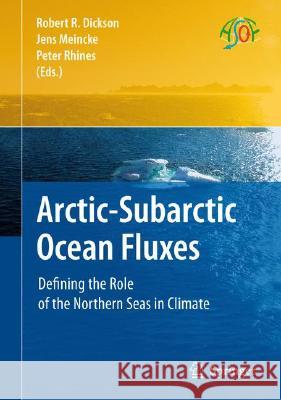
Robert R. Dickson; Jens Meincke; Peter Rhines
Arctic-Subarctic Ocean Fluxes: Defining the Role of the Northern Seas in Climate Dickson, Robert R. 9781402067730 Not Avail - książkaWidoczna okładka, to zdjęcie poglądowe, a rzeczywista szata graficzna może różnić się od prezentowanej.

Arctic-Subarctic Ocean Fluxes: Defining the Role of the Northern Seas in Climate

ISBN-13: 9781402067730 / Angielski / Twarda / 2008 / 736 str.

Robert R. Dickson; Jens Meincke; Peter Rhines
cena 806,99 zł
(netto: 768,56 VAT:  5%)

Najniższa cena z 30 dni: 771,08 zł
Termin realizacji zamówienia:
ok. 22 dni roboczych
Bez gwarancji dostawy przed świętami

Darmowa dostawa!

The Ocean-Atmosphere-Cryosphere s- tem of the Arctic is of unique importance to the World, its climate and its peoples and is changing rapidly; it is no accident that the Arctic Climate Impact Assessment (ACIA) was the first comprehensive regional assessment of climate-impact to be conducted. Reporting in 2005, ACIA concluded that changes in climate and in ozone and UV radiation levels were likely to affect every aspect of life in the Arctic. In effect, the ACIA process was essentially one of prediction: projecting that large climatic changes are likely to occur over the 21st century and documenting what might be their projected impacts. Although the ACIA Report was based on the most modern synthesis of obser- tions, modelling and analysis by hundreds of Arctic scientists, it notes with clarity that its conclusions are only a first step in what must be a continuing process. nd Reporting in November 2007, the 2 International Conference on Arctic Research Planning (ICARP II) has recently made much the same point. To make its proj- tions with higher confidence, --- to take the crucial second step in other words, -- both reports plainly state the need for a more complete and detailed understanding of the complex processes, interactions, and feedbacks that drive and underlie change at high northern latitudes, including particularly the long-term processes of circulation and exchange in our northern seas where much of the decadal m- ory for Arctic change must reside."


Kategorie:
Nauka, Geografia
Kategorie BISAC:
Science > Earth Sciences - Oceanography
Science > Earth Sciences - Meteorology & Climatology
Science > Earth Sciences - Geography
Wydawca:
Not Avail
Język:
Angielski
ISBN-13:
9781402067730
Rok wydania:
2008
Wydanie:
2008
Ilość stron:
736
Waga:
1.35 kg
Wymiary:
23.62 x 15.75 x 3.3
Oprawa:
Twarda
Wolumenów:
01

A. The Subarctic seas as a source of Arctic change. 1. The inflow of Atlantic water, heat, and salt to the Nordic Seas across the Greenland-Scotland Ridge 2. Flux of heat, salt and mass to the Arctic Ocean via Norway Coast and Barents Sea 3. Flux of heat, salt and mass to the Arctic Ocean via Fram Strait. Eberhard Fahrbach 4. The debate about the importance of ocean heat transport to climate 5. Long-term variability of Atlantic water inflow to the Northern Seas: insights from model experiments B. The freshwater flux from Northern seas as a moderator of the Atlantic Meridional Overturning Circulation 6. Freshwater storage in the Northern Ocean: spatial distribution and temporal variation 7. Modelling the sea ice export through Fram Strait 8. Arctic outflows across the Canadian Polar Shelf 9. The freshwater flux from Hudson Strait 10. Freshwater fluxes east of Greenland 11. Changing ideas about how freshwater impacts the AMOC at local, regional and global scales 12. Constraints on calculating the balances of heat, mass and salt for the Arctic Mediterranean 13. Variability and change in the atmospheric branch of the Arctic hydrologic cycle 14. Simulating the terms in the Arctic hydrological budget. Peili Wu, Helmuth Haak 15. Is the Conveyor Belt Threatened by Arctic Ocean Fresh Water Outflow? 16. Long term variability of the freshwater export from the Arctic Ocean as seen in model results C. The dense water overflows from Northern Seas as drivers of the Atlantic Meridional Overturning Circulation. 17. The overflow flux east of Iceland: variability, origins, forcing and fate 18. The overflow flux west of Iceland: variability, origins and forcing 19. Tracer evidence of DSOW origins and variability 20. Transformation and fate of the overflows in the subpolar North Atlantic 21. Modelling of dense overflows D. The 'receiving volume' of the northern North Atlantic. 22. Satellite evidence of change in the Northern Gyre 23. The history of Labrador Sea Water 24. Convective- to gyrescale-dynamics, the first SeaGlider campaigns, 2003-5 25. The 'footprint' of subgrid convective events and their climatic importance 26. North Atlantic Deep Water transformation in the Labrador Sea, recirculation through the subpolar gyre, and discharge to the subtropics 27. Accessing the inaccessible: towards an understanding of Subarctic shelf processes E. Invited lectures 28. The bursting of the Baltic and its impact: the 'European Lake Agassiz' Lennart Bengtsson, Director, Max Planck Institute for Meteorology, 1991 - 2000. 29. Trends in the Climatic Forcing of Northern Seas'. Jim Hurrell, Director, Climate Dynamics Division, NCAR F. Conclusions. 30. How would ASOF define the cutting-edge questions for the IPY across its domain? In the light of these, what is an appropriate ocean-observing system for climate in subarctic seas? ASOF Group.

The two-way oceanic exchanges that connect the Arctic and Atlantic oceans through subarctic seas are of fundamental importance to climate. Change may certainly be imposed on the Arctic Ocean from subarctic seas, including a changing poleward ocean heat flux that is central to determining the present state and future fate of the perennial sea-ice. And the signal of Arctic change is expected to have its major climatic impact by reaching south through subarctic seas, either side of Greenland, to modulate the Atlantic thermohaline ‘conveyor’. Developing the predictive skills of climate models is seen to be the most direct way of extending the ability of society to mitigate for or adapt to 'global change' and is the main justification for continuing an intense observational effort in these waters. As records have lengthened, they have shown that important aspects of oceanic exchange through subarctic seas are currently at a long-term extreme state, providing further motivation for their study. As one important example, the longest records of all show that the temperature of the main oceanic inflow to the Norwegian Sea along the Scottish shelf and slope, and the temperature of the poleward extension of that flow through the Kola Section of the Barents Sea have never been greater in >100 years. However, we are only now beginning to understand the climatic impact of the remarkable events that are currently in train in subarctic waters, and models remain undecided on some of the most basic issues that link change in our northern seas to climate. Reviewing the achievements of an intense recent observing and modelling effort, this volume intends to assemble the body of evidence that climate models will need if they are one day to make that assessment, quantifying the ocean exchanges through subarctic seas, describing their importance to climate as we currently understand it, explaining their variability, setting out our current ideas on the forcing of these fluxes and our improved capability in modelling the fluxes themselves and the processes at work. Much of that evidence is assembled here for the first time.

Audience:
This book will be of interest to researchers and scientists in oceanographic and climate research institutions, fisheries laboratories, arctic/polar institutions, climate change policy advisors. 


Udostępnij

Facebook - konto krainaksiazek.pl


Opinie o Krainaksiazek.pl na Opineo.pl

Partner Mybenefit

Krainaksiazek.pl w programie rzetelna firma Krainaksiaze.pl - płatności przez paypal

Czytaj nas na:

Facebook - krainaksiazek.pl
  • książki na zamówienie
  • granty
  • książka na prezent
  • kontakt
  • pomoc
  • opinie
  • regulamin
  • polityka prywatności

Zobacz:

  • Księgarnia czeska

  • Wydawnictwo Książkowe Klimaty

1997-2025 DolnySlask.com Agencja Internetowa

© 1997-2022 krainaksiazek.pl
     
KONTAKT | REGULAMIN | POLITYKA PRYWATNOŚCI | USTAWIENIA PRYWATNOŚCI
Zobacz: Księgarnia Czeska | Wydawnictwo Książkowe Klimaty | Mapa strony | Lista autorów
KrainaKsiazek.PL - Księgarnia Internetowa

Polityka prywatnosci - link
Krainaksiazek.pl - płatnośc Przelewy24
Przechowalnia Przechowalnia





