• Wyszukiwanie zaawansowane
  • Kategorie
  • Kategorie BISAC
  • Książki na zamówienie
  • Promocje
  • Granty
  • Książka na prezent
  • Opinie
  • Pomoc
  • Załóż konto
  • Zaloguj się

Architecture-Independent Programming for Wireless Sensor Networks » książka


zaloguj się | załóż konto
Logo Krainaksiazek.pl

koszyk

konto

szukaj
topmenu
Księgarnia internetowa
Szukaj
Książki na zamówienie
Promocje
Granty
Książka na prezent
Moje konto
Pomoc
 
 
Wyszukiwanie zaawansowane
Pusty koszyk
Bezpłatna dostawa dla zamówień powyżej 20 złBezpłatna dostawa dla zamówień powyżej 20 zł

Kategorie główne

• Nauka
 [2946600]
• Literatura piękna
 [1856966]

  więcej...
• Turystyka
 [72221]
• Informatyka
 [151456]
• Komiksy
 [35826]
• Encyklopedie
 [23190]
• Dziecięca
 [619653]
• Hobby
 [140543]
• AudioBooki
 [1577]
• Literatura faktu
 [228355]
• Muzyka CD
 [410]
• Słowniki
 [2874]
• Inne
 [445822]
• Kalendarze
 [1744]
• Podręczniki
 [167141]
• Poradniki
 [482898]
• Religia
 [510455]
• Czasopisma
 [526]
• Sport
 [61590]
• Sztuka
 [243598]
• CD, DVD, Video
 [3423]
• Technologie
 [219201]
• Zdrowie
 [101638]
• Książkowe Klimaty
 [124]
• Zabawki
 [2473]
• Puzzle, gry
 [3898]
• Literatura w języku ukraińskim
 [254]
• Art. papiernicze i szkolne
 [8170]
Kategorie szczegółowe BISAC

Architecture-Independent Programming for Wireless Sensor Networks

ISBN-13: 9780471778899 / Angielski / Twarda / 2008 / 208 str.
Viktor K. Prasanna
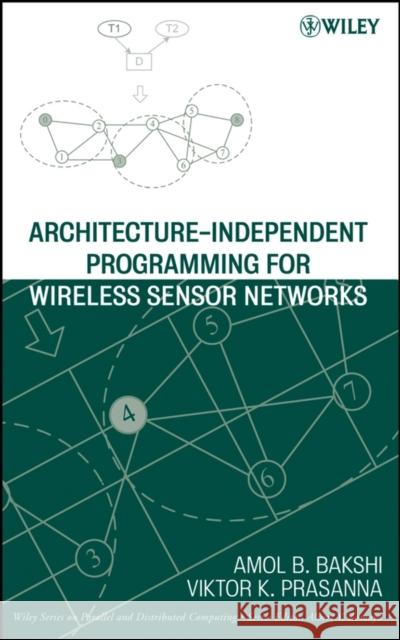
Architecture-Independent Programming for Wireless Sensor Networks Viktor K. Prasanna 9780471778899 Wiley-Interscience - książkaWidoczna okładka, to zdjęcie poglądowe, a rzeczywista szata graficzna może różnić się od prezentowanej.

Architecture-Independent Programming for Wireless Sensor Networks

ISBN-13: 9780471778899 / Angielski / Twarda / 2008 / 208 str.

Viktor K. Prasanna
cena 518,33 zł
(netto: 493,65 VAT:  5%)

Najniższa cena z 30 dni: 513,03 zł
Termin realizacji zamówienia:
ok. 30 dni roboczych
Bez gwarancji dostawy przed świętami

Darmowa dostawa!

New automated, application-independent methodology for designing and deploying sensor networks Following this book's clear explanations, examples, and illustrations, domain experts can design and deploy nontrivial networked sensing applications without much knowledge of the low-level networking aspects of deployment. This new approach is based on the Abstract Task Graph (ATaG), a data-driven programming model and an innovative methodology forarchitecture-independent programming and automatic software synthesis for sensor networks. ATaG programs are concise, understandable, and network-independent descriptions of global application functionality that can be automatically compiled onto any target deployment. The book begins with an overview chapter that addresses the important issues of programming methodologies and compares various programming models for sensor networks. Next, the authors set forth everything you need for designing and deploying sensor networks using ATaG, including:

  • Detailed description of the ATaG model's features
  • System-level support for architecture-independent programming
  • Examination of the graphical programming and software synthesis environment for ATaG
  • Case study illustrating the process of end-to-end application development and software synthesis using ATaG
Throughout the book, the authors provide code excerpts and figures to help clarify key concepts and explain each step. For programmers, the graphical formalism of the ATaG program, coupled with the fact it uses an existing language (Java), means that no special training is needed to start developing and deploying applications in ATaG. Everything you need to know is clearly set forth in this book.

Kategorie:
Technologie
Kategorie BISAC:
Computers > Computer Architecture
Wydawca:
Wiley-Interscience
Seria wydawnicza:
Wiley Series on Parallel and Distributed Computing
Język:
Angielski
ISBN-13:
9780471778899
Rok wydania:
2008
Numer serii:
000107225
Ilość stron:
208
Waga:
0.47 kg
Wymiary:
24.26 x 16.03 x 1.8
Oprawa:
Twarda
Wolumenów:
01
Dodatkowe informacje:
Bibliografia
Wydanie ilustrowane

Preface.

Acknowledgments.

1. Introduction.

1.1 Sensor networks and traditional distributed systems.

1.2 Programming of distributed sensor networks.

1.2.1 Layers of programming abstraction.

1.2.1.1 Service–oriented specification.

1.2.1.2 Macroprogramming.

1.2.1.3 Node–centric programming.

1.2.2 Lessons from parallel and distributed computing.

1.3 Macroprogramming: What and Why?

1.4 Contributions and Outline.

2. The Abstract Task Graph.

2.1 Target applications and architectures.

2.2 Key Concepts.

2.2.1 Data Driven Computing.

2.2.1.1 Program flow mechanisms.

2.2.1.2 Why data driven?

2.2.2 Mixed Imperative–Declarative Specification.

2.3 Syntax.

2.3.1 The Structure of an ATaG Program.

2.3.2 More on Task Annotations.

2.3.3 Illustrative examples.

2.4 Semantics.

2.4.1 Terminology.

2.4.2 Firing rules.

2.4.3 Task graph execution.

2.4.4 get() and put().

2.5 Programming idioms.

2.5.1 Object tracking.

2.5.2 Interaction within local neighborhoods.

2.5.3 In–network aggregation.

2.5.4 Hierarchical data fusion.

2.5.5 Event–triggered behavior instantiation.

2.6 Future work.

2.6.1 State–based dynamic behaviors.

2.6.2 Resource management in the runtime system.

2.6.3 Utility based negotiation for task scheduling and resource allocation.

2.6.4 Analyzing feasibility of compilation.

3. DART:The Data Driven ATaG Runtime.

3.1 Design objectives.

3.1.1 Support for ATaG semantics.

3.1.2 Platform independence.

3.1.3 Component–based design.

3.1.4 Ease of software synthesis.

3.2 Overview.

3.3 Components and functionalities.

3.3.1 Task, Data, and Channel Declarations.

3.3.2 UserTask.

3.3.2.1 Service.

3.3.2.2 Interactions.

3.3.2.3 Implementation.

3.3.3 DataPool.

3.3.3.1 Service.

3.3.3.2 Interactions.

3.3.3.3 Implementation.

3.3.4 AtagManager.

3.3.4.1 Service.

3.3.4.2 Interactions.

3.3.4.3 Implementation.

3.3.5 NetworkStack.

3.3.5.1 Service.

3.3.5.2 Interactions.

3.3.5.3 Implementation.

3.3.6 NetworkArchitecture.

3.3.6.1 Service.

3.3.6.2 Interactions.

3.3.6.3 Implementation.

3.3.7 Dispatcher.

3.3.7.1 Service.

3.3.7.2 Interactions.

3.3.7.3 Implementation.

3.4 Control flow.

3.4.1 Startup.

3.4.2 get() and put().

3.4.3 Illustrative example.

3.5 Future work.

3.5.1 Lazy compilation of channel annotations.

3.5.2 Automatic priority assignment for task scheduling.

4. Programming and Software Synthesis.

4.1 Terminology.

4.2 Meta–modeling for the ATaG domain.

4.2.1 Objectives.

4.2.2 Application model.

4.2.3 Network model.

4.3 The programming interface.

4.4 Compilation and software synthesis.

4.4.1 Translating task annotations.

4.4.2 Automatic software synthesis.

4.4.3 The ATaG simulator.

4.4.4 Initialization.

4.4.4.1 Situatedness.

4.4.4.2 Network interface.

4.4.4.3 Network architecture.

4.4.4.4 Sensor interface.

4.4.5 Visualizing synthesized application behavior.

5 Case Study: Application Development with ATaG.

5.1 Overview of the use case.

5.2 Designing the macroprograms.

5.2.1 Temperature gradient monitoring.

5.2.2 Object detection and tracking.

5.3 Specifying the declarative portion.

5.4 Imperative portion: Temperature gradient monitoring.

5.4.1 Abstract data items: Temperature and Fire.

5.4.2 Abstract Task: Monitor.

5.4.3 Abstract Task: Temperature Sampler.

5.4.4 Abstract Task: Alarm Actuator.

5.5 Imperative portion: Object detection and tracking.

5.5.1 Abstract data items: TargetAlert and TargetInfo.

5.5.2 Abstract Task: SampleAndThreshold.

5.5.3 Abstract Task: Leader.

5.5.4 Abstract Task: Supervisor.

5.6 Application Composition.

5.7 Software Synthesis.

6 Concluding Remarks.

6.1 A framework for domain–specific application development.

6.2 A framework for compilation and software synthesis.

References.

Amol B. Bakshi, PhD, is a Research Assistant Professor in the Ming Hsieh Department of Electrical Engineering at the University of Southern California (USC), Los Angeles. He also manages the Integrated Asset Management project at the USC–Chevron Center of Excellence for Research and Academic Training on Interactive Smart Oilfield Technologies. Dr. Bakshi′s PhD research was on programming models for networked sensor systems and led to the creation of the ATaG programming model and software synthesis toolkit. His current interests include semantic Web technologies for information integration, smart oilfield technologies, model integrated computing, and sensor networks.

Viktor K. Prasanna, PhD, is Charles Lee Powell Chair in Engineering and Professor of Electrical Engineering and Professor of Computer Science at the University of Southern California (USC), Los Angeles. He is also an associate member of the Center for Applied Mathematical Sciences (CAMS) at USC, and a member of the USC–Chevron Center of Excellence for Research and Academic Training on Interactive Smart Oilfield Technologies. He has served on the editorial boards of the Journal of Parallel and Distributed Computing, Proceedings of the IEEE, IEEE Transactions on VLSI Systems, and IEEE Transactions on Parallel and Distributed Systems. He was editor–in–chief of the IEEE Transactions on Computers and was the founding chair of the IEEE Computer Society Technical Committee on Parallel Processing. He is a Fellow of the IEEE and the ACM.

New automated, application–independent methodology for designing and deploying sensor networks

Following this book′s clear explanations, examples, and illustrations, domain experts can design and deploy nontrivial networked sensing applications without much knowledge of the low–level networking aspects of deployment. This new approach is based on the Abstract Task Graph (ATaG), a data–driven programming model and an innovative methodology forarchitecture–independent programming and automatic software synthesis for sensor networks. ATaG programs are concise, understandable, and network–independent descriptions of global application functionality that can be automatically compiled onto any target deployment.

The book begins with an overview chapter that addresses the important issues of programming methodologies and compares various programming models for sensor networks. Next, the authors set forth everything you need for designing and deploying sensor networks using ATaG, including:

  • Detailed description of the ATaG model′s features

  • System–level support for architecture–independent programming

  • Examination of the graphical programming and software synthesis environment for ATaG

  • Case study illustrating the process of end–to–end application development and software synthesis using ATaG

Throughout the book, the authors provide code excerpts and figures to help clarify key concepts and explain each step.

For programmers, the graphical formalism of the ATaG program, coupled with the fact it uses an existing language (Java), means that no special training is needed to start developing and deploying applications in ATaG. Everything you need to know is clearly set forth in this book.

Prasanna, Viktor K. Amol B. Bakshi, PhD, is a Research Assistant Profe... więcej >


Udostępnij

Facebook - konto krainaksiazek.pl


Opinie o Krainaksiazek.pl na Opineo.pl

Partner Mybenefit

Krainaksiazek.pl w programie rzetelna firma Krainaksiaze.pl - płatności przez paypal

Czytaj nas na:

Facebook - krainaksiazek.pl
  • książki na zamówienie
  • granty
  • książka na prezent
  • kontakt
  • pomoc
  • opinie
  • regulamin
  • polityka prywatności

Zobacz:

  • Księgarnia czeska

  • Wydawnictwo Książkowe Klimaty

1997-2025 DolnySlask.com Agencja Internetowa

© 1997-2022 krainaksiazek.pl
     
KONTAKT | REGULAMIN | POLITYKA PRYWATNOŚCI | USTAWIENIA PRYWATNOŚCI
Zobacz: Księgarnia Czeska | Wydawnictwo Książkowe Klimaty | Mapa strony | Lista autorów
KrainaKsiazek.PL - Księgarnia Internetowa

Polityka prywatnosci - link
Krainaksiazek.pl - płatnośc Przelewy24
Przechowalnia Przechowalnia





