• Wyszukiwanie zaawansowane
  • Kategorie
  • Kategorie BISAC
  • Książki na zamówienie
  • Promocje
  • Granty
  • Książka na prezent
  • Opinie
  • Pomoc
  • Załóż konto
  • Zaloguj się

Applied Manova and Discriminant Analysis » książka


zaloguj się | załóż konto
Logo Krainaksiazek.pl

koszyk

konto

szukaj
topmenu
Księgarnia internetowa
Szukaj
Książki na zamówienie
Promocje
Granty
Książka na prezent
Moje konto
Pomoc
 
 
Wyszukiwanie zaawansowane
Pusty koszyk
Bezpłatna dostawa dla zamówień powyżej 20 złBezpłatna dostawa dla zamówień powyżej 20 zł

Kategorie główne

• Nauka
 [2949965]
• Literatura piękna
 [1857847]

  więcej...
• Turystyka
 [70818]
• Informatyka
 [151303]
• Komiksy
 [35733]
• Encyklopedie
 [23180]
• Dziecięca
 [617748]
• Hobby
 [139972]
• AudioBooki
 [1650]
• Literatura faktu
 [228361]
• Muzyka CD
 [398]
• Słowniki
 [2862]
• Inne
 [444732]
• Kalendarze
 [1620]
• Podręczniki
 [167233]
• Poradniki
 [482388]
• Religia
 [509867]
• Czasopisma
 [533]
• Sport
 [61361]
• Sztuka
 [243125]
• CD, DVD, Video
 [3451]
• Technologie
 [219309]
• Zdrowie
 [101347]
• Książkowe Klimaty
 [123]
• Zabawki
 [2362]
• Puzzle, gry
 [3791]
• Literatura w języku ukraińskim
 [253]
• Art. papiernicze i szkolne
 [7933]
Kategorie szczegółowe BISAC

Applied Manova and Discriminant Analysis

ISBN-13: 9780471468158 / Angielski / Twarda / 2006 / 528 str.
Carl J. Huberty; Stephen Olejnik
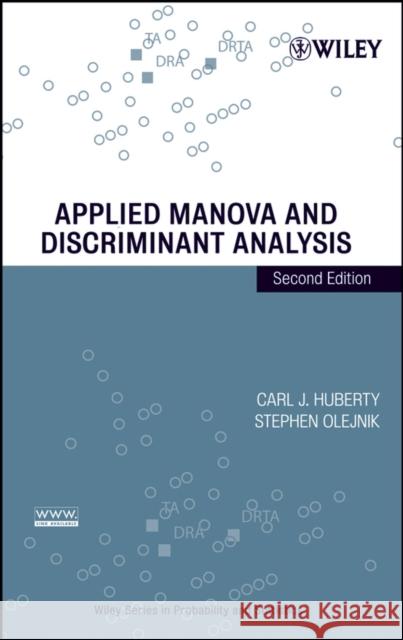
Applied Manova and Discriminant Analysis Huberty, Carl J. 9780471468158 Wiley-Interscience - książkaWidoczna okładka, to zdjęcie poglądowe, a rzeczywista szata graficzna może różnić się od prezentowanej.

Applied Manova and Discriminant Analysis

ISBN-13: 9780471468158 / Angielski / Twarda / 2006 / 528 str.

Carl J. Huberty; Stephen Olejnik
cena 723,71 zł
(netto: 689,25 VAT:  5%)

Najniższa cena z 30 dni: 716,31 zł
Termin realizacji zamówienia:
ok. 30 dni roboczych
Bez gwarancji dostawy przed świętami

Darmowa dostawa!

A complete introduction to discriminant analysis--extensively revised, expanded, and updated This Second Edition of the classic book, Applied Discriminant Analysis, reflects and references current usage with its new title, Applied MANOVA and Discriminant Analysis. Thoroughly updated and revised, this book continues to be essential for any researcher or student needing to learn to speak, read, and write about discriminant analysis as well as develop a philosophy of empirical research and data analysis. Its thorough introduction to the application of discriminant analysis is unparalleled. Offering the most up-to-date computer applications, references, terms, and real-life research examples, the Second Edition also includes new discussions of MANOVA, descriptive discriminant analysis, and predictive discriminant analysis. Newer SAS macros are included, and graphical software with data sets and programs are provided on the book's related Web site. The book features:

  • Detailed discussions of multivariate analysis of variance and covariance
  • An increased number of chapter exercises along with selected answers
  • Analyses of data obtained via a repeated measures design
  • A new chapter on analyses related to predictive discriminant analysis
  • Basic SPSS(r) and SAS(r) computer syntax and output integrated throughout the book
Applied MANOVA and Discriminant Analysis enables the reader to become aware of various types of research questions using MANOVA and discriminant analysis; to learn the meaning of this field's concepts and terms; and to be able to design a study that uses discriminant analysis through topics such as one-factor MANOVA/DDA, assessing and describing MANOVA effects, and deleting and ordering variables.

Kategorie:
Nauka, Matematyka
Kategorie BISAC:
Mathematics > Prawdopodobieństwo i statystyka
Wydawca:
Wiley-Interscience
Seria wydawnicza:
Wiley Series in Probability and Statistics
Język:
Angielski
ISBN-13:
9780471468158
Rok wydania:
2006
Numer serii:
000033279
Ilość stron:
528
Waga:
0.85 kg
Wymiary:
23.57 x 16.1 x 3.0
Oprawa:
Twarda
Wolumenów:
01
Dodatkowe informacje:
Bibliografia
Wydanie ilustrowane

" This is a valuable addition to the literature on MANOVA and DA, with emphasis on applications." ( Zentralblatt MATH, 2007)

" a useful addition to the literature I am very happy to have this book on my shelf." (Journal of the American Statistical Association, September 2007)

List of Figures.

List of Tables.

Preface to Second Edition.

Acknowledgments.

Preface to First Edition.

Notation.

I INTRODUCTION.

1 Discriminant Analysis in Research.

1.1 A Little History.

1.2 Overview.

1.3 Descriptive Discriminant Analysis.

1.4 Predictive Discriminant Analysis.

1.5 Design in Discriminant Analysis.

2 Preliminaries.

2.1 Introduction.

2.2 Research Context.

2.3 Data, Analysis Units, Variables, and Constructs.

2.4 Summarizing Data.

2.5 Matrix Operations.

2.6 Distance.

2.7 Linear Composite.

2.8 Probability.

2.9 Statistical Testing.

2.10 Judgment in Data Analysis.

2.11 Summary.

II ONE–FACTOR MANOVA/DDA.

3 Group Separation.

3.1 Introduction.

3.2 Two–Group Analyses.

3.3 Test for Covariance Matrix Equality.

3.4 Yao Test.

3.5 Multiple–Group Analyses Single Factor.

3.6 Computer Application.

3.7 Summary.

4 Assessing MANOVA Effects.

4.1 Introduction.

4.2 Strength of Association.

4.3 Computer Application I.

4.4 Group Contrasts.

4.5 Computer Application II.

4.6 Covariance Matrix Heterogeneity.

4.7 Sample Size.

4.8 Summary.

5 Describing MANOVA Effects.

5.1 Introduction.

5.2 Omnibus Effects.

5.3 Computer Application I.

5.4 Standardized LDFWeights.

5.5 LDF Space Dimension.

5.6 Computer Application II.

5.7 Computer Application III.

5.8 Contrast Effects.

5.9 Computer Application IV.

5.10 Summary.

6 Deleting and Ordering Variables.

6.1 Introduction.

6.2 Variable Deletion.

6.3 Variable Ordering.

6.4 Contrast Analyses.

6.5 Computer Application II.

6.6 Comments.

7 Reporting DDA Results.

7.1 Introduction.

7.2 Example of Reporting DDA Results.

7.3 Computer Package Information.

7.4 Reporting Terms.

7.5 MANOVA/DDA Applications.

7.6 Concerns.

7.7 Overview.

III FACTORIAL MANOVA, MANCOVA, AND REPEATED MEASURES.

8 Factorial MANOVA.

8.1 Introduction.

8.2 Research Context.

8.3 Univariate Analysis.

8.4 Multivariate Analysis.

8.5 Computer Application I.

8.6 Computer Application II.

8.7 Nonorthogonal Design.

8.8 Outcome Variable Ordering and Deletion.

8.9 Summary.

9 Analysis of Covariance.

9.1 Introduction.

9.2 Research Context.

9.3 Univariate ANCOVA.

9.4 Multivariate ANCOVA (MANCOVA).

9.5 Computer Application I.

9.6 Comparing Adjusted Means Omnibus Test.

9.7 Computer Application II.

9.8 Contrast Analysis.

9.9 Computer Application III.

9.10 Summary.

10 Repeated–Measures Analysis.

10.1 Introduction.

10.2 Research Context.

10.3 Univariate Analyses.

10.4 Multivariate Analysis.

10.5 Computer Application I.

10.6 Univariate and Multivariate Analyses.

10.7 Testing for Sphericity.

10.8 Computer Application II.

10.9 Contrast Analysis.

10.10 Computer Application III.

10.11 Summary.

11 Mixed–Model Analysis.

11.1 Introduction.

11.2 Research Context.

11.3 Univariate Analysis.

11.4 Multivariate Analysis.

11.5 Computer Application I.

11.6 Contrast Analysis.

11.7 Computer Application II.

11.8 Summary.

IV GROUP MEMBERSHIP PREDICTION.

12 Classification Basics.

12.1 Introduction.

12.2 Notion of Distance.

12.3 Distance and Classification.

12.4 Classification Rules in General.

12.5 Comments.

13 Multivariate Normal Rules.

13.1 Introduction.

13.2 Normal Density Functions.

13.3 Classification Rules Based on Normality.

13.4 Classification Functions.

13.5 Summary of Classification Statistics.

13.6 Choice of Rule Form.

13.7 Comments.

14 Classification Results.

14.1 Introduction.

14.2 Research Context.

14.3 Computer Application.

14.4 Individual Unit Results.

14.5 Group Results.

14.6 Comments.

15 Hit Rate Estimation.

15.1 Introduction.

15.2 True Hit Rates.

15.3 Hit Rate Estimators.

15.4 Computer Application.

15.5 Choice of Hit Rate Estimator.

15.6 Outliers and In–Doubt Units.

15.7 Sample Size.

15.8 Comments.

16 Effectiveness of Classification Rules.

16.1 Introduction.

16.2 Proportional Chance Criterion.

16.3 Maximum–Chance Criterion.

16.4 Improvement over Chance.

16.5 Comparison of Rules.

16.6 Computer Application I.

16.7 Effect of Unequal Priors.

16.8 PDA Validity/Reliability.

16.9 Applying a Classification Rule to New Units.

16.10 Comments.

17 Deleting and Ordering Predictors.

17.1 Introduction.

17.2 Predictor Deletion.

17.3 Computer Application.

17.4 Predictor Ordering.

17.5 Reanalysis.

17.6 Comments.

17.7 Side Note.

18 Two–Group Classification.

18.1 Introduction.

18.2 Two–Group Rule.

18.3 Regression Analogy.

18.4 MRA PDA Relationship.

18.5 Necessary Sample Size.

18.6 Univariate Classification.

19 Nonnormal Rules.

19.1 Introduction.

19.2 Continuous Variables.

19.3 Categorical Variables.

19.4 Predictor Mixtures.

19.5 Comments.

20 Reporting PDA Results.

20.1 Introduction.

20.2 Example of Reporting PDA Results.

20.3 Some Additional Specific PDA Information.

20.4 Computer Package Information.

20.5 Reporting Terms.

20.6 Sources of PDA Applications.

20.7 Concerns.

20.8 Overview.

Further Reading.

Exercises.

21 PDA–Related Analyses.

21.1 Introduction.

21.2 Nonlinear Methods.

21.3 Other Methods.

V ISSUES AND PROBLEMS.

22 Issues in PDA and DDA.

22.1 Introduction.

22.2 Five Choices in PDA.

22.3 Stepwise Analyses.

22.4 StandardizedWeights Versus Structure r s.

22.5 Data–Based Structure.

23 Problems in PDA and DDA.

23.1 Introduction.

23.2 Missing Data.

23.3 Outliers and Influential Observations.

23.4 Initial Group Misclassification.

23.5 Misclassification Costs.

23.6 Statistical Versus Clinical Prediction.

23.7 Other Problems.

Appendix A: Data Set Descriptions.

Appendix B: Some DA–Related Originators.

Appendix C: List of Computer Syntax.

Appendix D: Contents ofWileyWebsite.

References.

Answers to Exercises.

Index.

CARL J. HUBERTY, PhD, is Professor Emeritus in the Department of Educational Psychology and Instructional Technology at The University of Georgia. He received his PhD in statistical methods from The University of Iowa and has written chapters in many books throughout his career.

STEPHEN OLEJNIK, PhD, is Professor in the Department of Educational Psychology and Instructional Technology at The University of Georgia. He received his PhD in educational psychology, applied statistics, and research design from Michigan State University.

A complete introduction to discriminant analysis extensively revised, expanded, and updated

This Second Edition of the classic book, Applied Discriminant Analysis, reflects and references current usage with its new title, Applied MANOVA and Discriminant Analysis. Thoroughly updated and revised, this book continues to be essential for any researcher or student needing to learn to speak, read, and write about discriminant analysis as well as develop a philosophy of empirical research and data analysis. Its thorough introduction to the application of discriminant analysis is unparalleled.

Offering the most up–to–date computer applications, references, terms, and real–life research examples, the Second Edition also includes new discussions of MANOVA, descriptive discriminant analysis, and predictive discriminant analysis. Newer SAS macros are included, and graphical software with data sets and programs are provided on the book′s related Web site.

The book features:

  • Detailed discussions of multivariate analysis of variance and covariance
  • An increased number of chapter exercises along with selected answers
  • Analyses of data obtained via a repeated measures design
  • A new chapter on analyses related to predictive discriminant analysis
  • Basic SPSS® and SAS® computer syntax and output integrated throughout the book

Applied MANOVA and Discriminant Analysis enables the reader to become aware of various types of research questions using MANOVA and discriminant analysis; to learn the meaning of this field′s concepts and terms; and to be able to design a study that uses discriminant analysis through topics such as one–factor MANOVA/DDA, assessing and describing MANOVA effects, and deleting and ordering variables.

Huberty, Carl J. CARL J. HUBERTY, PhD, is Professor Emeritus in the... więcej >
Olejnik, Stephen CARL J. HUBERTY, PhD, is Professor Emeritus in the... więcej >


Udostępnij

Facebook - konto krainaksiazek.pl


Opinie o Krainaksiazek.pl na Opineo.pl

Partner Mybenefit

Krainaksiazek.pl w programie rzetelna firma Krainaksiaze.pl - płatności przez paypal

Czytaj nas na:

Facebook - krainaksiazek.pl
  • książki na zamówienie
  • granty
  • książka na prezent
  • kontakt
  • pomoc
  • opinie
  • regulamin
  • polityka prywatności

Zobacz:

  • Księgarnia czeska

  • Wydawnictwo Książkowe Klimaty

1997-2025 DolnySlask.com Agencja Internetowa

© 1997-2022 krainaksiazek.pl
     
KONTAKT | REGULAMIN | POLITYKA PRYWATNOŚCI | USTAWIENIA PRYWATNOŚCI
Zobacz: Księgarnia Czeska | Wydawnictwo Książkowe Klimaty | Mapa strony | Lista autorów
KrainaKsiazek.PL - Księgarnia Internetowa

Polityka prywatnosci - link
Krainaksiazek.pl - płatnośc Przelewy24
Przechowalnia Przechowalnia





