• Wyszukiwanie zaawansowane
  • Kategorie
  • Kategorie BISAC
  • Książki na zamówienie
  • Promocje
  • Granty
  • Książka na prezent
  • Opinie
  • Pomoc
  • Załóż konto
  • Zaloguj się

Applied Data Mining for Business and Industry » książka


zaloguj się | załóż konto
Logo Krainaksiazek.pl

koszyk

konto

szukaj
topmenu
Księgarnia internetowa
Szukaj
Książki na zamówienie
Promocje
Granty
Książka na prezent
Moje konto
Pomoc
 
 
Wyszukiwanie zaawansowane
Pusty koszyk
Bezpłatna dostawa dla zamówień powyżej 20 złBezpłatna dostawa dla zamówień powyżej 20 zł

Kategorie główne

• Nauka
 [2950560]
• Literatura piękna
 [1849509]

  więcej...
• Turystyka
 [71097]
• Informatyka
 [151150]
• Komiksy
 [35848]
• Encyklopedie
 [23178]
• Dziecięca
 [617388]
• Hobby
 [139064]
• AudioBooki
 [1657]
• Literatura faktu
 [228597]
• Muzyka CD
 [383]
• Słowniki
 [2855]
• Inne
 [445295]
• Kalendarze
 [1464]
• Podręczniki
 [167547]
• Poradniki
 [480102]
• Religia
 [510749]
• Czasopisma
 [516]
• Sport
 [61293]
• Sztuka
 [243352]
• CD, DVD, Video
 [3414]
• Technologie
 [219456]
• Zdrowie
 [101002]
• Książkowe Klimaty
 [124]
• Zabawki
 [2311]
• Puzzle, gry
 [3459]
• Literatura w języku ukraińskim
 [254]
• Art. papiernicze i szkolne
 [8079]
Kategorie szczegółowe BISAC

Applied Data Mining for Business and Industry

ISBN-13: 9780470058879 / Angielski / Miękka / 2009 / 264 str.
Paolo Giudici; Silvia Figini
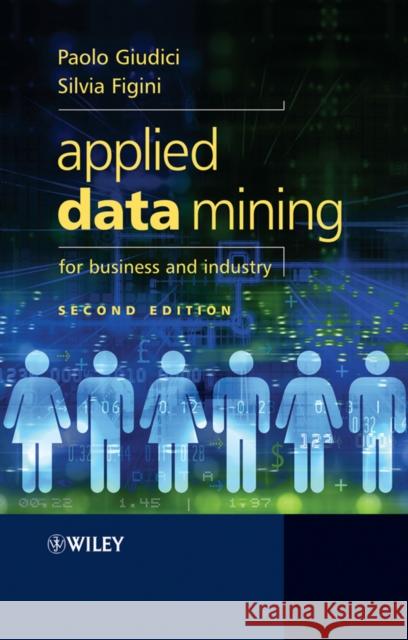
Applied Data Mining for Business and Industry Paolo Giudici Silvia Figini 9780470058879 John Wiley & Sons - książkaWidoczna okładka, to zdjęcie poglądowe, a rzeczywista szata graficzna może różnić się od prezentowanej.

Applied Data Mining for Business and Industry

ISBN-13: 9780470058879 / Angielski / Miękka / 2009 / 264 str.

Paolo Giudici; Silvia Figini
cena 255,42
(netto: 243,26 VAT:  5%)

Najniższa cena z 30 dni: 253,85
Termin realizacji zamówienia:
ok. 30 dni roboczych
Dostawa w 2026 r.

Darmowa dostawa!

The increasing availability of data in our current, information overloaded society has led to the need for valid tools for its modelling and analysis. Data mining and applied statistical methods are the appropriate tools to extract knowledge from such data. This book provides an accessible introduction to data mining methods in a consistent and application oriented statistical framework, using case studies drawn from real industry projects and highlighting the use of data mining methods in a variety of business applications.

Introduces data mining methods and applications.Covers classical and Bayesian multivariate statistical methodology as well as machine learning and computational data mining methods.Includes many recent developments such as association and sequence rules, graphical Markov models, lifetime value modelling, credit risk, operational risk and web mining.Features detailed case studies based on applied projects within industry.Incorporates discussion of data mining software, with case studies analysed using R.Is accessible to anyone with a basic knowledge of statistics or data analysis.Includes an extensive bibliography and pointers to further reading within the text.

"Applied Data Mining for Business and Industry, 2nd edition" is aimed at advanced undergraduate and graduate students of data mining, applied statistics, database management, computer science and economics. The case studies will provide guidance to professionals working in industry on projects involving large volumes of data, such as customer relationship management, web design, risk management, marketing, economics and finance.


Kategorie:
Nauka, Matematyka
Kategorie BISAC:
Mathematics > Prawdopodobieństwo i statystyka
Computers > Database Administration & Management
Wydawca:
John Wiley & Sons
Język:
Angielski
ISBN-13:
9780470058879
Rok wydania:
2009
Numer serii:
000022326
Ilość stron:
264
Waga:
0.38 kg
Wymiary:
22.61 x 14.99 x 1.78
Oprawa:
Miękka
Wolumenów:
01
Dodatkowe informacje:
Bibliografia
Wydanie ilustrowane

If I had to recommend a good introduction to data mining, I would choose this one.   (Stat Papers, 2011)

1 Introduction.

Part I Methodology.

2 Organisation of the data.

2.1 Statistical units and statistical variables.

2.2 Data matrices and their transformations.

2.3 Complex data structures.

2.4 Summary.

3 Summary statistics.

3.1 Univariate exploratory analysis.

3.1.1 Measures of location.

3.1.2 Measures of variability.

3.1.3 Measures of heterogeneity.

3.1.4 Measures of concentration.

3.1.5 Measures of asymmetry.

3.1.6 Measures of kurtosis.

3.2 Bivariate exploratory analysis of quantitative data.

3.3 Multivariate exploratory analysis of quantitative data.

3.4 Multivariate exploratory analysis of qualitative data.

3.4.1 Independence and association.

3.4.2 Distance measures.

3.4.3 Dependency measures.

3.4.4 Model–based measures.

3.5 Reduction of dimensionality.

3.5.1 Interpretation of the principal components.

3.6 Further reading.

4 Model specification.

4.1 Measures of distance.

4.1.1 Euclidean distance.

4.1.2 Similarity measures.

4.1.3 Multidimensional scaling.

4.2 Cluster analysis.

4.2.1 Hierarchical methods.

4.2.2 Evaluation of hierarchical methods.

4.2.3 Non–hierarchical methods.

4.3 Linear regression.

4.3.1 Bivariate linear regression.

4.3.2 Properties of the residuals.

4.3.3 Goodness of fit.

4.3.4 Multiple linear regression.

4.4 Logistic regression.

4.4.1 Interpretation of logistic regression.

4.4.2 Discriminant analysis.

4.5 Tree models.

4.5.1 Division criteria.

4.5.2 Pruning.

4.6 Neural networks.

4.6.1 Architecture of a neural network.

4.6.2 The multilayer perceptron.

4.6.3 Kohonen networks.

4.7 Nearest–neighbour models.

4.8 Local models.

4.8.1 Association rules.

4.8.2 Retrieval by content.

4.9 Uncertainty measures and inference.

4.9.1 Probability.

4.9.2 Statistical models.

4.9.3 Statistical inference.

4.10 Non–parametric modelling.

4.11 The normal linear model.

4.11.1 Main inferential results.

4.12 Generalised linear models.

4.12.1 The exponential family.

4.12.2 Definition of generalised linear models.

4.12.3 The logistic regression model.

4.13 Log–linear models.

4.13.1 Construction of a log–linear model.

4.13.2 Interpretation of a log–linear model.

4.13.3 Graphical log–linear models.

4.13.4 Log–linear model comparison.

4.14 Graphical models.

4.14.1 Symmetric graphical models.

4.14.2 Recursive graphical models.

4.14.3 Graphical models and neural networks.

4.15 Survival analysis models.

4.16 Further reading.

5 Model evaluation.

5.1 Criteria based on statistical tests.

5.1.1 Distance between statistical models.

5.1.2 Discrepancy of a statistical model.

5.1.3 Kullback Leibler discrepancy.

5.2 Criteria based on scoring functions.

5.3 Bayesian criteria.

5.4 Computational criteria.

5.5 Criteria based on loss functions.

5.6 Further reading.

Part II Business case studies.

6 Describing website visitors.

6.1 Objectives of the analysis.

6.2 Description of the data.

6.3 Exploratory analysis.

6.4 Model building.

6.4.1 Cluster analysis.

6.4.2 Kohonen networks.

6.5 Model comparison.

6.6 Summary report.

7 Market basket analysis.

7.1 Objectives of the analysis.

7.2 Description of the data.

7.3 Exploratory data analysis.

7.4 Model building.

7.4.1 Log–linear models.

7.4.2 Association rules.

7.5 Model comparison.

7.6 Summary report.

8 Describing customer satisfaction.

8.1 Objectives of the analysis.

8.2 Description of the data.

8.3 Exploratory data analysis.

8.4 Model building.

8.5 Summary.

9 Predicting credit risk of small businesses.

9.1 Objectives of the analysis.

9.2 Description of the data.

9.3 Exploratory data analysis.

9.4 Model building.

9.5 Model comparison.

9.6 Summary report.

10 Predicting e–learning student performance.

10.1 Objectives of the analysis.

10.2 Description of the data.

10.3 Exploratory data analysis.

10.4 Model specification.

10.5 Model comparison.

10.6 Summary report.

11 Predicting customer lifetime value.

11.1 Objectives of the analysis.

11.2 Description of the data.

11.3 Exploratory data analysis.

11.4 Model specification.

11.5 Model comparison.

11.6 Summary report.

12 Operational risk management.

12.1 Context and objectives of the analysis.

12.2 Exploratory data analysis.

12.3 Model building.

12.4 Model comparison.

12.5 Summary conclusions.

References.

Index.

Paolo Giudici   Department of Economics and Quantitative Methods, University of Pavia, A lecturer in data mining, business statistics, data analysis and risk management, Professor Giudici is also the director of the data mining laboratory. He is the author of around 80 publications, and the coordinator of 2 national research grants on data mining, and local coordinator of a European integrated project on the topic. He was the sole author of the first edition of this book, which has been translated into both Italian and Chinese. He is also one of the Editors of Wiley′s Series in Computational Statistics.

Silvia Figini, Ms Figini has worked for 2 years for the Competence centre for data mining analysis and business intelligence at SAS Milan. She is currently completing a PhD in statistics, and already has a collection of publications to her name

The increasing availability of data in our current, information overloaded society has led to the need for valid tools for its modelling and analysis. Data mining and applied statistical methods are the appropriate tools to extract knowledge from such data. This book provides an accessible introduction to data mining methods in a consistent and application oriented statistical framework, using case studies drawn from real industry projects and highlighting the use of data mining methods in a variety of business applications.

  • Introduces data mining methods and applications.
  • Covers classical and Bayesian multivariate statistical methodology as well as machine learning and computational data mining methods.
  • Includes many recent developments such as association and sequence rules, graphical Markov models, lifetime value modelling, credit risk, operational risk and web mining.
  • Features detailed case studies based on applied projects within industry.
  • Incorporates discussion of data mining software, with case studies analysed using R.
  • Is accessible to anyone with a basic knowledge of statistics or data analysis.
  • Includes an extensive bibliography and pointers to further reading within the text.

Applied Data Mining for Business and Industry, 2nd edition is aimed at advanced undergraduate and graduate students of data mining, applied statistics, database management, computer science and economics. The case studies will provide guidance to professionals working in industry on projects involving large volumes of data, such as customer relationship management, web design, risk management, marketing, economics and finance.




Udostępnij

Facebook - konto krainaksiazek.pl


Opinie o Krainaksiazek.pl na Opineo.pl

Partner Mybenefit

Krainaksiazek.pl w programie rzetelna firma Krainaksiaze.pl - płatności przez paypal

Czytaj nas na:

Facebook - krainaksiazek.pl
  • książki na zamówienie
  • granty
  • książka na prezent
  • kontakt
  • pomoc
  • opinie
  • regulamin
  • polityka prywatności

Zobacz:

  • Księgarnia czeska

  • Wydawnictwo Książkowe Klimaty

1997-2025 DolnySlask.com Agencja Internetowa

© 1997-2022 krainaksiazek.pl
     
KONTAKT | REGULAMIN | POLITYKA PRYWATNOŚCI | USTAWIENIA PRYWATNOŚCI
Zobacz: Księgarnia Czeska | Wydawnictwo Książkowe Klimaty | Mapa strony | Lista autorów
KrainaKsiazek.PL - Księgarnia Internetowa

Polityka prywatnosci - link
Krainaksiazek.pl - płatnośc Przelewy24
Przechowalnia Przechowalnia



