• Wyszukiwanie zaawansowane
  • Kategorie
  • Kategorie BISAC
  • Książki na zamówienie
  • Promocje
  • Granty
  • Książka na prezent
  • Opinie
  • Pomoc
  • Załóż konto
  • Zaloguj się

Applications of the Monte Carlo Method in Statistical Physics » książka


zaloguj się | załóż konto
Logo Krainaksiazek.pl

koszyk

konto

szukaj
topmenu
Księgarnia internetowa
Szukaj
Książki na zamówienie
Promocje
Granty
Książka na prezent
Moje konto
Pomoc
 
 
Wyszukiwanie zaawansowane
Pusty koszyk
Bezpłatna dostawa dla zamówień powyżej 20 złBezpłatna dostawa dla zamówień powyżej 20 zł

Kategorie główne

• Nauka
 [2949965]
• Literatura piękna
 [1857847]

  więcej...
• Turystyka
 [70818]
• Informatyka
 [151303]
• Komiksy
 [35733]
• Encyklopedie
 [23180]
• Dziecięca
 [617748]
• Hobby
 [139972]
• AudioBooki
 [1650]
• Literatura faktu
 [228361]
• Muzyka CD
 [398]
• Słowniki
 [2862]
• Inne
 [444732]
• Kalendarze
 [1620]
• Podręczniki
 [167233]
• Poradniki
 [482388]
• Religia
 [509867]
• Czasopisma
 [533]
• Sport
 [61361]
• Sztuka
 [243125]
• CD, DVD, Video
 [3451]
• Technologie
 [219309]
• Zdrowie
 [101347]
• Książkowe Klimaty
 [123]
• Zabawki
 [2362]
• Puzzle, gry
 [3791]
• Literatura w języku ukraińskim
 [253]
• Art. papiernicze i szkolne
 [7933]
Kategorie szczegółowe BISAC

Applications of the Monte Carlo Method in Statistical Physics

ISBN-13: 9783642967900 / Angielski / Miękka / 2012 / 311 str.
K. Binder; A. Baumg Rtner; J. -P Hansen
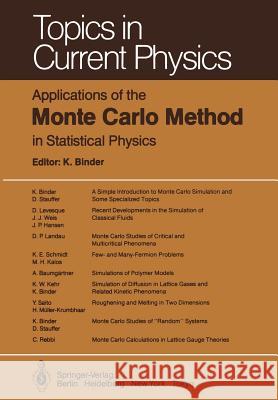
Applications of the Monte Carlo Method in Statistical Physics K. Binder A. Baum J. -P Hansen 9783642967900 Springer - książkaWidoczna okładka, to zdjęcie poglądowe, a rzeczywista szata graficzna może różnić się od prezentowanej.

Applications of the Monte Carlo Method in Statistical Physics

ISBN-13: 9783642967900 / Angielski / Miękka / 2012 / 311 str.

K. Binder; A. Baumg Rtner; J. -P Hansen
cena 201,72 zł
(netto: 192,11 VAT:  5%)

Najniższa cena z 30 dni: 192,74 zł
Termin realizacji zamówienia:
ok. 22 dni roboczych
Bez gwarancji dostawy przed świętami

Darmowa dostawa!

Monte Carlo computer simulations are now a standard tool in scientific fields such as condensed-matter physics, including surface-physics and applied-physics problems (metallurgy, diffusion, and segregation, etc. ), chemical physics, including studies of solutions, chemical reactions, polymer statistics, etc., and field theory. With the increasing ability of this method to deal with quantum-mechanical problems such as quantum spin systems or many-fermion problems, it will become useful for other questions in the fields of elementary-particle and nuclear physics as well. The large number of recent publications dealing either with applications or further development of some aspects of this method is a clear indication that the scientific community has realized the power and versatility of Monte Carlo simula tions, as well as of related simulation techniques such as "molecular dynamics" and "Langevin dynamics," which are only briefly mentioned in the present book. With the increasing availability of recent very-high-speed general-purpose computers, many problems become tractable which have so far escaped satisfactory treatment due to prac tical limitations (too small systems had to be chosen, or too short averaging times had to be used). While this approach is admittedly rather expensive, two cheaper alternatives have become available, too: (i) array or vector processors specifical ly suited for wide classes of simulation purposes; (ii) special purpose processors, which are built for a more specific class of problems or, in the extreme case, for the simulation of one single model system."


Kategorie:
Nauka, Fizyka
Kategorie BISAC:
Science > Chemia - Fizyczna
Science > Termodynamika
Science > Magnetyzm
Wydawca:
Springer
Seria wydawnicza:
Topics in Current Physics
Język:
Angielski
ISBN-13:
9783642967900
Rok wydania:
2012
Wydanie:
Softcover Repri
Numer serii:
000186407
Ilość stron:
311
Waga:
0.57 kg
Wymiary:
24.4 x 17.0
Oprawa:
Miękka
Wolumenów:
01

1. A Simple Introduction to Monte Carlo Simulation and Some Specialized Topics.- 1.1 A First Guide to Monte Carlo Sampling.- 1.1.1 Random Numbers.- 1.1.2 An Example of “Simple Sampling”: The Percolation Problem.- 1.1.3 An Example of “Importance Sampling”: The Ising Model.- 1.1.4 An Example of Continuous Degrees of Freedom: The Heisenberg Model.- 1.1.5 A First Warning: Finite-Size Effects, Metastability, Slowing Down.- 1.2 Special Topics.- 1.2.1 What can be Learned from Distribution Functions; Finite-Size Scaling.- 1.2.2 Estimation of Free Energy and Entropy.- 1.2.3 Estimation of Intensive Thermodynamic Quantities.- 1.2.4 Interface Free Energy.- 1.2.5 Methods of Locating First-Order Phase Changes.- 1.2.6 Linear Response, Susceptibilities and Transport Coefficients.- 1.3 Conclusion.- Appendix. 1.A. Multispin Coding.- References.- Notes Added in Proof.- 2. Recent Developments in the Simulation of Classical Fluids.- 2.1 Some Recent Methodological Developments.- 2.1.1 Modified Metropolis Algorithms.- 2.1.2 Sampling in the Grand-Canonical Ensemble.- 2.1.3 Evaluation of the Chemical Potential.- 2.1.4 Variations on a Theme.- 2.2 Simple Monatomic Fluids.- 2.2.1 Hard-Core Systems in Two and Three Dimensions.- 2.2.2 Soft-Core and Lennard-Jones Systems in Two Dimensions.- 2.2.3 Rare-Gas Fluids in Three Dimensions.- 2.2.4 Binary Mixtures of Simple Fluids.- 2.3 Coulombic Systems.- 2.3.1 Boundary Conditions.- 2.3.2 The One-Component Plasma (OCP).- 2.3.3 Two-Dimensional Electron Layers.- 2.3.4 Liquid Metals.- 2.3.5 Primitive Model Electrolytes.- 2.3.6 Simple Models of Polyelectrolytes.- 2.3.7 Molten Salts and Superionic Conductors.- a) KCl.- b) KCN.- c) Alkali Chlorides.- d) Rb Halides.- e) Cs Halides.- f) Alkaline Earth Halides.- g) Molten Salt Mixtures.- h) Superionic Conductors.- 2.4 Molecular Liquids.- 2.4.1 Hard Nonspherical Particles.- a) Hard Spherocylinders.- b) Mixtures of Hard Spheres and Hard Spherocylinders.- c) Hard Diatomics.- 2.4.2 Two-Center Molecular Liquids.- 2.4.3 Simple Dipolar and Multipolar Liquids.- a) Dipolar Hard-Sphere Systems.- b) Two- and Three-Dimensional Stockmayer Fluids.- c) Systems of Polarizable Particles.- d) Steric Effects in Polar Fluids.- 2.4.4 Realistic Models of Molecular Liquids.- 2.4.5 Liquid Water.- 2.5 Solutions.- 2.5.1 Dilute Aqueous Solutions of Nonelectrolytes.- 2.5.2 Solvation of Ions.- 2.5.3 Solvation of Large Dipoles.- 2.5.4 Solvation of Biological Molecules.- 2.6 Surfaces and Interfaces.- 2.6.1 Liquid-Vapor Interface of Simple Fluids.- 2.6.2 Liquid-Vapor Interface of Molecular Fluids.- 2.6.3 Density Profiles of the One-Component Plasma and Liquid Metals.- 2.6.4 Liquid-Wall Interfaces.- 2.6.5 Liquid-Solid Coexistence.- 2.6.6 The Electrical Double Layer.- 2.7 Conclusion.- References.- 3. Monte Carlo Studies of Critical and Multicritical Phenomena.- 3.1 Two-Dimensional Lattice-Gas Ising Models.- 3.1.1 Adsorbed Monolayers.- 3.1.2 Ising Model Critical and Multicritical Behavior.- 3.1.3 Models with Incommensurate Phases.- 3.2 Surfaces and Interfaces.- 3.3 Three-Dimensional Binary-Alloy Ising Models.- 3.4 Potts Models.- 3.5 Continuous Spin Models.- 3.6 Dynamic Critical Behavior.- 3.7 Other Models.- 3.7.1 Miscellaneous Magnetic Models.- 3.7.2 Superconductors.- 3.7.3 Interacting Electric Multipoles.- 3.7.4 Liquid Crystals.- 3.8 Conclusion and Outlook.- References.- 4. Few- and Many-Fermion Problems.- 4.1 Review of the GFMC Method.- 4.2 The Short Time Approximation.- 4.3 The Fermion Problem and the Method of Transient Estimation.- 4.4 The Fixed Node Approximation.- 4.5 An Exact Solution for Few-Fermion Systems.- 4.6 Speculations and Conclusions.- References.- 5. Simulations of Polymer Models.- 5.1 Background.- 5.2 Variants of the Monte Carlo Sampling Techniques.- 5.3 Equilibrium Configurations.- 5.3.1 Asymptotic Properties of Single Chains in Good Solvents.- 5.3.2 Phase Transitions of Single Chains.- 5.3.3 Chain Morphology in Concentrated Solutions and in the Bulk.- 5.3.4 Phase Transitions at High Concentrations.- 5.4 Polymer Dynamics.- 5.4.1 Brownian Dynamics of a Single Chain.- 5.4.2 Entanglement Effects.- 5.5 Conclusions and Outlook.- References.- 6. Simulation of Diffusion in Lattice Gases and Related Kinetic Phenomena.- 6.1 General Aspects of Monte Carlo Approaches to Dynamic Phenomena.- 6.2 Diffusion in Lattice-Gas Systems in Equilibrium.- 6.2.1 Self-Diffusion in Noninteracting Two- and Three-Dimensional Lattice Gases.- 6.2.2 Anomalous Diffusion in One-Dimensional Lattices.- 6.2.3 Tracer Particles with Different Jump Rates and the Percolation Conduction Problem.- 6.2.4 Self-Diffusion and Collective Diffusion in Interacting Lattice Gases, Including Systems with Order-Disorder Phase Transitions.- 6.3 Diffusion and Domain Growth in Systems far from Equilibrium.- 6.3.1 Nucleation, Spinodal Decomposition, and Lifshitz-Slyozov Growth.- 6.3.2 Late-Stage Sealing Behavior.- 6.3.3 Diffusion of Domain Walls and Ordering Kinetics.- 6.3.4 Kinetics of Aggregation, Gelation and Related Phenomena.- 6.4 Conclusion.- References.- 7. Roughening and Melting in Two Dimensions.- 7.1 Introductory Remarks.- 7.2 Roughening Transition.- 7.2.1 Solid-on-Solid (SOS) Model.- 7.2.2 Dual Coulomb Gas (CG) Model.- 7.2.3 Step Free Energy and Crystal Morphology.- 7.3 Melting Transition.- 7.3.1 Theoretical Predictions.- 7.3.2 Computer Experiments on Atomistic Systems.- 7.3.3 Dislocation Vector System.- References.- 8. Monte Carlo Studies of “Random” Systems.- 8.1 General Introduction.- 8.2 Spin Glasses.- 8.2.1 Short-Range Edwards-Anderson Ising Spin Glasses.- 8.2.2 Short-Range Edwards-Anderson Heisenberg Spin Glasses.- 8.2.3 Site-Disorder Models.- 8.2.4 The Infinite-Range Model.- 8.2.5 One-Dimensional Models.- 8.3 Other Systems with Random Interactions.- 8.4 Percolation Theory.- 8.4.1 Cluster Numbers.- 8.4.2 Computational Techniques.- 8.4.3 Cluster Structure.- 8.4.4 Large-Cell Monte Carlo Renormalization.- 8.4.5 Other Aspects.- 8.5 Conclusion.- References.- Note Added in Proof.- 9. Monte Carlo Calculations in Lattice Gauge Theories.- 9.1 Lattice Gauge Theories: Fundamental Notions.- 9.2 General Monte Carlo Results for Lattice Gauge Systems.- 9.3 Monte Carlo Determination of Physical Observables.- References.- Additional References with Titles.

David P. Landau is the Distinguished Professor of Physics and Director of the Center for Simulational Physics at the University of Georgia.


Udostępnij

Facebook - konto krainaksiazek.pl


Opinie o Krainaksiazek.pl na Opineo.pl

Partner Mybenefit

Krainaksiazek.pl w programie rzetelna firma Krainaksiaze.pl - płatności przez paypal

Czytaj nas na:

Facebook - krainaksiazek.pl
  • książki na zamówienie
  • granty
  • książka na prezent
  • kontakt
  • pomoc
  • opinie
  • regulamin
  • polityka prywatności

Zobacz:

  • Księgarnia czeska

  • Wydawnictwo Książkowe Klimaty

1997-2025 DolnySlask.com Agencja Internetowa

© 1997-2022 krainaksiazek.pl
     
KONTAKT | REGULAMIN | POLITYKA PRYWATNOŚCI | USTAWIENIA PRYWATNOŚCI
Zobacz: Księgarnia Czeska | Wydawnictwo Książkowe Klimaty | Mapa strony | Lista autorów
KrainaKsiazek.PL - Księgarnia Internetowa

Polityka prywatnosci - link
Krainaksiazek.pl - płatnośc Przelewy24
Przechowalnia Przechowalnia






