• Wyszukiwanie zaawansowane
  • Kategorie
  • Kategorie BISAC
  • Książki na zamówienie
  • Promocje
  • Granty
  • Książka na prezent
  • Opinie
  • Pomoc
  • Załóż konto
  • Zaloguj się

Applications of Mathematics in Models, Artificial Neural Networks and Arts: Mathematics and Society » książka


zaloguj się | załóż konto
Logo Krainaksiazek.pl

koszyk

konto

szukaj
topmenu
Księgarnia internetowa
Szukaj
Książki na zamówienie
Promocje
Granty
Książka na prezent
Moje konto
Pomoc
 
 
Wyszukiwanie zaawansowane
Pusty koszyk
Bezpłatna dostawa dla zamówień powyżej 20 złBezpłatna dostawa dla zamówień powyżej 20 zł

Kategorie główne

• Nauka
 [2949965]
• Literatura piękna
 [1857847]

  więcej...
• Turystyka
 [70818]
• Informatyka
 [151303]
• Komiksy
 [35733]
• Encyklopedie
 [23180]
• Dziecięca
 [617748]
• Hobby
 [139972]
• AudioBooki
 [1650]
• Literatura faktu
 [228361]
• Muzyka CD
 [398]
• Słowniki
 [2862]
• Inne
 [444732]
• Kalendarze
 [1620]
• Podręczniki
 [167233]
• Poradniki
 [482388]
• Religia
 [509867]
• Czasopisma
 [533]
• Sport
 [61361]
• Sztuka
 [243125]
• CD, DVD, Video
 [3451]
• Technologie
 [219309]
• Zdrowie
 [101347]
• Książkowe Klimaty
 [123]
• Zabawki
 [2362]
• Puzzle, gry
 [3791]
• Literatura w języku ukraińskim
 [253]
• Art. papiernicze i szkolne
 [7933]
Kategorie szczegółowe BISAC

Applications of Mathematics in Models, Artificial Neural Networks and Arts: Mathematics and Society

ISBN-13: 9789048185801 / Angielski / Twarda / 2010 / 617 str.
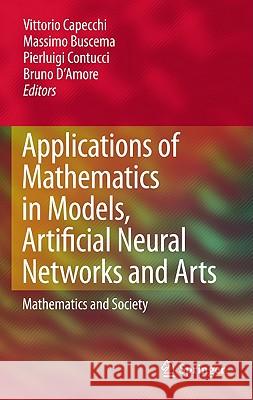
Vittorio Capecchi; Massimo Buscema; Pierluigi Contucci
Applications of Mathematics in Models, Artificial Neural Networks and Arts: Mathematics and Society Capecchi, Vittorio 9789048185801 Springer - książkaWidoczna okładka, to zdjęcie poglądowe, a rzeczywista szata graficzna może różnić się od prezentowanej.

Applications of Mathematics in Models, Artificial Neural Networks and Arts: Mathematics and Society

ISBN-13: 9789048185801 / Angielski / Twarda / 2010 / 617 str.

Vittorio Capecchi; Massimo Buscema; Pierluigi Contucci
cena 806,99
(netto: 768,56 VAT:  5%)

Najniższa cena z 30 dni: 771,08
Termin realizacji zamówienia:
ok. 22 dni roboczych
Bez gwarancji dostawy przed świętami

Darmowa dostawa!
inne wydania

The book shows a very original organization addressing in a non traditional way, but with a systematic approach, to who has an interest in using mathematics in the social sciences. The book is divided in four parts: (a) a historical part, written by Vittorio Capecchi which helps us understand the changes in the relationship between mathematics and sociology by analyzing the mathematical models of Paul F. Lazarsfeld, the model of simulation and artificial societies, models of artificial neural network and considering all the changes in scientific paradigms considered; (b) a part coordinated by Pier Luigi Contucci on mathematical models that consider the relationship between the mathematical models that come from physics and linguistics to arrive at the study of society and those which are born within sociology and economics; (c) a part coordinated by Massimo Buscema analyzing models of artificial neural networks; (d) a part coordinated by Bruno D Amore which considers the relationship between mathematics and art. The title of the book "Mathematics and Society" was chosen because the mathematical applications exposed in the book allow you to address two major issues: (a) the general theme of technological innovation and quality of life (among the essays are on display mathematical applications to the problems of combating pollution and crime, applications to mathematical problems of immigration, mathematical applications to the problems of medical diagnosis, etc.) (b) the general theme of technical innovation and creativity, for example the art and mathematics section which connects to the theme of creative cities. The book is very original because it is not addressed only to those who are passionate about mathematical applications in social science but also to those who, in different societies, are: (a) involved in technological innovation to improve the quality of life; (b) involved in the wider distribution of technological innovation in different areas of creativity (as in the project "Creative Cities Network" of UNESCO)."


Kategorie:
Nauka, Socjologia i społeczeństwo
Kategorie BISAC:
Social Science > Methodology
Mathematics > Matematyka stosowana
Social Science > Socjologia
Wydawca:
Springer
Język:
Angielski
ISBN-13:
9789048185801
Rok wydania:
2010
Wydanie:
2010
Ilość stron:
617
Waga:
2.34 kg
Wymiary:
23.5 x 15.5
Oprawa:
Twarda
Wolumenów:
01

Mathematics and Society PrefaceVittorio Capecchi, Massimo Buscema, Pierluigi Contucci, Bruno D’Amore 1- Vittorio Capecchi: Historical IntroductionSection I (mathematics and models)2- Pierluigi Contucci, Ignacio Gallo, Stefano Ghirlanda: 'Equilibria of culture contact derived from ingroup and outgroup attitudes'3- Oscar Bolina: 'Society from the Statistical Mechanics Perspective'4- Anna M. Borghi, Daniele Caligiore, Claudia Scorolli: 'Objects, words, and actions. Some reasons why embodied models are badly needed in cognitive psychology.'5- Luca Desanctis, Stefano Ghirlanda: 'Shared culture needs large social networks'6- C. Gallo: 'Mathematical models of financial markets'7- F. Gallo, Pierluigi Contucci, A. Coutts, Ignacio Gallo: 'Tackling climate change through energy efficiency: mathematical models to offer evidence-based recommendations for public policy'8- Simone Sarti, Marco Terraneo: 'An application of the multilevel regression technique to validate a social stratification scale'9- Robert B. Smith: 'The Academic Mind Revisited: Contextual Analysis via Multilevel Modeling' Section III (mathematics and neural networks)10 - Massimo Buscema: 'The General Philosophy of the Artificial Adaptive Systems'11 - Massimo Buscema, Pier Luigi Sacco: 'Auto-Contractive Maps, the H Function and the Maximally Regular Graph (MRG): a new methodology for data mining'12- Massimo Buscema, Pier Luigi Sacco: 'An Artificial Intelligent Systems Approach to - Unscrambling Power Networks in Italy’s Business Environment'13- Giulia Massini: 'Multi - Meta SOM'14- Massimo Buscema: 'How to make data mining: The Persons Arrested Dataset'15- Enzo Grossi: 'Medicine and Mathematics of Complex Systems'16- Massimo Buscema, Enzo Grossi: 'J-Net System: a new paradigm for Artificial Neural Networksapplied to diagnostic imaging'17 - S. Tangaro, R. Bellotti, F. De Carlo, G. Gargano: 'Digital Image Processing in Medical Applications' Section III (mathematics and art)18 - Giorgio T. Bagni: 'Mathematics, Art, and Interpretation: an Hermeneutic Perspective'19- Giorgio Bolondi: 'Point, line and surface, following Hilbert and Kandinsky'20- Bruno D’Amore: Figurative arts and mathematics: pipes, horses, triangles and meanings A contribution to a problematic theory of conceptual meaning, from Frege and Magritte up to the present time'21- Michele Emmer: The idea of space in art, technology and mathematics'22- Raffaele Mascella, Franco Eugeni,e Ezio Sciarra: 'Mathematical structures and sense of beauty'23- Monica Idà: 'Visual impact and mathematical learning'24- Marco Pierini: 'Art by Numbers.Mel Bochner, Roman Opalka and other Philarhythmics' 25-Aldo Spizzichino: 'My way of playing with the computer. Suggestions for a personal experience in vector graphics'26- Gian Marco Todesco: 'Four dimensional ideas'27- Igino Aschieri, Paola Vighi: 'From Art to Mathematics in the paintings of Theo van Doesburg' Editors’s biographies

VITTORIO CAPECCHI

Vittorio Capecchi ha avuto una laurea in economics e una specializzazione in mathematical sociology alla Columbia University con Paul F. Lazarsfeld ed è in seguito a questo incontro che nel 1967 ha fondato ed è diventato editor della rivista "Quality and Quantity". Dopo questa rivista ha fondato ed è diventato editor nel 1971 della rivista "Inchiesta", una rivista di economia e sociologia che ha cercato di diffondere la pratica dell’inchiesta fuori e all’interno dell’università. I suoi interessi vanno in due direzioni. Una prima direzione è quella della metodologia della ricerca e Capecchi ha studiato sia le applicazioni della matematica alla sociologia ma anche i cambiamenti nei paradigmi della ricerca (paradigma della oggettività, paradigma della ricerca azione/co-ricerca, paradigma della feminist methodology). Una seconda direzione è quella dello sviluppo e cambiamento della innovazione tecnologica.

PIERLUIGI CONTUCCI

Pierluigi Contucci is a Professor at University of Bologna, Department of Mathematics. He has taught and done scientific research at Princeton University and University of California. In 2000 he was been awarded the Schloessman prize from the Max Plank Society. His research interests are in Statistical Mechanics and applications to the social and economical sciences.


MASSIMO BUSCEMA

Massimo Buscema (1955). Professor and Computer Scientist, expert in Neural Networks and Adaptive Artificial Systems. Founder and Director of Semeion – Research Centre of Science and Communication (a Scientific Organization Recognized by Italian Ministry of Research in 1991). Professor and Director of the Department of Science of Communications at the University of Charleston (West Virginia-USA 1981-1985) and Professor of "Computers and Linguistics" at the University of Perugia (1984-1985). Member on the Editorial Board of various international journals. He has designed, constructed developed new models and algorithms of Artificial Intelligence. Author of scientific publications on theoretical aspects of Natural Computation, with over 150 scientific articles, essays, and 18 books on the same subject. Inventor of 14 international patents. He programmed over 20 software packages in Artificial Neural Networks and Evolutionary Systems. Scientific Director of research projects on the application of artificial intelligence systems in biomedical field and security field.

BRUNO D’AMORE

Bruno D’Amore is a graduate in mathematics, philosophy and pedagogy; PhD in Mathematics Education; full professor in Mathematics Education at the Bologna University; co-director of Research Doctoral School at the Distrital University of Bogotà (Colombia). Is investigation field is Mathematics Education.

CV complete:

www.dm.unibo.it/rsddm

This book is set up in a non-traditional way, yet it takes a systematic approach. There are four parts. The first part is historical and deals with the changes that have taken place in recent years in the relationship between mathematics and sociology: an analysis is made of Paul F. Lazarsfeld’s mathematical models, models of simulation and artificial societies, and models of artificial neural networks. The second part compares and contrasts mathematical models that come from physics and linguistics and those that come from sociology and economics. The third part analyzes models of artificial neural networks in detail. The final part examines the relationship between mathematics and the arts.

The book will be of interest to everyone involved in the application of mathematics to the social sciences and the use of technological innovations to improve the quality of life, and their distribution among the various creative arts.


Udostępnij

Facebook - konto krainaksiazek.pl


Opinie o Krainaksiazek.pl na Opineo.pl

Partner Mybenefit

Krainaksiazek.pl w programie rzetelna firma Krainaksiaze.pl - płatności przez paypal

Czytaj nas na:

Facebook - krainaksiazek.pl
  • książki na zamówienie
  • granty
  • książka na prezent
  • kontakt
  • pomoc
  • opinie
  • regulamin
  • polityka prywatności

Zobacz:

  • Księgarnia czeska

  • Wydawnictwo Książkowe Klimaty

1997-2025 DolnySlask.com Agencja Internetowa

© 1997-2022 krainaksiazek.pl
     
KONTAKT | REGULAMIN | POLITYKA PRYWATNOŚCI | USTAWIENIA PRYWATNOŚCI
Zobacz: Księgarnia Czeska | Wydawnictwo Książkowe Klimaty | Mapa strony | Lista autorów
KrainaKsiazek.PL - Księgarnia Internetowa

Polityka prywatnosci - link
Krainaksiazek.pl - płatnośc Przelewy24
Przechowalnia Przechowalnia





