• Wyszukiwanie zaawansowane
  • Kategorie
  • Kategorie BISAC
  • Książki na zamówienie
  • Promocje
  • Granty
  • Książka na prezent
  • Opinie
  • Pomoc
  • Załóż konto
  • Zaloguj się

Ancient Engineers' Inventions: Precursors of the Present » książka


zaloguj się | załóż konto
Logo Krainaksiazek.pl

koszyk

konto

szukaj
topmenu
Księgarnia internetowa
Szukaj
Książki na zamówienie
Promocje
Granty
Książka na prezent
Moje konto
Pomoc
 
 
Wyszukiwanie zaawansowane
Pusty koszyk
Bezpłatna dostawa dla zamówień powyżej 20 złBezpłatna dostawa dla zamówień powyżej 20 zł

Kategorie główne

• Nauka
 [2952079]
• Literatura piękna
 [1850969]

  więcej...
• Turystyka
 [71058]
• Informatyka
 [151066]
• Komiksy
 [35579]
• Encyklopedie
 [23181]
• Dziecięca
 [620496]
• Hobby
 [139036]
• AudioBooki
 [1646]
• Literatura faktu
 [228729]
• Muzyka CD
 [379]
• Słowniki
 [2932]
• Inne
 [445708]
• Kalendarze
 [1409]
• Podręczniki
 [164793]
• Poradniki
 [480107]
• Religia
 [510956]
• Czasopisma
 [511]
• Sport
 [61267]
• Sztuka
 [243299]
• CD, DVD, Video
 [3411]
• Technologie
 [219640]
• Zdrowie
 [100984]
• Książkowe Klimaty
 [124]
• Zabawki
 [2281]
• Puzzle, gry
 [3363]
• Literatura w języku ukraińskim
 [258]
• Art. papiernicze i szkolne
 [8020]
Kategorie szczegółowe BISAC

Ancient Engineers' Inventions: Precursors of the Present

ISBN-13: 9789048122523 / Angielski / Twarda / 2009 / 340 str.
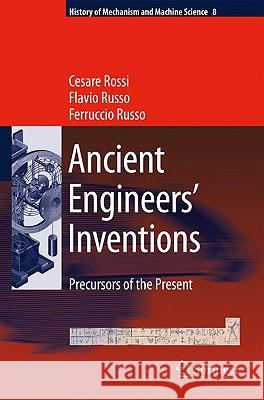
Cesare Rossi; Flavio Russo; Ferruccio Russo
Ancient Engineers' Inventions: Precursors of the Present Rossi, Cesare 9789048122523 Springer - książkaWidoczna okładka, to zdjęcie poglądowe, a rzeczywista szata graficzna może różnić się od prezentowanej.

Ancient Engineers' Inventions: Precursors of the Present

ISBN-13: 9789048122523 / Angielski / Twarda / 2009 / 340 str.

Cesare Rossi; Flavio Russo; Ferruccio Russo
cena 201,72
(netto: 192,11 VAT:  5%)

Najniższa cena z 30 dni: 192,74
Termin realizacji zamówienia:
ok. 22 dni roboczych.

Darmowa dostawa!

This book describes inventions and designs of ancient engineers that are the precursors of the present. The ages mainly range from 300 B.C. to 1600 A.D. with some exceptions from before and after this period.

As for the very ancient ones, the book describes inventions (documented by archaeological finds mainly from Pompei, Ercolano and Stabia) that generally are very little known and sometimes not known at all. Some inventions are in the military field. This is because (unfortunately) many inventions and technological innovations have been conceived starting from military applications.

The book is divided into five parts.

The first four parts pertain to definite fields and present inventions generally conceived up to the late Roman Empire. Inventions that are representative of the engineering genius of the ancients and that may be considered as milestones, each in their respective field.

The fifth part refers to fields of engineering (such as textiles and automation) in which important innovations were conceived also in more recent centuries.

For each of the inventions presented, even the ancient ones of many centuries past, the authors provide three elements of research and reference:

Written documents (the classics)

Iconic references (coins, bas-reliefs, etc.)

Archaeological findings.

The target groups of the book are students and scholars with interest on History of Mechanical Engineering in Antiquity and Archaelogy.


Kategorie:
Nauka, Historia
Kategorie BISAC:
Technology & Engineering > Industrial Design - Product
Technology & Engineering > Machinery
Technology & Engineering > History
Wydawca:
Springer
Seria wydawnicza:
History of Mechanism and Machine Science
Język:
Angielski
ISBN-13:
9789048122523
Rok wydania:
2009
Wydanie:
2009
Numer serii:
000342995
Ilość stron:
340
Waga:
0.67 kg
Wymiary:
23.5 x 15.5
Oprawa:
Twarda
Wolumenów:
01
Dodatkowe informacje:
Bibliografia
Wydanie ilustrowane

From the reviews:

"A lovingly compiled catalogue of engineering achievement, prepared most especially for young engineers, and dedicated to the appreciation of the works of pioneers. The reader is shown the problems and guided to their solutions, via all the technical detail needed to command attention. The target reader is thus served, under these terms of reference, well. ... All in all, we have a collection of ingenious devices, well-described, frequently 'reconstructed' and lovingly commemorated." (Michael A. B. Deakin, Metascience, Vol. 19, March, 2010)

Preface; PART I : MEASURING THE ENVIRONMENT: Introduction; Ancient Greek units; Length units; Area units; Volume units; Weight/mass units; Roman units; Length units; Area units; Volume units; Weight/mass units; Chap. 1 – MEASURING MASS: Introduction; 1.1 The balance scale; 1.2 The steelyard balance; Observations; Chap. 2 – MEASURING DISTANCE : Introduction; 2.1 Jacobs’ staff, Astrolabe; 2.2 Range finders; 2.2.1 Groma; 2.2.2 Surveyors’ cross; 2.2.3 Chorobate; 2.3 The dioptre by Heron; 2.4 The ancient odometer; 2.4.1 The odometer by Vitruvius; 2.4.2 The odometer by Heron; Observations; Chap. 3 - MEASURING TIME : Introduction; 3.1 The sundial; 3.1.1 Fixed sundials; 3.1.1.1 Equatorial sundials; 3.1.1.2 Horizontal sundials; 3.1.1.3 Vertical sundials; 3.1.1.4 Non-planar sundials; 3.1.2 Portable sundials; 3.2 Water clocks; 3.2.1 Early water clocks; 3.2.2 The water clock by Ctesibius; Observations; Chap. 4 – COMPUTATION DEVICES: Introduction; 4.1 The abacus; 4.2 The mesolabio; 4.2.1 The mesolabio of Heratostenes; 4.2.2 The solution by Hippocrates and the Mesolabio by Dürer; 4.3 The mechanism of Antikitera; 4.3.1 The history of the finding; 4.3.2 Description of the mechanism; 4.3.3 Technological aspects; 4.3.4 Planetariums in ancient literature; 4.3.5 A recent interesting finding; Observations; PART II – USING NATURAL ENERGY: Chap. 5 – WIND MOTORS: Introduction; 5.1 The wind mills; 5.1.1 TheAfghan mill; 5.1.2 The Cretan mill ; 5.2 Wings on the sea: the sails; 5.2.1 Evolution of the sail rig; 5.2.2 The Chinese junk; 5.2.3 The Flettner rotor; Observations; Chap. 6 – HYDRAULIC MOTORS: Introduction; 6.1 Water wheels with vertical axis; 6.1.1 The Greek mill; 6.1.2 Vertical axis rotor with oblique blades; 6.2 Water wheels with horizontal axis; 6.2.1 Undershot water wheels; 6.2.2 Overshot water wheels; 6.2.2.1 The wheel of Venafro; 6.3 The floating mill; 6.4 Water wheels in the Middle Ages and the Renaissance;Observations; PART III – USING WATER: Chap. 7 – LIFTING WATER: Introduction; 7.1 The early devices; 7.2 The Archimedes’ screw; 7.3 Norias; 7.3.1 Scoop wheel; 7.3.2 Chain norias; 7.4 Pumps; 7.4.1 Chain pumps; 7.4.2 Reciprocating pumps; Observations; Chap. 8 – ADDUCTION AND DISTRIBUTION OF WATER: Introduction; 8.1 Open ducts; 8.2 Penstocks; 8.3 The great cistern; 8.3.1 The Piscina Mirabilis at Miseno; 8.4 Water distribution systems ; 8.4.1 Piezometric turrets; 8.5 Pipes; 8.5.1 Dimensions of the lead pipes; 8.6 Valves; 8.6.1 Shut-off valves; 8.6.2 Single control mixers; 8.7 Hydraulic mining; 8.7.1 The technique 'Ruina Montium'; 8.7.2 Historical references; Observations; Chap. 9 – UNDERWATER ACTIVITIES: Introduction; 9.1 Scuba divers; 9.2 Diving bell; PART IV – COMMUNICATION AND TELECOMMUNICATION: Introduction; The capstan; Telecommunication devices; Chap. 10 – LIFT AND TRANSPORTS: Introduction; 10.1 Cranes and tackle; 10.2 Gravity driven elevators; 10.3 Roman charts; 10.4 Railed cargo; 10.5 The rails of Pompei; 10.6 Ancient self propelled vehicles; 10.7 Early ball bearings; 10.8 Transport on water; 10.8.1 Early paddle wheeled boats; 10.8.2 Pneumatic boats; 10.9 Cableways; 10.10 The dawn of flight in antiquity; 10.10.1 Legends and tales; 10.10.2 Ancient gliders; 10.10.3 Ancient rockets; Observations; Chap. 11 – TELECOMMUNICATIONS : Introduction; 11.1 Acoustic; 11.2 Carrier pigeons; 11.3 Optical telecommunication systems; 11.3.1 Systems based on image modification; 11.3.2 Systems based on brilliancy modification; 11.4 Lighthouses; 11.5 The water telegraph; Observations; PART V – TOWARDS THE MODERN AGE: Chap. 12 – SECONDARY MOTORS : Introduction; 12.1 Flexion elastic motors; 12.1.1 Metal spring flexion elastic motors, 12.2 Torsion elastic motors; 12.3 Pneumatic motors; 12.3.1 The air spring ballista; 12.4 Small spring motors; 12.4.1 Locks and padlocks; 12.5 Counterweight motors; 12.5.1 The trebuchet; 12.6 Ancient

Prof. Ing. CESARE ROSSI

Curriculum Vitae et Studiorum

Cesare Rossi was born in Naples on 26 July1955. In 1973 was graduated at High School focusing on Humanities.

In 1979 received the Mechanical Engineer Degree cum Laude at the University of Napoli - "Federico II"; in the same year the doctoral thesis received the Asmeccanica (Italian Mechanical Engineering Association) award.

In the first years of his career he has worked at the Istituto di Meccanica Applicata alle Macchine (Applied Mechanics Institute) of the University of Napoli "Federico II, attending researches on traction fluids for variable speed gearboxes and cooperating at several doctoral theses. In that period he was research fellow of the A.T.A. (Automobile Technicians Association) at the same University Institute.

Then he has been the technical manager of a textile industry and later designer of tools for aircraft’s tests and maintenance at an aerospace industry.

In Dec.1983 he was appointed Ricercatore Universitario (Assistant Professor) at the Applied Mechanics Institute (then Department of Mechanical Engineering - D.I.M.E.) of the University of Napoli "Federico II".

In 1992 he has been appointed Associate Professor of Applied Mechanics and from 1 nov.1993 Associate Professor of Robot Mechanics. From those years he has established a Laboratory for experimental researches on Robot Mechanics at the D.I.M.E. and is a member of G.M.A (Italian Group for Mechanics of Machinery).

From 1 nov.2000 has been appointed Full Professor of Applied Mechanics at the same University.

Presently teaches Mechanics Fundamentals and Robot Mechanics both to Mechanical and Automation Engineering students. He is supervisor of Master and Ph.D. theses and professor at the Ph.D. coursed at the same University.

He participated to many International Conferences, often with invited lectures and as Chairman.

His research activities where carried on mainly in the topics of Tribology, Rotor Dynamics, Mechanical Vibrations, Chaotic Motions of Mechanical Systems, Robot Mechanics, Video Applications for Robotics.

Since several years he is interested in studies and researches on the History of Engineering and presently he cooperates with researchers (also on the field) mainly in which the Classic Age is concerned.

He is a member of the A.I.S.I (Italian Society for the History of Engineering).


Dott. Ing. FLAVIO RUSSO;

Curriculum Vitae et Studiorum

FLAVIO RUSSO was born in Torre del Greco (Naples) in 1947. He was graduated at High School focusing on Humanities and then received the Mining Engineer Degree at the University of Rome.

Has been studying military architecture and military history in general for the past thirty years, focusing especially on military technology.

For ten years he was member of Scientific Councils of the Italian Institute for the Castles and of National Committee for Studies of Fortified Architectures at the Italian Cultural Heritage Department.

He has given invited lessons and short courses at the Universities of Molise, Napoli "Federico II" and Salerno; at the same Universities he was co-supervisor of some doctoral theses.

For more than 20 years he cooperates with USSME (Historical Bureau HQ Italian Army) and is member of the committee for the editorial proposals.

He designed and built some full scale and working of Roman artilleries committed by the Cultural Heritage Department; these reconstructions are actually shown at the archaeological area of Saepinum.

He arranged several exhibitions on historical topics.

He writes for several national magazines focused on History, Technology, Achaeology and Militaria.In addition to a large number of scientific publications, he is also the author of many volumes on history and ancient technologies. Some of them were published for the Historical Bureaus of the Italian Army, Italian Navy and Italian Air Forces.

For the N.A.T.O. Allied Maritime Component Command he has recently published:

- 79 A.D. Corse for Pompeii, Inquiry on the death of an Admiral.

- POMPEI Course Toward Transformation - the forgotten contributions of roman naval technology.

Actually he is working at the reconstruction of a roman water wheel, starting from archaeological finds.

Sig. FERRUCCIO RUSSO

Curriculum Vitae et Studiorum

FERRUCCIO RUSSO was born in 1980 and is a student of History at the University of Napoli "Federico II". He has been working for several years with computer graphics, specifically with photo-similar three-dimensional virtual reconstructions of mechanical devices, archeological artifacts and architectural structures. His tables have also appeared in numerous national magazines.

He is autor of several illustrations and a book for the Historical Bureau of the Italian Army and for the Istituto Poligrafico e Zecca dello Stato (Italian Mint Institute).

He arranged several exhibitions in which graphical reconstructions of historical topics where shown.

He is co-autor of several books by Flavio Russo.

This book describes the inventions and designs of ancient engineers who are the precursors of the present. The period ranges mainly from 300 B.C: to 1600 A.D. with several exceptions. Many of the oldest inventions are documented by archaeological finds, often very little known, mainly from Pompeii, Herculaneum and Stabiae and reveal a surprising modernity in their conception.

Most of the inventions presented in the first four parts of the book were conceived up to the late Roman Empire and may be considered as milestones, each in their respective field. The fifth part concentrates on more recent centuries. The sixth part deals with some building construction techniques.

Generally, for each of the presented inventions, three elements of research and reference are provided: written documents (the classics), iconic references (coins, bas-reliefs, etc.) and archaeological findings.

The authors did not write this book for engineers only; hence they describe all the devices without assuming wide technical knowledge. The authors’ main aim is to try to communicate their enthusiasm for the inventions and the inventors of the past and to  contribute to the fascinating study of the History of Engineering.


Udostępnij

Facebook - konto krainaksiazek.pl


Opinie o Krainaksiazek.pl na Opineo.pl

Partner Mybenefit

Krainaksiazek.pl w programie rzetelna firma Krainaksiaze.pl - płatności przez paypal

Czytaj nas na:

Facebook - krainaksiazek.pl
  • książki na zamówienie
  • granty
  • książka na prezent
  • kontakt
  • pomoc
  • opinie
  • regulamin
  • polityka prywatności

Zobacz:

  • Księgarnia czeska

  • Wydawnictwo Książkowe Klimaty

1997-2026 DolnySlask.com Agencja Internetowa

© 1997-2022 krainaksiazek.pl
     
KONTAKT | REGULAMIN | POLITYKA PRYWATNOŚCI | USTAWIENIA PRYWATNOŚCI
Zobacz: Księgarnia Czeska | Wydawnictwo Książkowe Klimaty | Mapa strony | Lista autorów
KrainaKsiazek.PL - Księgarnia Internetowa

Polityka prywatnosci - link
Krainaksiazek.pl - płatnośc Przelewy24
Przechowalnia Przechowalnia





