• Wyszukiwanie zaawansowane
  • Kategorie
  • Kategorie BISAC
  • Książki na zamówienie
  • Promocje
  • Granty
  • Książka na prezent
  • Opinie
  • Pomoc
  • Załóż konto
  • Zaloguj się

Ancient Engineers' Inventions: Precursors of the Present » książka


zaloguj się | załóż konto
Logo Krainaksiazek.pl

koszyk

konto

szukaj
topmenu
Księgarnia internetowa
Szukaj
Książki na zamówienie
Promocje
Granty
Książka na prezent
Moje konto
Pomoc
 
 
Wyszukiwanie zaawansowane
Pusty koszyk
Bezpłatna dostawa dla zamówień powyżej 20 złBezpłatna dostawa dla zamówień powyżej 20 zł

Kategorie główne

• Nauka
 [2949965]
• Literatura piękna
 [1857847]

  więcej...
• Turystyka
 [70818]
• Informatyka
 [151303]
• Komiksy
 [35733]
• Encyklopedie
 [23180]
• Dziecięca
 [617748]
• Hobby
 [139972]
• AudioBooki
 [1650]
• Literatura faktu
 [228361]
• Muzyka CD
 [398]
• Słowniki
 [2862]
• Inne
 [444732]
• Kalendarze
 [1620]
• Podręczniki
 [167233]
• Poradniki
 [482388]
• Religia
 [509867]
• Czasopisma
 [533]
• Sport
 [61361]
• Sztuka
 [243125]
• CD, DVD, Video
 [3451]
• Technologie
 [219309]
• Zdrowie
 [101347]
• Książkowe Klimaty
 [123]
• Zabawki
 [2362]
• Puzzle, gry
 [3791]
• Literatura w języku ukraińskim
 [253]
• Art. papiernicze i szkolne
 [7933]
Kategorie szczegółowe BISAC

Ancient Engineers' Inventions: Precursors of the Present

ISBN-13: 9783319444758 / Angielski / Twarda / 2016 / 420 str.
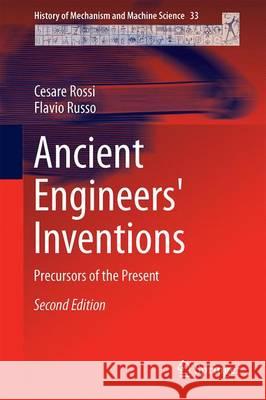
Cesare Rossi; Flavio Russo
Ancient Engineers' Inventions: Precursors of the Present Rossi, Cesare 9783319444758 Springer - książkaWidoczna okładka, to zdjęcie poglądowe, a rzeczywista szata graficzna może różnić się od prezentowanej.

Ancient Engineers' Inventions: Precursors of the Present

ISBN-13: 9783319444758 / Angielski / Twarda / 2016 / 420 str.

Cesare Rossi; Flavio Russo
cena 645,58
(netto: 614,84 VAT:  5%)

Najniższa cena z 30 dni: 616,85
Termin realizacji zamówienia:
ok. 22 dni roboczych
Bez gwarancji dostawy przed świętami

Darmowa dostawa!

We live in an age in which one can easily think that our generation has invented and discovered almost everything; but the truth is quite the opposite. Progress cannot be considered as sudden unexpected spurts of individual brains: such a genius, the inventor of everything, has never existed in the history of humanity. What did exist was a limitless procession of experiments made by men who did not waver when faced with defeat, but were inspired by the rare successes that have led to our modern comfortable reality. And that continue to do so with the same enthusiasm. The study of the History of Engineering is valuable for many reasons, not the least of which is the fact that it can help us to understand the genius of the scientists, engineers and craftsmen who existed centuries and millenniums before us; who solved problems using the devices of their era, making machinery and equipment whose concept is of such a surprising modernity that we must rethink our image of the past.


Kategorie:
Technologie
Kategorie BISAC:
Technology & Engineering > Industrial Design - Product
Technology & Engineering > Machinery
Technology & Engineering > History
Wydawca:
Springer
Seria wydawnicza:
History of Mechanism and Machine Science
Język:
Angielski
ISBN-13:
9783319444758
Rok wydania:
2016
Wydanie:
2017
Numer serii:
000342995
Ilość stron:
420
Waga:
0.97 kg
Wymiary:
24.33 x 15.93 x 2.84
Oprawa:
Twarda
Wolumenów:
01

"The book is well illustrated with both black-and-white and color drawings and photographs. ... this book will appeal to individuals interested in the histories of both mechanical engineering and civil engineering. It is recommended to those who are also interested in ancient Greek and Roman technologies. Summing Up: Recommended. Upper-division undergraduates and above; faculty and professionals." (A. M. Strauss, Choice, Vol. 54 (9), May, 2017)

  Premise: Representing and Measuring the Environment.- A premise: it all started with a drawing.- I.1 Elevations, Plan and Sections.- I.2 Protohistoric Drafting machine for the clay tablets engraving.- I.3 Examples of planimetries from the IV millennium B.C. to the I century A.D..-  I.4 Ancient Units.-  1. Measuring Mass.- Introduction.- 1.1 The balance scale.- 1.2 The steelyard balance.- Observations.- 2 Measuring Distance and Slope.- Introduction.- 2.1 Jacob’s staff.- 2.2 Range finders.- 2.3 The Astrolabe.- 2.4 The dioptre by Heron.- 2.5 The ancient odometers.- Observations.- Measuring a building height by an astrolabe.- Measuring the distances by the groma and by the surveyor’s cross.- 3 Measuring Time.- Introduction.- 3.1 The sundial.- 3.2 Water clocks.- Observations.- 4 Orientation.-  Introduction.- 4.1 The Sundial Compass.- 4.2 The Chinese South-Pointing Chariot Sundial Compass.- 4.3 The Windrose and the Magnetic Compass.- 5 Ancient Computation Devices.- Introduction.- 5.1 The Abacus.- 5.2 The Mesolabio.- 5.3 The Mechanism of Antikitera.- Observations.- 6 The Natural Energy Used In Antiquity.- Introduction.- 6.1 Energy from man.- 6.2 Energy from animals.- 6.3 The capstan.- 6.4 The treadwheel.- 6.5 Rough evaluation of the power from a wind motor.- 6.6 Rough evaluation of the power from a waterwheel.- 7 Wind Motors.- Introduction.- 7.1 The wind mills.- 7.2 Wings on the sea: the sails.- 7.3.3 The Flettner rotor.- Observations.- 8 Hydraulic Motors.- Introduction.- 8.1 Water wheels with vertical axis.- 8.2 Water wheels with horizontal axis.- 8.3 The floating mill.- 8.4 Water wheels in the Middle Ages and the Renaissance.- Observations.- 9 Refrigeration and Heating.- 9.1 Air Cooling with Wind Towers.-  9.2 The production of ice.- 9.3 Nero’s Sherbet.-  9.3 Wheat Pits.-  9.4 Heating and Thermal Baths.- 9.5 Energy Saving: the Sun Chimney  Heating and Thermal Baths.- 10 The Production Of Water.- 10.1 The Air Well.- 10.2 The Dew Basin.-  10.3 The Qanat.- 10.4 Distillation.- 11 Lifting Water.- Introduction.- 11.1 The early devices.- 11.2 The Archimedes’ screw.- 11.3 Norias.- 11.4 Pumps.- Observations.- 12 Adduction and Distribution of Water.- Introduction.- 12.1 Open ducts.- 12.2 Penstocks.- 12.3 The great cisterns.- 12.4 Water distribution systems.- 12.5 Pipes.- 12.6 Valves.- 12.7 Hydraulic mining.- Observations.- 13 Underwater Activities.- Introduction.- 13.1 Scuba divers.-  13.2 Diving bell.- 14 Transports.- Introduction.- 14.1 Roman charts.- 14.2 Railed cargo.- 14.3 The rails of Pompei.- 14.4 Ancient self-propelled vehicles.- 14.5 Early ball bearings.- 14.6 Transport on water.- 14.7 Cableways.- 14.10 The dawn of the flight in the antiquity.- Observations.- 15 Telecommunications.- Introduction.- 15.1 Acoustic.-  15.2 Carrier pigeons.- 15.3 Optical telecommunication systems.- 15.4 Lighthouses.- 15.5 The water telegraph.- Observations.- 16 Medicine and Health.- Introduction.- 16.1 Medical Assistance provided to Legionnaires.- 16.2 Reconstructive Plastic Surgery.- 16.3 Early Penicillin.- 16.4 The Beginning of Biological Warfare.- 17 Secondary Motors.- Introduction.- 17.1 Cranes and tackle.-   17.2 Gravity driven elevators.- 17.3 Siege towers.- 17.4 The trebuchet.- 17.5 Flexion elastic motors.-  17.6 Torsion elastic motors.- 17.7 Throwing machines operated by torsion motors.- 17.8 Mechanics of the throwing machines.- 17.9 Pneumatic motors.- 17.10 Small spring motors.- 17.11 Ancient steam engines.- Observations.- 18 Spinnind and Weaving.- Introduction.- 18.1 The dawn of spinning and weaving.- 18.2 The spinning wheel.- 18.3 The mechanical spinning.- 18.4 The automatic weaving.- Observations.- 19 Some Applications of Fire.- Introduction.- 19.1 Fire ignition.- 19.1.2 Optical flints.- 19.2 Marine fire – the Roman candle.- 19.3 Wind lanterns.- 19.4 Fire for warming.- 19.5 Fire for warfare.- 19.6 The protection from fire: asbestos.- 20 Automata (Towards automation and robots).- Introduction.- 20.1 The Hellenistic Age.- 20.2 The Middle Ages.- 20.3 The Renaissance.- 20.4 The XVIII Century.- 20.5 The XIX Century.- 20.6 Automata of the Far East.- 20.7 Between the two millenniums.- Observations.- 21 Some Ancient Building Techniques.- Introduction.- 21.1 Stone buildings.- 21.2 Concrete Buildings.- 21.3 Considerations on the polygonal work.- 21.4 Earthquake-resistant buildings with wooden ribs.- 21.5 Seismic isolators.-  21.6 Consideration on ancient concrete.- Subject Index.   

Cesare Rossi received the Mechanical Engineer Degree cum Laude at the University of Napoli - "Federico II" in 1979; in the same year his doctoral thesis received the Asmeccanica (Italian Mechanical Engineering Association) award.

He participated in many International Conferences, often with invited lectures and as Chairman. His research activities where carried on mainly in the topics of Tribology, Rotor Dynamics, Mechanical Vibrations, Chaotic Motions of Mechanical Systems, Robot Mechanics, Video Applications for Robotics. Since several years he is interested in studies and researches on the History of Engineering and presently he cooperates with researchers (also on the field) mainly in which the Classic Age is concerned. He is a member of the A.I.S.I (Italian Society for the History of Engineering). 

Flavio Russo holds a degree in Mining Engineering from the University of Rome.

Has been studying military architecture and military history in general for the past thirty years, focusing especially on military technology. For ten years he was member of Scientific Councils of the Italian Institute for the Castles and of National Committee for Studies of Fortified Architectures at the Italian Cultural Heritage Department.

Currently he is working at the reconstruction of a roman water wheel, starting from archaeological finds.


This book describes the inventions and designs of ancient engineers who are the precursors of the present. The period ranges mainly from 300 B.C. to 1600 A.D. with several exceptions. Many of the oldest inventions are documented by archaeological finds, often very little known, mainly from Pompeii, Herculaneum and Stabiae and reveal a surprising modernity in their conception.

Most of the inventions presented in the first four parts of the book were conceived up to the late Roman Empire and may be considered as milestones, each in their respective field. The fifth part concentrates on more recent centuries. The sixth part deals with some building construction techniques.

Generally, for each of the presented inventions, three elements of research and reference are provided: written documents (the classics), iconic references (coins, bas-reliefs, etc.) and archaeological findings.

The authors did not write this book for engineers only; hence they describe all the devices without assuming wide technical knowledge. The authors’ main aim is to try to communicate their enthusiasm for the inventions and the inventors of the past and to contribute to the fascinating study of the History of Engineering.

This second edition includes new topics and chapters that are of special interest to engineers.


Udostępnij

Facebook - konto krainaksiazek.pl


Opinie o Krainaksiazek.pl na Opineo.pl

Partner Mybenefit

Krainaksiazek.pl w programie rzetelna firma Krainaksiaze.pl - płatności przez paypal

Czytaj nas na:

Facebook - krainaksiazek.pl
  • książki na zamówienie
  • granty
  • książka na prezent
  • kontakt
  • pomoc
  • opinie
  • regulamin
  • polityka prywatności

Zobacz:

  • Księgarnia czeska

  • Wydawnictwo Książkowe Klimaty

1997-2025 DolnySlask.com Agencja Internetowa

© 1997-2022 krainaksiazek.pl
     
KONTAKT | REGULAMIN | POLITYKA PRYWATNOŚCI | USTAWIENIA PRYWATNOŚCI
Zobacz: Księgarnia Czeska | Wydawnictwo Książkowe Klimaty | Mapa strony | Lista autorów
KrainaKsiazek.PL - Księgarnia Internetowa

Polityka prywatnosci - link
Krainaksiazek.pl - płatnośc Przelewy24
Przechowalnia Przechowalnia





