• Wyszukiwanie zaawansowane
  • Kategorie
  • Kategorie BISAC
  • Książki na zamówienie
  • Promocje
  • Granty
  • Książka na prezent
  • Opinie
  • Pomoc
  • Załóż konto
  • Zaloguj się

Analyzing Rational Crime -- Models and Methods » książka


zaloguj się | załóż konto
Logo Krainaksiazek.pl

koszyk

konto

szukaj
topmenu
Księgarnia internetowa
Szukaj
Książki na zamówienie
Promocje
Granty
Książka na prezent
Moje konto
Pomoc
 
 
Wyszukiwanie zaawansowane
Pusty koszyk
Bezpłatna dostawa dla zamówień powyżej 20 złBezpłatna dostawa dla zamówień powyżej 20 zł

Kategorie główne

• Nauka
 [2949965]
• Literatura piękna
 [1857847]

  więcej...
• Turystyka
 [70818]
• Informatyka
 [151303]
• Komiksy
 [35733]
• Encyklopedie
 [23180]
• Dziecięca
 [617748]
• Hobby
 [139972]
• AudioBooki
 [1650]
• Literatura faktu
 [228361]
• Muzyka CD
 [398]
• Słowniki
 [2862]
• Inne
 [444732]
• Kalendarze
 [1620]
• Podręczniki
 [167233]
• Poradniki
 [482388]
• Religia
 [509867]
• Czasopisma
 [533]
• Sport
 [61361]
• Sztuka
 [243125]
• CD, DVD, Video
 [3451]
• Technologie
 [219309]
• Zdrowie
 [101347]
• Książkowe Klimaty
 [123]
• Zabawki
 [2362]
• Puzzle, gry
 [3791]
• Literatura w języku ukraińskim
 [253]
• Art. papiernicze i szkolne
 [7933]
Kategorie szczegółowe BISAC

Analyzing Rational Crime -- Models and Methods

ISBN-13: 9781402016578 / Angielski / Twarda / 2003 / 218 str.
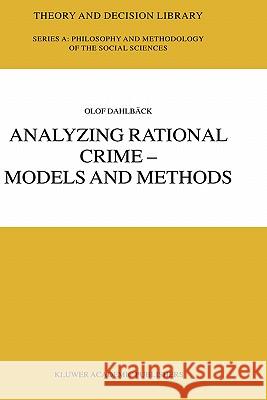
Olof Dahlback; Olof Dahlbc$ck; Olof Dahlbdck
Analyzing Rational Crime -- Models and Methods Dahlbäck, Olof 9781402016578 Kluwer Academic Publishers - książkaWidoczna okładka, to zdjęcie poglądowe, a rzeczywista szata graficzna może różnić się od prezentowanej.

Analyzing Rational Crime -- Models and Methods

ISBN-13: 9781402016578 / Angielski / Twarda / 2003 / 218 str.

Olof Dahlback; Olof Dahlbc$ck; Olof Dahlbdck
cena 403,47 zł
(netto: 384,26 VAT:  5%)

Najniższa cena z 30 dni: 385,52 zł
Termin realizacji zamówienia:
ok. 22 dni roboczych
Bez gwarancji dostawy przed świętami

Darmowa dostawa!

Olof Dahlback's book breaks new ground for the analysis of crime from a rationality perspective by presenting models and methods that go far beyond those with which researchers have hitherto been equipped. The book examines single crimes, individual criminality, and societal crime, and it discusses thoroughly the general decision theoretical presuppositions necessary for analyzing these various types of crime. An expected utility maximization model for a single discrete choice regarding the commission of a crime is the foundation of most of the analyses presented. A version of this model is developed that permits interpersonal comparisons, and this basic model is used when deriving more complex models of crime as well as when analyzing the potential for such derivations. The rigorous, powerful methods suggested provide considerable opportunities for improving research and for seeing old problems in a new light.


Kategorie:
Nauka, Prawo i administracja
Kategorie BISAC:
Social Science > Criminology
Business & Economics > Operations Research
Business & Economics > Economics - Theory
Wydawca:
Kluwer Academic Publishers
Seria wydawnicza:
Theory and Decision Library
Język:
Angielski
ISBN-13:
9781402016578
Rok wydania:
2003
Wydanie:
2003
Numer serii:
000051475
Ilość stron:
218
Waga:
1.11 kg
Wymiary:
29.7 x 21.0
Oprawa:
Twarda
Wolumenów:
01
Dodatkowe informacje:
Bibliografia

Introduction: The rationality perspective in modern criminology. Problems of perspective. Purpose and organization of this book. I: Single Choices. General Theoretical Presuppositions. 1. The Assumption of Rationality. The general meaning of rationality. Rationality in a broad sense. The concept of rationality used in this book. 2. Rational Decisions under Conditions of Risk. Focusing on individual's decisions under conditions of risk. The concept of utility. The von-Neumann-Morgenstern theory of maximization of expected utility. Maximization of expected 'riskless' utility. The basic model of the choice to commit or not to commit a crime. 3. Descriptive Validity of the Rationality Theories of Expected Utility Maximization. Introduction. Judgment mechanisms. Maximization of expected von-Neumann-Morgenstern utility. Prospect theory and the use of reference points. Some comments on research methods. What choices are the result of decisions? Why use the rational-choice approach? 4. Interpersonal Comparison of Utility. A fundamental problem. The significance of utility's metrical properties. Using relativized utility to solve the problem. Analyses. 5. Previous Research. Introduction. Theoretical research. Experimental research. Nonexperimental empirical research. Some summarizing comments. 6. Research Strategies. Introduction. Examining or not examining indifferences in choices. Choosing a dependent factor in the indifference approach. The eclectic nature of existing empirical research. Determining utility. Interpersonal comparability. 7. Analyzing the Bivariate Linear Relationships between Choice and Punishment Factors. Numerical examples of the relationships. Discussion. 8. Experimental Analysis. Introduction. General advantages and disadvantages of the experimental approach. Drawing conclusionsabout rationality. Critique and a suggestion. 9. Nonexperimental Analysis. Introduction. Distortion of retrospective information. Measuring all independent factors. Recommendations. II: Aggregated Choices. General Theoretical Presuppositions. 10. Applying the Rationality Model to Individual Criminality. Introduction. Constructing a model under simplistic premises. Creation of decision situations. Learning, planning and rationality. 11. Rationality and Proneness to Taking Risks. Systematic deviations from rationality. Is there a general proneness to taking risks? Individual risk-taking in groups and group risk-taking. 12. Societal Crime. Introduction. Holistic explanation and the complexity of social context. Ideal and actual possibilities: strategies for forming an applicable theory. Robustness of rationality theories. Analyses. 13. Previous Research on Individual Criminality. Introduction. Noneconomic research that explicitly applies the rationality assumption. Does nonrationality cause criminality? Relationship with proneness to risk-taking. Conclusions. 14. Previous Research on Societal Crime. Introduction. Economic theory: Becker and Ehrlich. Noneconomic deterrence research. Research combining environmental and rational choice aspects. Conclusions. 15. An Aggregation Model. Introduction. Relationships at the aggregate level. Some practical considerations and conclusions. 16. Basing the Analysis on Crime Opportunity and Crime Propensity Factors. Introduction. Individual criminality. A general model of a society's theft rate. Operationalized models. Ideals of the rational choice approach to the realistic possibilities. Summary and Conclusions. References. Appendix 1: A General Method for the Simultaneous Determination of Outcomes Util


Udostępnij

Facebook - konto krainaksiazek.pl


Opinie o Krainaksiazek.pl na Opineo.pl

Partner Mybenefit

Krainaksiazek.pl w programie rzetelna firma Krainaksiaze.pl - płatności przez paypal

Czytaj nas na:

Facebook - krainaksiazek.pl
  • książki na zamówienie
  • granty
  • książka na prezent
  • kontakt
  • pomoc
  • opinie
  • regulamin
  • polityka prywatności

Zobacz:

  • Księgarnia czeska

  • Wydawnictwo Książkowe Klimaty

1997-2025 DolnySlask.com Agencja Internetowa

© 1997-2022 krainaksiazek.pl
     
KONTAKT | REGULAMIN | POLITYKA PRYWATNOŚCI | USTAWIENIA PRYWATNOŚCI
Zobacz: Księgarnia Czeska | Wydawnictwo Książkowe Klimaty | Mapa strony | Lista autorów
KrainaKsiazek.PL - Księgarnia Internetowa

Polityka prywatnosci - link
Krainaksiazek.pl - płatnośc Przelewy24
Przechowalnia Przechowalnia






