• Wyszukiwanie zaawansowane
  • Kategorie
  • Kategorie BISAC
  • Książki na zamówienie
  • Promocje
  • Granty
  • Książka na prezent
  • Opinie
  • Pomoc
  • Załóż konto
  • Zaloguj się

Analyzing Environmental Data » książka


zaloguj się | załóż konto
Logo Krainaksiazek.pl

koszyk

konto

szukaj
topmenu
Księgarnia internetowa
Szukaj
Książki na zamówienie
Promocje
Granty
Książka na prezent
Moje konto
Pomoc
 
 
Wyszukiwanie zaawansowane
Pusty koszyk
Bezpłatna dostawa dla zamówień powyżej 20 złBezpłatna dostawa dla zamówień powyżej 20 zł

Kategorie główne

• Nauka
 [2950560]
• Literatura piękna
 [1849509]

  więcej...
• Turystyka
 [71097]
• Informatyka
 [151150]
• Komiksy
 [35848]
• Encyklopedie
 [23178]
• Dziecięca
 [617388]
• Hobby
 [139064]
• AudioBooki
 [1657]
• Literatura faktu
 [228597]
• Muzyka CD
 [383]
• Słowniki
 [2855]
• Inne
 [445295]
• Kalendarze
 [1464]
• Podręczniki
 [167547]
• Poradniki
 [480102]
• Religia
 [510749]
• Czasopisma
 [516]
• Sport
 [61293]
• Sztuka
 [243352]
• CD, DVD, Video
 [3414]
• Technologie
 [219456]
• Zdrowie
 [101002]
• Książkowe Klimaty
 [124]
• Zabawki
 [2311]
• Puzzle, gry
 [3459]
• Literatura w języku ukraińskim
 [254]
• Art. papiernicze i szkolne
 [8079]
Kategorie szczegółowe BISAC

Analyzing Environmental Data

ISBN-13: 9780470848364 / Angielski / Twarda / 2005 / 488 str.
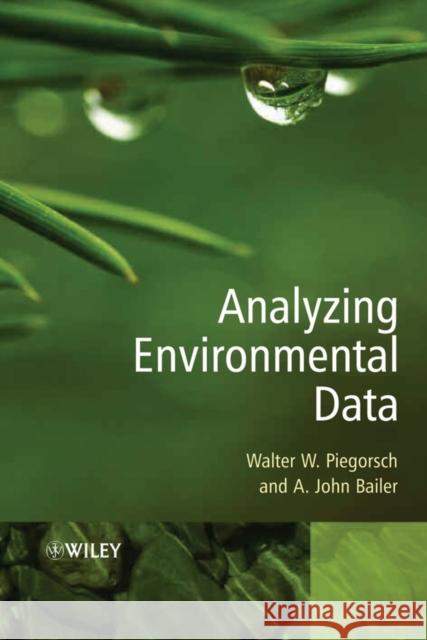
Walter W. Piegorsch; A. John Bailer
Analyzing Environmental Data Walter W. Piegorsch A. John Bailer 9780470848364 John Wiley & Sons - książkaWidoczna okładka, to zdjęcie poglądowe, a rzeczywista szata graficzna może różnić się od prezentowanej.

Analyzing Environmental Data

ISBN-13: 9780470848364 / Angielski / Twarda / 2005 / 488 str.

Walter W. Piegorsch; A. John Bailer
cena 383,26
(netto: 365,01 VAT:  5%)

Najniższa cena z 30 dni: 380,90
Termin realizacji zamówienia:
ok. 30 dni roboczych
Dostawa w 2026 r.

Darmowa dostawa!

Environmental statistics is a rapidly growing field, supported by advances in digital computing power, automated data collection systems, and interactive, linkable Internet software. Concerns over public and ecological health and the continuing need to support environmental policy-making and regulation have driven a concurrent explosion in environmental data analysis. This textbook is designed to address the need for trained professionals in this area. The book is based on a course which the authors have taught for many years, and prepares students for careers in environmental analysis centered on statistics and allied quantitative methods of data evaluation. The text extends beyond the introductory level, allowing students and environmental science practitioners to develop the expertise to design and perform sophisticated environmental data analyses. In particular, it:

  • Provides a coherent introduction to intermediate and advanced methods for modeling and analyzing environmental data.
  • Takes a data-oriented approach to describing the various methods.
  • Illustrates the methods with real-world examples
  • Features extensive exercises, enabling use as a course text.
  • Includes examples of SAS computer code for implementation of the statistical methods.
  • Connects to a Web site featuring solutions to exercises, extra computer code, and additional material.
  • Serves as an overview of methods for analyzing environmental data, enabling use as a reference text for environmental science professionals.
Graduate students of statistics studying environmental data analysis will find this invaluable as will practicing data analysts and environmental scientists including specialists in atmospheric science, biology and biomedicine, chemistry, ecology, environmental health, geography, and geology.

Kategorie:
Nauka
Kategorie BISAC:
Mathematics > Prawdopodobieństwo i statystyka
Science > Environmental Science (see also Chemistry - Environmental)
Wydawca:
John Wiley & Sons
Język:
Angielski
ISBN-13:
9780470848364
Rok wydania:
2005
Ilość stron:
488
Waga:
0.98 kg
Wymiary:
25.2 x 17.37 x 3.17
Oprawa:
Twarda
Wolumenów:
01
Dodatkowe informacje:
Bibliografia
Wydanie ilustrowane

"This book covers an impressive range of topics . . . The book can be used as a basis for courses of different levels." (Stat Papers, 2010)

"Some of the unique aspects of Piegorsch and Bailer s treatment are benchmark dose estimation for toxicants, statistical issues in risk assessment, the assessment of trend and step changes in temporal data, and the discussion of sampling." (Journal of the American Statistical Association, June 2008)

"I enjoyed reading this book and I recommend it to those readers interested in the field of environmental statistics." (Journal of Applied Statistics, January 2009)

"This highly recommended book will provide the background for the proper application of statistical methods. These will make an invaluable contribution to the realistic assessment of the damage to the environment to be expected as a result of global warming. The subject and author indexes are both excellent." (Journal of Chemical Technology and Biotechnology, August 2006)

"This highly recommended book will provide the background for the proper application of statistical methods. These will make an invaluable contribution to the realistic assessment of the damage to the environment to be expected as a result of global warming. The subject and author indexes are both excellent." (Journal of Chemical Technology and Biotechnology, Aug 2008)

"...This is a substantial and thorough book...a handy reference book for any statistician′s bookshelf..." (International Statistical Institute, January 2006)

Preface.

1 Linear regression.

1.1 Simple linear regression.

1.2 Multiple linear regression.

1.3 Qualitative predictors: ANOVA and ANCOVA models.

1.4 Random–effects models.

1.5 Polynomial regression.

Exercises.

2 Nonlinear regression.

2.1 Estimation and testing.

2.2 Piecewise regression models.

2.3 Exponential regression models.

2.4 Growth curves.

2.5 Rational polynomials.

2.6 Multiple nonlinear regression.

Exercises.

3 Generalized linear models.

3.1 Generalizing the classical linear model.

3.2 Theory of generalized linear models.

3.3 Specific forms of generalized linear models.

Exercises.

4 Quantitative risk assessment with stimulus–response data.

4.1 Potency estimation for stimulus–response data.

4.2 Risk estimation.

4.3 Benchmark analysis.

4.4 Uncertainty analysis.

4.5 Sensitivity analysis.

4.6 Additional topics.

Exercises.

5 Temporal data and autoregressive modeling.

5.1 Time series.

5.2 Harmonic regression.

5.3 Autocorrelation.

5.4 Autocorrelated regression models.

5.5 Simple trend and intervention analysis.

5.6 Growth curves revisited.

Exercises.

6 Spatially correlated data.

6.1 Spatial correlation.

6.2 Spatial point patterns and complete spatial randomness.

6.3 Spatial measurement.

6.4 Spatial prediction.

Exercises.

7 Combining environmental information.

7.1 Combining P–values.

7.2 Effect size estimation.

7.3 Meta–analysis.

7.4 Historical control information.

Exercises.

8 Fundamentals of environmental sampling.

8.1 Sampling populations simple random sampling.

8.2 Designs to extend simple random sampling.

8.3 Specialized techniques for environmental sampling.

Exercises.

A Review of probability and statistical inference.

A.1 Probability functions.

A.2 Families of distributions.

A.3 Random sampling.

A.4 Parameter estimation.

A.5 Statistical inference.

A.6 The delta method.

B Tables.

References.

Author index.

Subject index.

Walter W. Piegorsch, University of South Carolina, Columbia, South Carolina, USA
Walter W. Piegorsch earned an M.S. and a Ph.D. Statistics at the Biometrics Unit, Cornell University. He was a Statistician with the U.S. National Institute of Environmental Health Sciences from 1984 to 1993, then moved to the University of South Carolina, Columbia, where he is now Professor and Director of Undergraduate Studies in Statistics. Walter has co–authored or co–edited two books, Statistics for Environmental Biology and Toxicology with A. John Bailer, and Case Studies in Environmental Statistics with Douglas W. Nychka and Lawrence H. Cox. He also serves or has served as a member of the Editorial Board of Environmental and Molecular Mutagenesis and Mutation Research, the Editorial Review Board of Environmental Health Perspectives, and as an Associate Editor for Environmetrics, Environmental and Ecological Statistics, Biometrics, and the Journal of the American Statistical Association. Walter is a Fellow of the American Statistical Association, an elected member of the International Statistical Institute, and has received a Distinguished Achievement Medal from the American Statistical Association Section on Statistics and the Environment. He has served as Vice–Chair of the American Statistical Association Council of Sections Governing Board, as Program Chairman of the Joint Statistical Meetings, and as Secretary of the Eastern North American Region of the International Biometric Society. He has also served and continues to serve on advisory boards and peer review groups for governmental agencies including the U.S. National Toxicology Program, the U.S. Environmental Protection Agency, and the U.S. National Science Foundation.

Environmental statistics is a rapidly growing field, supported by advances in digital computing power, automated data collection systems, and interactive, linkable Internet software. Concerns over public and ecological health and the continuing need to support environmental policy–making and regulation have driven a concurrent explosion in environmental data analysis. This textbook is designed to address the need for trained professionals in this area. The book is based on a course which the authors have taught for many years, and prepares students for careers in environmental analysis centered on statistics and allied quantitative methods of data evaluation. The text extends beyond the introductory level, allowing students and environmental science practitioners to develop the expertise to design and perform sophisticated environmental data analyses. In particular, it:

  • Provides a coherent introduction to intermediate and advanced methods for modeling and analyzing environmental data.
  • Takes a data–oriented approach to describing the various methods.
  • Illustrates the methods with real–world examples
  • Features extensive exercises, enabling use as a course text.
  • Includes examples of SAS computer code for implementation of the statistical methods.
  • Connects to a Web site featuring solutions to exercises, extra computer code, and additional material.
  • Serves as an overview of methods for analyzing environmental data, enabling use as a reference text for environmental science professionals.

Graduate students of statistics studying environmental data analysis will find this invaluable as will practicing data analysts and environmental scientists including specialists in atmospheric science, biology and biomedicine, chemistry, ecology, environmental health, geography, and geology.

Piegorsch, Walter W. Walter W. Piegorsch is the Director of Statistical... więcej >
Bailer, A. John A. John Bailer, PhD, is Distinguished Professor an... więcej >


Udostępnij

Facebook - konto krainaksiazek.pl


Opinie o Krainaksiazek.pl na Opineo.pl

Partner Mybenefit

Krainaksiazek.pl w programie rzetelna firma Krainaksiaze.pl - płatności przez paypal

Czytaj nas na:

Facebook - krainaksiazek.pl
  • książki na zamówienie
  • granty
  • książka na prezent
  • kontakt
  • pomoc
  • opinie
  • regulamin
  • polityka prywatności

Zobacz:

  • Księgarnia czeska

  • Wydawnictwo Książkowe Klimaty

1997-2025 DolnySlask.com Agencja Internetowa

© 1997-2022 krainaksiazek.pl
     
KONTAKT | REGULAMIN | POLITYKA PRYWATNOŚCI | USTAWIENIA PRYWATNOŚCI
Zobacz: Księgarnia Czeska | Wydawnictwo Książkowe Klimaty | Mapa strony | Lista autorów
KrainaKsiazek.PL - Księgarnia Internetowa

Polityka prywatnosci - link
Krainaksiazek.pl - płatnośc Przelewy24
Przechowalnia Przechowalnia





