• Wyszukiwanie zaawansowane
  • Kategorie
  • Kategorie BISAC
  • Książki na zamówienie
  • Promocje
  • Granty
  • Książka na prezent
  • Opinie
  • Pomoc
  • Załóż konto
  • Zaloguj się

Analysis of Physiological Systems: The White-Noise Approach » książka


zaloguj się | załóż konto
Logo Krainaksiazek.pl

koszyk

konto

szukaj
topmenu
Księgarnia internetowa
Szukaj
Książki na zamówienie
Promocje
Granty
Książka na prezent
Moje konto
Pomoc
 
 
Wyszukiwanie zaawansowane
Pusty koszyk
Bezpłatna dostawa dla zamówień powyżej 20 złBezpłatna dostawa dla zamówień powyżej 20 zł

Kategorie główne

• Nauka
 [2950560]
• Literatura piękna
 [1849509]

  więcej...
• Turystyka
 [71097]
• Informatyka
 [151150]
• Komiksy
 [35848]
• Encyklopedie
 [23178]
• Dziecięca
 [617388]
• Hobby
 [139064]
• AudioBooki
 [1657]
• Literatura faktu
 [228597]
• Muzyka CD
 [383]
• Słowniki
 [2855]
• Inne
 [445295]
• Kalendarze
 [1464]
• Podręczniki
 [167547]
• Poradniki
 [480102]
• Religia
 [510749]
• Czasopisma
 [516]
• Sport
 [61293]
• Sztuka
 [243352]
• CD, DVD, Video
 [3414]
• Technologie
 [219456]
• Zdrowie
 [101002]
• Książkowe Klimaty
 [124]
• Zabawki
 [2311]
• Puzzle, gry
 [3459]
• Literatura w języku ukraińskim
 [254]
• Art. papiernicze i szkolne
 [8079]
Kategorie szczegółowe BISAC

Analysis of Physiological Systems: The White-Noise Approach

ISBN-13: 9781461339724 / Angielski / Miękka / 2011 / 488 str.
Vasilis Marmarelis
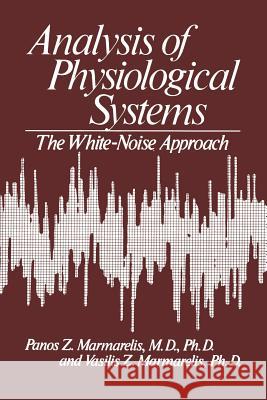
Analysis of Physiological Systems: The White-Noise Approach Vasilis Marmarelis 9781461339724 Springer - książkaWidoczna okładka, to zdjęcie poglądowe, a rzeczywista szata graficzna może różnić się od prezentowanej.

Analysis of Physiological Systems: The White-Noise Approach

ISBN-13: 9781461339724 / Angielski / Miękka / 2011 / 488 str.

Vasilis Marmarelis
cena 401,58
(netto: 382,46 VAT:  5%)

Najniższa cena z 30 dni: 385,52
Termin realizacji zamówienia:
ok. 22 dni roboczych
Dostawa w 2026 r.

Darmowa dostawa!

In studying physiological systems bioscientists are continually faced with the problem of providing descriptions of cause-effect relationships. This task is usually carried out through the performance of stimulus-response experiments. In the past, the design of such experiments has been ad hoc, incomplete, and certainly inefficient. Worse yet, bioscientists have failed to take advantage of advances in fields directly related to their problems (specifically, advances in the area of systems analysis). The raison d'etre of this book is to rectify this deficiency by providing the physiologist with methodological tools that will be useful to him or her in everyday labora- tory encounters with physiological systems. The book was written so that it would be practical, useful, and up-to- date. With this in mind, parts of it give step-by-step descriptions of in the laboratory. It is hoped that this systematic procedures to be followed will increase the usefulness of the book to the average research physiologist and, perhaps, reduce the need for in-depth knowledge of some of the associated mathematics. Even though the material deals with state-of-the- art techniques in systems and signal analysis, the mathematical level has been kept low so as to be comprehensible to the average physiologist with no extensive training in mathematics. To this end, mathematical rigor is often sacrificed readily to intuitive simple arguments.


Kategorie:
Nauka, Medycyna
Kategorie BISAC:
Medical > Neuroscience
Science > Life Sciences - Neuroscience
Wydawca:
Springer
Seria wydawnicza:
Computers in Biology and Medicine
Język:
Angielski
ISBN-13:
9781461339724
Rok wydania:
2011
Wydanie:
1978
Numer serii:
000224542
Ilość stron:
488
Waga:
0.70 kg
Wymiary:
23.39 x 15.6 x 2.59
Oprawa:
Miękka
Wolumenów:
01

1. The Problem of System Identification in Physiology.- 1.1. The Problem of Systems Analysis in Physiology.- 1.2. Functional and Structural Identification of Physiological Systems.- 1.3. “Black Box” vs. Parameter Identification in Physiological Systems.- 2. Analysis of Physiological Signals.- 2.1. Physiological Systems Data: Deterministic and Stochastic Descriptions.- 2.2. Some Statistical Tools and Concepts.- 2.2.1. Stationarity and Ergodicity of Signals.- 2.2.2. Certain Statistical Quantities of Interest.- 2.3. Autocorrelation and Crosscorrelation Functions.- 2.3.1. Certain Properties of the Auto- and Crosscorrelation Functions.- 2.3.2. Correlation Measurement from Underlying Probability Distribution.- 2.3.3. Summary of Definitions of Auto- and Crosscorrelation Functions.- 2.3.4. Use of Correlation Functions.- 2.4. Frequency Domain Description of Signals.- 2.4.1. Fourier Series.- 2.4.2. The Fourier Transform.- 2.4.3. Power Spectrum.- 2.5. Certain Properties of Gaussian Signals.- 2.5.1. High-Order Moments of Gaussian Signals.- 2.5.2. Stationarity and Ergodicity of Gaussian Signals.- 2.5.3. Gaussian Signals through Linear Systems.- 2.5.4. Gaussian White Noise.- 2.6. Sampling Considerations.- 2.7. Statistical Estimation from Physiological Signals.- 2.7.1. Variance of the Mean for Sampled Signals.- 2.7.2. Confidence Interval of Estimates.- 2.8. Filtering of Physiological Signals.- 2.8.1. Averaging Responses to Identical Stimuli.- 2.8.2. Low-Frequency Trend Removal.- 2.8.3. Digital Filters.- 2.8.4. Analog Filtering.- 2.9. Considerations in Computing Power Spectra.- 2.9.1. Aliasing.- 2.9.2. Statistical Errors.- 2.9.3. Smoothing.- 2.9.4. Practical Considerations.- 3. Traditional Approaches to Physiological System Identification.- 3.1. Stimulus-Response Relations in Linear Systems.- 3.1.1. Time Domain.- 3.1.2. Frequency Domain.- 3.2. Transfer Functions and Bode Plots.- 3.2.1. Analysis.- 3.2.2. (Non-) Minimum-Phase Systems.- 3.2.3. Synthesis.- 3.2.4. Delays in Transfer Functions.- 3.3. Transfer Functions from Stimulus-Response Spectra.- 3.3.1. The Effect of Noise.- 3.3.2. Application to a Physiological System: Light ? ERG.- 3.4. Coherence Function.- 3.5. Mufti-Input Linear Systems.- 3.5.1. Two-Input Systems.- 3.5.2. Application to a Two-Input Neural System.- 3.5.3. n-Input Systems.- 3.6. Nonlinear Systems: Identification Using “Describing Functions”..- 3.6.1. Describing Functions.- 3.6.2. Use of Describing Functions for Identification of Systems..- 3.6.3. A Linearization Technique.- 3.7. Effects of Feedback in Physiological Systems.- 3.7.1. On the System Gain.- 3.7.2. On Reliability of Processing Signals.- 3.7.3. On Signal-to-Noise Ratio ..- 3.7.4. On System Bandwidth.- 3.7.5. On System Response and Stability.- 3.7.6. On Sustained Physiological Oscillations.- 3.8. Feedback Analysis in a Neurosensory System.- 4. The White-Noise Method in System Identification.- 4.1. Linear and Nonlinear Systems-The Volterra Series.- 4.1.1. Linear Systems.- 4.1.2. Nonlinear Systems.- 4.1.3. Analogy between Volterra and Taylor Series.- 4.1.4. Functional Meaning of the Volterra Kernels.- 4.2. The Wiener Theory.- 4.2.1. System Representation by Functionals.- 4.2.2. The Wiener Series.- 4.2.3. Comparison of Wiener and Volterra Representations.- 4.2.4. Meaning of Wiener Kernels.- 4.2.5. Kernels of System Cascades.- 4.3. Schemes for the Estimation of the System Kernels.- 4.3.1. The Wiener-Bose Approach.- 4.3.2. The Lee-Schetzen Approach (Crosscorrelation Technique)..- 4.3.3. A Paradigm: White-Noise Analysis of a Physiological System.- 4.4. Multi-Input, Multi-Output Systems.- 4.5. Other Formulations of the White-Noise Approach.- 5. Applicability of the White-Noise Method and the Use of Quasiwhite Test Signals.- 5.1. The Band-Limited Gaussian White Noise.- 5.1.1. General Description and Generation of GWN.- 5.1.2. Autocorrelation Properties of GWN and Application in Nonlinear System Identification.- 5.2. The Pseudorandom Signals Based on m Sequences.- 5.2.1. General Description and Generation of PRS.- 5.2.2. Autocorrelation Properties of PRS and Application in Nonlinear System Identification.- 5.3. The Constant-Switching-Pace Symmetric Random Signals.- 5.3.1. General Description and Generation of CSRS.- 5.3.2. Autocorrelation Properties of CSRS and Application in Nonlinear System Identification.- 5.3.3. An Analytical Example.- 5.4. Comparative Study of the Use of GWN, PRS, and CSRS in System Identification.- 5.4.1. Discussion on Relative Advantages and Disadvantages of GWN, PRS, and CSRS.- 5.4.2. Computer-Simulated Applications of GWN, PRS, and CSRS.- 5.5. Validation of Generated Quasiwhite Test Signals.- 5.5.1. Check on Autocorrelation Functions.- 5.5.2. Check on Stationarity.- 5.5.3. Check on Amplitude Distribution.- 5.5.4. Check on Power Spectrum.- 5.5.5. Check on Independence of Multiple Stimuli.- 6. Methods of Computation of System Kernels.- 6.1. Computational Considerations for Kernel Measurement.- 6.2. Time-Domain Approaches to Kernel Computation.- 6.2.1. Utilization of Intermediate Products.- 6.2.2. Treatment of Long Stimulus-Response Records.- 6.2.3. Quantization of the Input Signal.- 6.2.4. Monte Carlo Methods for Kernel Computation.- 6.3. Frequency-Domain Approach: Use of the Fast Fourier Transform Algorithm.- 6.3.1. Frequency-Domain Formulation and Procedure.- 6.3.2. Analysis of Kernel Computation via the Frequency Domain.- 6.4. Special Cases of Kernel Computation.- 6.4.1. The Use of Binary and Ternary Inputs.- 6.4.2. Spike Train Output.- 6.5. Analog (Hybrid) Methods for the Computation of Kernels.- 6.6. Evaluation of the System Kernels.- 6.7. Evaluation of Results of Experiment.- 6.7.1. One-Input System.- 6.7.2. Two-Input System.- 6.7.3. Physical Units of Kernels.- 7. Errors in the Estimation of System Kernels.- 7.1. Estimation Errors Using GWN Stimulus.- 7.1.1. Errors Due to the Finite Record Length.- 7.1.2. Errors Due to the Finite Stimulus Bandwidth.- 7.1.3. Errors Due to Experimental Limitations.- 7.1.4. Dependence of Kernel Estimate Accuracy on the Degree of System Nonlinearity.- 7.1.5. Effect of Kernel Memory Truncation on Frequency Response Estimate.- 7.1.6. Errors Due to the Presence of Other Inputs in the Mufti-Input Case.- 7.2. Estimation Errors Using PRS Stimuli.- 7.3. Estimation Errors Using CSRS Stimuli.- 7.3.1. The Deconvolution Error.- 7.3.2. The Statistical Fluctuation Error.- 7.3.3. The Approximate Orthogonality Errors.- 7.3.4. The Erroneous Power Level Error.- 7.3.5. The Finite Transition Time Error.- 7.3.6. Computational Errors.- 7.3.7. General Error Management.- 7.3.8. Minimization of the Deconvolution and Statistical Fluctuation Errors-The Fundamental Error Equation.- 7.4. Errors Due to the Presence of Contaminating Noise.- 7.4.1. Noise at the Output.- 7.4.2. Internal Noise.- 7.4.3. Noise at the Input.- 8. Tests and Analyses Preliminary to Identification Experiment.- 8.1. Determination of the System Input and Output and Region of Operation.- 8.2. Examination of System Stationarity and Noise Conditions.- 8.2.1. System Stationarity.- 8.2.2. Noise Conditions.- 8.3. Removal of Drifts in the Response Data.- 8.3.1. Trend Removal by Fitting Least-Squares Polynomials.- 8.3.2. High-Pass Filtering of the Response.- 8.4. The Measurement of System Memory and Bandwidth.- 8.5. Measurement of Extent of System Nonlinearity.- 8.6. Recording and Digitalization of Stimulus-Response Data.- 8.6.1. Effect of Aliasing on Kernel Estimation.- 8.6.2. Effect of Digitalization on Kernel Estimation.- 8.7. Choice of GWN Bandwidth and Record Length.- 8.8. Optimal Choice of CSRS Step and Record Length.- 9. Peeking into the Black Box.- 9.1. Analysis of Cascades in Physiological Systems.- 9.1.1. Linear System Followed by Zero-Memory Nonlinearity.- 9.1.2. Linear System Preceded by Zero-Memory Nonlinearity.- 9.1.3. Illustrative Applications to Physiological Systems.- 9.2. Zero-Memory Systems.- 9.3. Combinations of Systems.- 9.3.1. Identity System.- 9.3.2. Sum System.- 9.3.3. Cascade System.- 9.3.4. Feedback System.- 9.3.5. Illustrative Applications to Physiological Systems.- 10. Applications of the White-Noise Method to Neural Systems.- 10.1. Practical Considerations in Application of the White-Noise Method to Neural Systems.- 10.1.1. Dynamic Range of Stimulus.- 10.1.2. Stationarity of System Response.- 10.1.3. Lower-Frequency Limitations.- 10.1.4. Intracellular Recording.- 10.1.5. Modeling of Neural Systems.- 10.2. Identification of One-Input Neural Systems Using GWN Stimulus.- 10.2.1. System with Continuous Input and Continuous Output: Light? Horizontal Cell.- 10.2.2. System with Continuous Input and Discrete Output: Horizontal Cell? Ganglion Cell.- 10.3. Identification of Two-Input Neural Systems Using GWN Stimulus.- 10.3.1. System with Continuous Inputs and Continuous Output: Spot and Annulus Light? Horizontal Cell.- 10.3.2. System with Continuous Inputs and Discrete Output: Two Spot Light? Horizontal Motion Detection Fiber.- 10.4. Identification of One-Input Neural System Using Pseudorandom Binary Stimulus.- 10.5. Identification of One-Input Neural System Using CSRS Stimulus.- 10.6. Applications of Alternate Identification Techniques to Neural Systems with Discrete Input or Output.- 10.6.1. System with Continuous Input and Discrete Output.- 10.6.2. System with Discrete Input and Continuous Output.- 11. Physiological Systems Requiring Special Treatment.- 11.1. Physiological Systems with Point Process Inputs and Outputs.- 11.1.1. Continuous-to-Discrete System.- 11.1.2. Discrete-to-Continuous System.- 11.1.3. Discrete-to-Discrete System.- 11.2. Systems with Spatiotemporal Inputs.- 11.3. Nonstationary Systems.- 11.4. Systems with Nonwhite Random Inputs.- 12. Dialogue for Epilogue.- References.- Related Literature.


Udostępnij

Facebook - konto krainaksiazek.pl


Opinie o Krainaksiazek.pl na Opineo.pl

Partner Mybenefit

Krainaksiazek.pl w programie rzetelna firma Krainaksiaze.pl - płatności przez paypal

Czytaj nas na:

Facebook - krainaksiazek.pl
  • książki na zamówienie
  • granty
  • książka na prezent
  • kontakt
  • pomoc
  • opinie
  • regulamin
  • polityka prywatności

Zobacz:

  • Księgarnia czeska

  • Wydawnictwo Książkowe Klimaty

1997-2025 DolnySlask.com Agencja Internetowa

© 1997-2022 krainaksiazek.pl
     
KONTAKT | REGULAMIN | POLITYKA PRYWATNOŚCI | USTAWIENIA PRYWATNOŚCI
Zobacz: Księgarnia Czeska | Wydawnictwo Książkowe Klimaty | Mapa strony | Lista autorów
KrainaKsiazek.PL - Księgarnia Internetowa

Polityka prywatnosci - link
Krainaksiazek.pl - płatnośc Przelewy24
Przechowalnia Przechowalnia






