• Wyszukiwanie zaawansowane
  • Kategorie
  • Kategorie BISAC
  • Książki na zamówienie
  • Promocje
  • Granty
  • Książka na prezent
  • Opinie
  • Pomoc
  • Załóż konto
  • Zaloguj się

Analysis of Financial Data » książka


zaloguj się | załóż konto
Logo Krainaksiazek.pl

koszyk

konto

szukaj
topmenu
Księgarnia internetowa
Szukaj
Książki na zamówienie
Promocje
Granty
Książka na prezent
Moje konto
Pomoc
 
 
Wyszukiwanie zaawansowane
Pusty koszyk
Bezpłatna dostawa dla zamówień powyżej 20 złBezpłatna dostawa dla zamówień powyżej 20 zł

Kategorie główne

• Nauka
 [2946912]
• Literatura piękna
 [1852311]

  więcej...
• Turystyka
 [71421]
• Informatyka
 [150889]
• Komiksy
 [35717]
• Encyklopedie
 [23177]
• Dziecięca
 [617324]
• Hobby
 [138808]
• AudioBooki
 [1671]
• Literatura faktu
 [228371]
• Muzyka CD
 [400]
• Słowniki
 [2841]
• Inne
 [445428]
• Kalendarze
 [1545]
• Podręczniki
 [166819]
• Poradniki
 [480180]
• Religia
 [510412]
• Czasopisma
 [525]
• Sport
 [61271]
• Sztuka
 [242929]
• CD, DVD, Video
 [3371]
• Technologie
 [219258]
• Zdrowie
 [100961]
• Książkowe Klimaty
 [124]
• Zabawki
 [2341]
• Puzzle, gry
 [3766]
• Literatura w języku ukraińskim
 [255]
• Art. papiernicze i szkolne
 [7810]
Kategorie szczegółowe BISAC

Analysis of Financial Data

ISBN-13: 9780470013212 / Angielski / Miękka / 2006 / 256 str.
Gary Koop
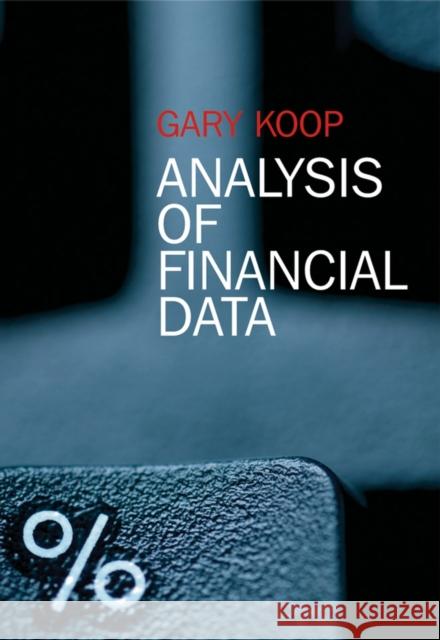
Analysis of Financial Data Gary Koop 9780470013212  - książkaWidoczna okładka, to zdjęcie poglądowe, a rzeczywista szata graficzna może różnić się od prezentowanej.

Analysis of Financial Data

ISBN-13: 9780470013212 / Angielski / Miękka / 2006 / 256 str.

Gary Koop
cena 240,58
(netto: 229,12 VAT:  5%)

Najniższa cena z 30 dni: 238,60
Termin realizacji zamówienia:
ok. 30 dni roboczych
Bez gwarancji dostawy przed świętami

Darmowa dostawa!

Analysis of Financial Data teaches basic methods and techniques of data analysis to finance students. It covers many of the major tools used by the financial economist i.e. regression and time series methods including discussion of nonstationary models, multivariate concepts such as cointegration and models of conditional volatility. It shows students how to apply such techniques in the context of real-world empirical problems. It adopts a largely non-mathematical approach relying on verbal and graphical intuition and contains extensive use of real data examples and involves readers in hands-on computer work. Analysis of Financial Data has been adapted by Gary Koop from his highly successful textbook Analysis of Economic Data.


Kategorie:
Nauka, Ekonomia i biznes
Kategorie BISAC:
Business & Economics > Finance - General
Język:
Angielski
ISBN-13:
9780470013212
Rok wydania:
2006
Ilość stron:
256
Waga:
0.48 kg
Wymiary:
24.26 x 17.02 x 1.5
Oprawa:
Miękka
Wolumenów:
01
Dodatkowe informacje:
Bibliografia
Wydanie ilustrowane

Preface.

Chapter 1: Introduction.

Organization of the book.

Useful background.

Appendix 1.1: Concepts in mathematics used in this book.

Chapter 2: Basic data handling.

Types of financial data.

Obtaining data.

Working with data: graphical methods.

Working with data: descriptive statistics.

Expected values and variances.

Chapter summary.

Appendix 2.1: Index numbers.

Appendix 2.2: Advanced descriptive statistics.

Chapter 3: Correlation.

Understanding correlation.

Understanding why variables are correlated.

Understanding correlation through XY–plots.

Correlation between several variables.

Covariances and population correlations.

Chapter summary.

Appendix 3.1: Mathematical details.

Chapter 4: An introduction to simple regression.

Regression as a best fitting line.

Interpreting OLS estimates.

Fitted values and R2: measuring the fit of a regression model.

Nonlinearity in regression.

Chapter summary.

Appendix 4.1: Mathematical details.

Chapter 5: Statistical aspects of regression.

Which factors affect the accuracy of the estimate β?

Calculating a confidence interval for β.

Testing whether β = 0.

Hypothesis testing involving R2: the F–statistic.

Chapter summary.

Appendix 5.1: Using statistical tables for testing whether β = 0.

Chapter 6: Multiple regression.

Regression as a best fitting line.

Ordinary least squares estimation of the multiple regression model.

Statistical aspects of multiple regression.

Interpreting OLS estimates.

Pitfalls of using simple regression in a multiple regression context.

Omitted variables bias.

Multicollinearity.

Chapter summary.

Appendix 6.1: Mathematical interpretation of regression coefficients.

Chapter 7: Regression with dummy variables.

Simple regression with a dummy variable.

Multiple regression with dummy variables.

Multiple regression with both dummy and non–dummy explanatory variables.

Interacting dummy and non–dummy variables.

What if the dependent variable is a dummy?

Chapter summary.

Chapter 8: Regression with lagged explanatory variables.

Aside on lagged variables.

Aside on notation.

Selection of lag order.

Chapter summary.

Chapter 9: Univariate time series analysis.

The autocorrelation function.

The autoregressive model for univariate time series.

Nonstationary versus stationary time series.

Extensions of the AR(1) model.

Testing in the AR( p) with deterministic trend model.

Chapter summary.

Appendix 9.1: Mathematical intuition for the AR(1) model.

Chapter 10: Regression with time series variables.

Time series regression when X and Y are stationary.

Time series regression when Y and X have unit roots: spurious regression.

Time series regression when Y and X have unit roots: cointegration.

Time series regression when Y and X are cointegrated: the error correction model.

Time series regression when Y and X have unit roots but are not cointegrated.

Chapter summary.

Chapter 11: Regression with time series variables with several equations.

Granger causality.

Vector autoregressions.

Chapter summary.

Appendix 11.1: Hypothesis tests involving more than one coefficient.

Appendix 11.2: Variance decompositions.

Chapter 12: Financial volatility.

Volatility in asset prices: Introduction.

Autoregressive conditional heteroskedasticity (ARCH).

Chapter summary.

Appendix A: Writing an empirical project.

Description of a typical empirical project.

General considerations.

Appendix B: Data directory.

Index.

Gary Koop is Professor of Economics at the University of Strathclyde.

Analysis of Financial Data teaches the basic methods and techniques of data analysis to finance students, by showing them how to apply such techniques in the context of real–world empirical problems.

Adopting a largely non–mathematical approach Analysis of Financial Data relies more on verbal intuition and graphical methods for understanding.

Key features include:

  • Coverage of many of the major tools used by the financial economist e.g. correlation, regression, time series analysis and methods for analyzing financial volatility.
  • Extensive use of real data examples, which involves readers in hands–on computer work.
  • Mathematical techniques at a level suited to MBA students and undergraduates taking a first course in the topic.

Supplementary material for readers and lecturers provided on an accompanying website.


Udostępnij

Facebook - konto krainaksiazek.pl


Opinie o Krainaksiazek.pl na Opineo.pl

Partner Mybenefit

Krainaksiazek.pl w programie rzetelna firma Krainaksiaze.pl - płatności przez paypal

Czytaj nas na:

Facebook - krainaksiazek.pl
  • książki na zamówienie
  • granty
  • książka na prezent
  • kontakt
  • pomoc
  • opinie
  • regulamin
  • polityka prywatności

Zobacz:

  • Księgarnia czeska

  • Wydawnictwo Książkowe Klimaty

1997-2025 DolnySlask.com Agencja Internetowa

© 1997-2022 krainaksiazek.pl
     
KONTAKT | REGULAMIN | POLITYKA PRYWATNOŚCI | USTAWIENIA PRYWATNOŚCI
Zobacz: Księgarnia Czeska | Wydawnictwo Książkowe Klimaty | Mapa strony | Lista autorów
KrainaKsiazek.PL - Księgarnia Internetowa

Polityka prywatnosci - link
Krainaksiazek.pl - płatnośc Przelewy24
Przechowalnia Przechowalnia





