An Overview of the SIGMA Research Project: A European Approach to Seismic Hazard Analysis » książka





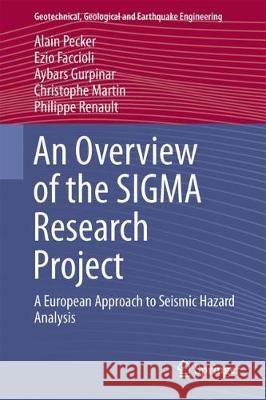
An Overview of the SIGMA Research Project: A European Approach to Seismic Hazard Analysis
ISBN-13: 9783319581538 / Angielski / Twarda / 2017 / 172 str.
An Overview of the SIGMA Research Project: A European Approach to Seismic Hazard Analysis
ISBN-13: 9783319581538 / Angielski / Twarda / 2017 / 172 str.
(netto: 423,68 VAT: 5%)
Najniższa cena z 30 dni: 424,07
ok. 16-18 dni roboczych.
Darmowa dostawa!
1 Introduction
Alain Pecker received his MSc Degree from the University of California, Berkeley, in 1973. Subsequently he worked as an engineer in the field of geosciences. He currently is professor at the Graduate School of Earthquake Engineering at the University of Pavia, Italy (since 2001) and at the Civil and Construction Engineering Department at Ecole des Ponts ParisTech, France (since 2002). He is an expert in soil mechanics and geotechnical engineering, dynamic and seismic analyses with a focus on nuclear installations, marine installations, bridges, dams-canals, among others. He is a member of a number of associations in the field and served as president of the French Association for Earthquake Engineering from 1992 to 1996. Pecker has authored or coauthored 6 books on soil dynamics and earthquake engineering and has published 48 papers in international peer reviewed journals. He was keynote speaker at a large number of conferences, among them the 14th and 15th European Conference on Earthquake Engineering in Ohrid (2010) and Istanbul (2014). He is a member of the French National Academy of Technology.
Ezio Faccioli received his MSc degree in Civil Engineering from Milan Technical University in 1964 and his PhD in Civil Engineering from the University of Illinois, USA, in 1968. Currently, he holds the position of retained consultant and partner at Studio Geotecnico Italiano srl, in Milan, Italy. He is a retired professor of Earthquake Engineering and Engineering Seismology at the Department of Structured Engineering at Politecnico di Milano, with which he had been affiliated since 1968. Faccioli was the leader of the SGI-Politecnico di Milano specialist team in the 5 year SIGMA research and development program. His main interests are engineering seismology, soil dynamics and vibration. He was member of the national working group charged with the elaboration of the current seismic zonation map of Italy, promulgated by a decree in May 2006. He co-authored 5 books has published 50 papers in international peer reviewed journals
After twenty one years of service at the International Atomic Energy Agency at various levels of responsibility, Dr. Gurpinar retired from the IAEA and started independent consulting work. He specializes in three major fields; (i) new build nuclear power plant projects focusing on selection and qualification of the site, (ii) protection of nuclear and other critical facilities against acts of sabotage, and (iii) design and evaluation of nuclear and other critical facilities against external hazards, especially earthquakes. He is a regular consultant to Worley Parsons, involved in NPP Projects in Bulgaria, Egypt, Jordan, Armenia, Poland and Turkey. He has also worked as a consultant for international organizations such as the IAEA and the European Commission. He is a current member of INSAG, the advisory group to the Director General of the IAEA. Gurpinar received his MSc in Civil Engineering from the State University of California in 1968 and his PhD in Civil Engineering with a minor in Mathematics from the University of New Mexico in 1971. He has published three books and over 150 papers in international journals or conference proceedings. He is also one of the principal authors of IAEA's Comprehensive Report on the Fukushima Daiichi accident.
Christophe Martin is a Certified Seismologist (PhD in Engineering Seismology, University of Grenoble, 1988) with over 25 years of professional experience in geoconsultancy services in the field. He provided consultancy services for a wide spectrum of multi-disciplinary infrastructure projects but currently provides specialized emphasis on nuclear power projects. He has performed regional and site investigations to assess geologic and seismic hazards for nuclear power plants, large engineered facilities, including bridges, dams, pipelines, and LNG terminals throughout France and several other countries (Algeria, Bolivia, China, Italy, Morocco, Romania, United Kingdom, among others). During the last 10 years, Martin has coordinated the revision of seismic hazard assessments for almost all nuclear sites in France. He was also actively involved in the nuclear industry working groups of the IAEA. He is author of numerous projects reports submitted to peer review by national regulators. Currently, Martin is the Project Technical Integrator for the Sinop Nuclear Site in Turkey and for the Moorside Nuclear Site in the UK.
Philippe L.A. Renault is the managing director of swissnuclear in Olten, Switzerland. He received his MSc degree in Civil Engineering from RWTH Aachen University in 2002. Subsequently, he worked as a research assistant at the same university. In 2007, he published his PhD thesis entitled "Assessment Procedure for the Evaluation of the Earthquake Safety of Bridges". He was the project manager of the Swiss seismic hazard study PEGASOS Refinement and was the head of the hazard and structural analyses group. He has authored or coauthored over 20 papers in international peer reviewed journals within the scope of his interests: structural dynamics and earthquake engineering, soil-structure interaction, impact simulations, seismic hazard assessment and seismic risk and vulnerability assessment.
This book presents a summary of the important outcomes of the SIGMA project related to all aspects of Probabilistic Seismic Hazard Assessment: source characterization, rock motion characterization, site response characterization, and hazard calculations, with for all of them emphasis on the treatment of uncertainties.
In recent years, attempts have been made to identify and quantify uncertainties in seismic hazard estimations for regions with moderate seismicity. These uncertainties, for which no estimation standards exist, create major difficulties and can lead to different interpretations and divergent opinions among experts. To address this matter, an international research project was launched in January 2011, by an industrial consortium composed of French and Italian organizations. This program, named SIGMA (Seismic Ground Motion Assessment) lasted for five years and involved a large number of international institutions.
This book is intended for instructors running courses on engineering seismology, graduate students in the same field and practicing engineers involved in Probabilistic Seismic Hazard Analyses.




Czytaj nas na:
1997-2026 DolnySlask.com Agencja Internetowa
KrainaKsiazek.PL - Księgarnia Internetowa


