• Wyszukiwanie zaawansowane
  • Kategorie
  • Kategorie BISAC
  • Książki na zamówienie
  • Promocje
  • Granty
  • Książka na prezent
  • Opinie
  • Pomoc
  • Załóż konto
  • Zaloguj się

An Introduction to Global Spectral Modeling » książka


zaloguj się | załóż konto
Logo Krainaksiazek.pl

koszyk

konto

szukaj
topmenu
Księgarnia internetowa
Szukaj
Książki na zamówienie
Promocje
Granty
Książka na prezent
Moje konto
Pomoc
 
 
Wyszukiwanie zaawansowane
Pusty koszyk
Bezpłatna dostawa dla zamówień powyżej 20 złBezpłatna dostawa dla zamówień powyżej 20 zł

Kategorie główne

• Nauka
 [2946600]
• Literatura piękna
 [1856966]

  więcej...
• Turystyka
 [72221]
• Informatyka
 [151456]
• Komiksy
 [35826]
• Encyklopedie
 [23190]
• Dziecięca
 [619653]
• Hobby
 [140543]
• AudioBooki
 [1577]
• Literatura faktu
 [228355]
• Muzyka CD
 [410]
• Słowniki
 [2874]
• Inne
 [445822]
• Kalendarze
 [1744]
• Podręczniki
 [167141]
• Poradniki
 [482898]
• Religia
 [510455]
• Czasopisma
 [526]
• Sport
 [61590]
• Sztuka
 [243598]
• CD, DVD, Video
 [3423]
• Technologie
 [219201]
• Zdrowie
 [101638]
• Książkowe Klimaty
 [124]
• Zabawki
 [2473]
• Puzzle, gry
 [3898]
• Literatura w języku ukraińskim
 [254]
• Art. papiernicze i szkolne
 [8170]
Kategorie szczegółowe BISAC

An Introduction to Global Spectral Modeling

ISBN-13: 9780387302546 / Angielski / Twarda / 2006 / 320 str.
T. N. Krishnamurti; H. S. Bedi; L. Ramaswamy
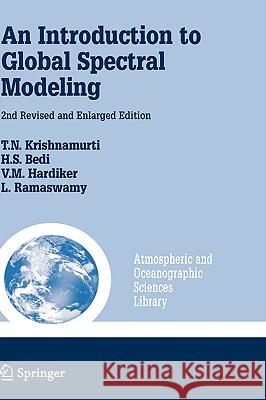
An Introduction to Global Spectral Modeling T. N. Krishnamurti H. S. Bedi L. Ramaswamy 9780387302546 Springer - książkaWidoczna okładka, to zdjęcie poglądowe, a rzeczywista szata graficzna może różnić się od prezentowanej.

An Introduction to Global Spectral Modeling

ISBN-13: 9780387302546 / Angielski / Twarda / 2006 / 320 str.

T. N. Krishnamurti; H. S. Bedi; L. Ramaswamy
cena 201,72 zł
(netto: 192,11 VAT:  5%)

Najniższa cena z 30 dni: 192,74 zł
Termin realizacji zamówienia:
ok. 22 dni roboczych
Bez gwarancji dostawy przed świętami

Darmowa dostawa!

This is an introductory textbook on global spectral modeling designed for senior-level undergraduates and possibly for first-year graduate students. This text starts with an introduction to elementary finite-difference methods and moves on towards the gradual description of sophisticated dynamical and physical models in spherical coordinates. Computational aspects of the spectral transform method, the planetary boundary layer physics, the physics of precipitation processes in large-scale models, the radiative transfer including effects of diagnostic clouds and diurnal cycle, the surface energy balance over land and ocean, and the treatment of mountains are some issues that are addressed. The topic of model initialization includes the treatment of normal modes and physical processes. A concluding chapter covers the spectral energetics as a diagnostic tool for model evaluation. This revised second edition of the text also includes three additional chapters. Chapter 11 deals with the formulation of a regional spectral model for mesoscale modeling which uses a double Fourier expansion of data and model equations for its transform. Chapter 12 deals with ensemble modeling. This is a new and important area for numerical weather and climate prediction. Finally, yet another new area that has to do with adaptive observational strategies is included as Chapter 13. It foretells where data deficiencies may reside in model from an exploratory ensemble run of experiments and the spread of such forecasts.


Kategorie:
Nauka
Kategorie BISAC:
Science > Earth Sciences - Meteorology & Climatology
Science > Geofizyka
Science > Earth Sciences - Geology
Wydawca:
Springer
Seria wydawnicza:
Atmospheric and Oceanographic Sciences Library
Język:
Angielski
ISBN-13:
9780387302546
Rok wydania:
2006
Wydanie:
Rev. and Enlarg
Numer serii:
000174110
Ilość stron:
320
Waga:
0.59 kg
Wymiary:
24.23 x 15.75 x 2.16
Oprawa:
Twarda
Wolumenów:
01
Dodatkowe informacje:
Bibliografia
Wydanie ilustrowane

James Russell Carr in Mathematical Geology, Vol. 31, No. 8, 1999 on the book's first edition:


In summary, the mathematical treatment is quite intense and demands patience of readers, at least in the case of this one. But if at all intrigued by how sophisticated weather forecasting has become (certainly strom forecasting) then a reader will find this book not only interesting, but thorough enough to enable model development if that is a goal. Problems are presneted at the end of each chapter, so this book can be used as a texct in the class room. Reserachers involved in the modeling of turbulence, ocean systems and tectonic systems may also value the presentation of this book.

Introduction An Introduction to Finite Differencing 2.1 Introduction 2.2 Application of Taylor’s Series to Finite Differencing 2.3 Forward and Backward Differencing 2.4 Centered Finite Differencing 2.5 Fourth-Order Accurate Formulas 2.6 Second-Order Accurate Laplacian 2.7 Fourth-Order Accurate Laplacian 2.8 Elliptical Partial Differential Equations in Meteorology 2.9 Direct Method 2.10 Relaxation Method 2.11 Sequential Relaxation Versus Simultaneous Relaxation 2.12 Barotropic Vorticity Equation 2.13 The 5-Point Jacobian 2.14 Arakawa Jacobian 2.15 Exercises 3 Time-Differencing Schemes 3.1 Introduction 3.2 Amplification Factor 3.3 Stability 3.4 Shallow-Water Model 4 What Is a Spectral Model? 4.1 Introduction 4.2 The Galerkin Method 4.3 A Meteorological Application 4.4 Exercises 5 Low-Order Spectral Model 5.1 Introduction 5.2 Maximum Simplification 5.3 Conservation of Mean-Square Vorticity and Mean Kinetic Energy 5.4 Energy Transformations 5.5 Mapping the Solution 5.6 An Example of Chaos 5.7 Exercises 6 Mathematical Aspects of Spectral Models 6.1 Introduction 6.2 Legendre Equation and Associated Legendre Equation 6.3 Laplace’s Equation 6.4 Orthogonality Properties 6.5 Recurrence Relations 6.6 Gaussian Quadrature 6.7 Spectral Representation of Physical Fields 6.8 Barotropic Spectral Model on a Sphere 6.9 Shallow-Water Spectral Model 6.10 Semi-implicit Shallow-Water Spectral Model 6.11 Inclusion of Bottom Topography 6.12 Exercises 7 Multilevel Global Spectral Model 7.1 Introduction 7.2 Truncation in a Spectral Model 7.3 Aliasing 7.4 Transform Method 7.5 The x-y-s Coordinate System 7.6 A Closed System of Equations in s Coordinates on a Sphere 7.7 Spectral Form of the Primitive Equations 7.8 Examples 8 Physical Processes 8.1 Introduction 8.2 The Planetary Boundary Layer 8.3 Cumulus Parameterization 8.4 Large-Scale Condensation 8.5 Parameterization of Radiative Processes 9 Initialization Procedures 9.1 Introduction 9.2 Normal Mode Initialization 9.3 Physical Initialization 9.4 Initialization of the Earth’s Radiation Budget 10 Spectral Energetics 10.1 Introduction 10.2 Energy Equations on a Sphere 10.3 Energy Equations in Wavenumber Domain 10.4 Energy Equations in Two-Dimensional Wavenumber Domain 11 Limited Area Spectral Model 11.1 Introduction 11.2 Map Projection 11.3 Model Equations 11.4 Orography and Lateral Boundary Relaxation 11.5 Spectral Representation and Lateral Boundary Conditions 11.6 Spectral Truncation 11.7 Model Physics and Vertical Structure 11.8 Regional Model Forecast Procedure 12 Ensemble Forecasting 12.1 Introduction 12.2 Monte Carlo Method 12.3 National Center for

T.N. Krishnamurti is professor of meteorology at Florida State University. He obtained his PhD in 1959 at the University of Chicago. His research interests are in the following areas: high resolution hurricane forecast (tracks, landfall, and intensity), monsoon forecasts on short, medium range, and monthly time scale and studies of interseasonal and interannual variability of the tropical atmosphere. As a participant in the meteorology team in tropical field projects, he has been responsible for the acquisition and analysis of meteorological data, which extends over most of the tropical atmosphere over several years and is now being assembled and analyzed. These data are unique; it is unlikely that a meteorological data record will be available for decades. Phenomenological interests include hurricanes, monsoons, jet streams, and the meteorology of arid zones.

H.S. Bedi is affiliated with Florida State University.

V.M. Hardiker is a research associate at Florida State University.

L. Ramaswamy is a graduate research assistant in the Department of Meteorology at Florida State University.

Numerical weather prediction is receiving increased attention as weather forecasters aim to improve the numerical models used to forecast the weather. This is a textbook on global spectral modeling, which is an important component for global weather forecasts at numerous operational centers. This book covers all areas of model development including numerical analysis, treatment of clouds, mountains, radiation, precipitation processes, and the surface layers over land and the ocean. The objectives of this book are to provide a systematic and sequential background for students, researchers, and operational weather forecasters in order to develop comprehensive weather forecast models. This is designed for a one semester introductory graduate level course on weather prediction methodologies. As a prerequisite it requires a basic background in meteorology, applied mathematics, and numerical analysis.


Udostępnij

Facebook - konto krainaksiazek.pl


Opinie o Krainaksiazek.pl na Opineo.pl

Partner Mybenefit

Krainaksiazek.pl w programie rzetelna firma Krainaksiaze.pl - płatności przez paypal

Czytaj nas na:

Facebook - krainaksiazek.pl
  • książki na zamówienie
  • granty
  • książka na prezent
  • kontakt
  • pomoc
  • opinie
  • regulamin
  • polityka prywatności

Zobacz:

  • Księgarnia czeska

  • Wydawnictwo Książkowe Klimaty

1997-2025 DolnySlask.com Agencja Internetowa

© 1997-2022 krainaksiazek.pl
     
KONTAKT | REGULAMIN | POLITYKA PRYWATNOŚCI | USTAWIENIA PRYWATNOŚCI
Zobacz: Księgarnia Czeska | Wydawnictwo Książkowe Klimaty | Mapa strony | Lista autorów
KrainaKsiazek.PL - Księgarnia Internetowa

Polityka prywatnosci - link
Krainaksiazek.pl - płatnośc Przelewy24
Przechowalnia Przechowalnia






