• Wyszukiwanie zaawansowane
  • Kategorie
  • Kategorie BISAC
  • Książki na zamówienie
  • Promocje
  • Granty
  • Książka na prezent
  • Opinie
  • Pomoc
  • Załóż konto
  • Zaloguj się

An Introduction to Correspondence Analysis » książka


zaloguj się | załóż konto
Logo Krainaksiazek.pl

koszyk

konto

szukaj
topmenu
Księgarnia internetowa
Szukaj
Książki na zamówienie
Promocje
Granty
Książka na prezent
Moje konto
Pomoc
 
 
Wyszukiwanie zaawansowane
Pusty koszyk
Bezpłatna dostawa dla zamówień powyżej 20 złBezpłatna dostawa dla zamówień powyżej 20 zł

Kategorie główne

• Nauka
 [2946912]
• Literatura piękna
 [1852311]

  więcej...
• Turystyka
 [71421]
• Informatyka
 [150889]
• Komiksy
 [35717]
• Encyklopedie
 [23177]
• Dziecięca
 [617324]
• Hobby
 [138808]
• AudioBooki
 [1671]
• Literatura faktu
 [228371]
• Muzyka CD
 [400]
• Słowniki
 [2841]
• Inne
 [445428]
• Kalendarze
 [1545]
• Podręczniki
 [166819]
• Poradniki
 [480180]
• Religia
 [510412]
• Czasopisma
 [525]
• Sport
 [61271]
• Sztuka
 [242929]
• CD, DVD, Video
 [3371]
• Technologie
 [219258]
• Zdrowie
 [100961]
• Książkowe Klimaty
 [124]
• Zabawki
 [2341]
• Puzzle, gry
 [3766]
• Literatura w języku ukraińskim
 [255]
• Art. papiernicze i szkolne
 [7810]
Kategorie szczegółowe BISAC

An Introduction to Correspondence Analysis

ISBN-13: 9781119041948 / Angielski / Twarda / 2021 / 240 str.
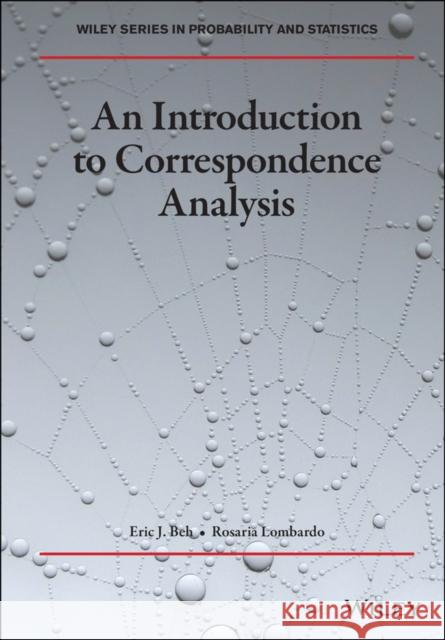
Eric J. Beh;Rosaria Lombardo
An Introduction to Correspondence Analysis Eric J. Beh Rosaria Lombardo  9781119041948 Wiley-Blackwell (an imprint of John Wiley & S - książkaWidoczna okładka, to zdjęcie poglądowe, a rzeczywista szata graficzna może różnić się od prezentowanej.

An Introduction to Correspondence Analysis

ISBN-13: 9781119041948 / Angielski / Twarda / 2021 / 240 str.

Eric J. Beh;Rosaria Lombardo
cena 265,10
(netto: 252,48 VAT:  5%)

Najniższa cena z 30 dni: 264,01
Termin realizacji zamówienia:
ok. 30 dni roboczych
Bez gwarancji dostawy przed świętami

Darmowa dostawa!

This book is intended as an introductory text supplementing the authors' advanced level/specialist book Correspondence Analysis: Theory, Methods and New Strategies(Wiley, August 2014). This introduction will provide the reader with a discussion of the key issues concerned with correspondence analysis that is discussed in great detail in the earlier book; there will be relatively little theory beyond the basics (no proofs, no equivalent statements ? just one framework), no methods will be discussed that have not been available to the analyst for decades, and there will be no new strategies. Once the reader has reached the appropriate level of mastery of the technique, they can then move onto the more thorough examination of the mathematical and bibliographic aspects of the technique presented in the advanced text.


Kategorie:
Nauka, Matematyka
Kategorie BISAC:
Mathematics > Probability & Statistics - Multivariate Analysis
Wydawca:
Wiley-Blackwell (an imprint of John Wiley & S
Język:
Angielski
ISBN-13:
9781119041948
Rok wydania:
2021
Numer serii:
000906604
Ilość stron:
240
Waga:
0.56 kg
Wymiary:
24.41 x 16.99 x 2.11
Oprawa:
Twarda
Wolumenów:
01
Dodatkowe informacje:
Bibliografia

Dedication iiiPreface xi1 Introduction 11.1 Data Visualisation 11.2 Correspondence Analysis in a "Nutshell" 31.3 Data Sets 41.3.1 Traditional European Food Data 41.3.2 Temperature Data 41.3.3 Shoplifting Data 51.3.4 Alligator Data 61.4 Symmetrical vs Asymmetrical Association 71.5 Notation 91.5.1 The Two-way Contingency Table 91.5.2 The Three-way Contingency Table 101.6 Formal Test of Symmetrical Association 111.6.1 Test of Independence for Two-way Contingency Tables 111.6.2 The Chi-squared Statistic for a Two-way Table 121.6.3 Analysis of the Traditional European Food Data 121.6.4 The Chi-squared Statistic for a Three-way Table 141.6.5 Analysis of the Alligator Data 151.7 Formal Test of Asymmetrical Association 151.7.1 Test of Predictability for Two-way Contingency Tables 151.7.2 The Goodman-Kruskal tau Index 161.7.3 Analysis of the Traditional European Food Data 171.7.4 Test of Predictability for Three-way Contingency Tables 171.7.5 Marcotorchino's Index 181.7.6 Analysis of the Alligator Data 191.7.7 The Gray-Williams Index & Delta Index 191.8 Correspondence Analysis and R 201.9 Overview of the Book 24Part One Classical Analysis of Two Categorical Variables 272 Simple Correspondence Analysis 292.1 Introduction 292.2 Reducing Multidimensional Space 302.2.1 Profiles Cloud of Points 302.2.2 Profiles for the Traditional European Food Data 312.2.3 Weighted Centred Profiles 342.3 Measuring Symmetric Association 392.3.1 The Pearson Ratio 392.3.2 Analysis of the Traditional European Food Data 402.4 Decomposing the Pearson Residual for Nominal Variables 422.4.1 The Generalised SVD of gammaij . 1 422.4.2 SVD of the Pearson Ratio's 442.4.3 GSVD and the Traditional European Food Data 452.5 Constructing a Low-Dimensional Display 452.5.1 Standard Coordinates 452.5.2 Principal Coordinates 472.6 Practicalities of the Low-Dimensional Plot 512.6.1 The Two-Dimensional Correspondence Plot 512.6.2 What is NOT Being Shown in a Two-Dimensional CorrespondencePlot? 542.6.3 The Three-Dimensional Correspondence Plot 582.7 The Biplot Display 582.7.1 Definition 582.7.2 Isometric Biplots of the Traditional European Food Data 612.7.3 What is NOT Being Shown in a Two-Dimensional Biplot? 642.8 The Case for No Visual Display 642.9 Detecting Statistically Significant Points 652.9.1 Confidence Circles and Ellipses 652.9.2 Confidence Ellipses for the Traditional European Food Data 662.10 Approximate P-values 702.10.1 The Hypothesis Test and its P-value 702.10.2 P-values and the Traditional European Food Data 712.11 Final Comments 713 Non-Symmetrical Correspondence Analysis 733.1 Introduction 733.2 Quantifying Asymmetric Association 743.2.1 The Goodman-Kruskal tau Index 743.2.2 The tau Index and the Traditional European Food Data 743.2.3 Weighted Centred Column Profile 753.2.4 Profiles of the Traditional European Food Data 753.3 Decomposing pii|jfor Nominal Variables 783.3.1 The Generalised SVD of pii|j 783.3.2 GSVD and the Traditional Food Data 793.4 Constructing a Low-Dimensional Display 813.4.1 Standard Coordinates 813.4.2 Principal Coordinates 823.5 Practicalities of the Low-Dimensional Plot 853.5.1 The Two-Dimensional Correspondence Plot 853.5.2 The Three-Dimensional Correspondence Plot 873.6 The Biplot Display 913.6.1 Definition 913.6.2 The Column Isometric Biplot for the Traditional Food Data 923.6.3 The Three-Dimensional Biplot 953.7 Detecting Statistically Significant Points 953.7.1 Confidence Circles and Ellipses 953.7.2 Confidence Ellipses for the Traditional Food Data 963.8 Final Comments 98Part Two Ordinal Analysis of Two Categorical Variables 1014 Simple Ordinal Correspondence Analysis 1034.1 Introduction 1034.2 A Simple Correspondence Analysis of the Temperature Data 1044.3 On the Mean and Variation of Profiles with Ordered Categories 1064.3.1 Profiles of the Temperature Data 1064.3.2 Defining Scores 1074.3.3 On the Mean of the Profiles 1104.3.4 On the Variation of the Profiles 1114.3.5 Mean & Variation of Profiles for the Temperature Data 1124.4 Decomposing the Pearson Residual for Ordinal Variables 1144.4.1 The Bivariate Moment Decomposition of gammaij . 1 1144.4.2 BMD and the Temperature Data 1164.5 Constructed a Low-Dimensional Display 1194.5.1 Standard Coordinates 1194.5.2 Principal Coordinates 1194.5.3 Practicalities of the Ordered Principal Coordinates 1234.6 The Biplot Display 1234.6.1 Definition 1234.6.2 Ordered Column Isometric Biplot 1234.6.3 Ordered Row Isometric Biplot 1244.6.4 Ordered Isometric Biplots for the Temperature Data 1244.7 Final Comments 1275 Ordered Non-symmetrical Correspondence Analysis 1295.1 Introduction 1295.2 The Goodman-Kruskal tau Index Revisited 1305.3 Decomposing pii|jfor Ordinal and Nominal Variables 1325.3.1 The Hybrid Decomposition of pii|j 1325.3.2 Hybrid decomposition and the Shoplifting Data 1355.4 Constructing a Low-Dimensional Display 1385.4.1 Standard Coordinates 1385.4.2 Principal Coordinates 1385.5 The Biplot 1395.5.1 An Overview 1395.5.2 Column Isometric Biplot 1395.5.3 Column Isometric Biplot of the Shoplifting Data 1405.5.4 Row Isometric Biplot 1415.5.5 Row Isometric Biplot of the Shoplifting Data 1425.5.6 Distance Measures and the Row Isometric Biplots 1455.6 Some Final Words 146Part Three Analysis of Multiple Categorical Variables 1476 Multiple Correspondence Analysis 1496.1 Introduction 1496.2 Crisp Coding and the Indicator Matrix 1506.2.1 Crisp Coding 1506.2.2 The Indicator Matrix 1506.2.3 Crisp Coding and the Alligator data 1516.2.4 Application of Multiple Correspondence Analysis using the IndicatorMatrix 1516.3 The Burt Matrix 1576.4 Stacking 1626.4.1 A Definition 1626.4.2 Stacking and the Alligator Data - Lake(Size)×Food 1626.4.3 Stacking and the Alligator Data - Food(Size)×Lake 1666.5 Final Comments 1677 Multi-way Correspondence Analysis 1697.1 An Introduction 1697.2 Pearson's Residual gammaijk . 1 and the Partition of X2 1707.2.1 The Pearson Residual 1707.2.2 The Partition of X2 1717.2.3 Partition of X2for the Alligator Data 1717.3 Symmetric Multi-way Correspondence Analysis 1737.3.1 Tucker3 Decomposition of gammaijk . 1 1737.3.2 T3D and the Analysis of Two Variables 1767.3.3 On the Choice of the Number of Components 1777.3.4 Tucker3 Decomposition of gammaijk . 1 and the Alligator Data 1787.4 Constructing a Low-Dimensional Display 1827.4.1 Principal Coordinates 1827.4.2 The Interactive Biplot 1827.4.3 Column-Tube Interactive Biplot for the Alligator Data 1887.4.4 Row Interactive Biplot for the Alligator Data 1927.5 The Marcotorchino Residual pii|j,k and the Partition of tauM 1947.5.1 The Marcotrochino Residual 1947.5.2 The Partition of tauM 1967.5.3 Partition of tauM for the Alligator Data 1977.6 Non-symmetrical Multi-way Correspondence Analysis 1987.6.1 Tucker3 Decomposition of pii|j,k 1987.6.2 Tucker3 Decomposition of pii|j,k and the Alligator Data 2007.7 Constructing a Low-Dimensional Display 2017.7.1 On the Choice of Coordinates 2017.7.2 Column-Tube Interactive Biplot for the Alligator Data 2027.8 Final Comments 206References 208

Eric J. Beh is Professor of Statistics at the School of Mathematical & Physical Sciences at the University of Newcastle, Australia. He has been actively researching in many areas of categorical data analysis including ecological inference, measures of association and categorical models. For the past 25 years his research has focused primarily on the technical, computational and practical development of correspondence analysis. He has over 100 publications and, with Rosaria Lombardo, has authored Correspondence Analysis: Theory, Methods and New Strategies published by Wiley. Together, they have given short courses and workshops around the world on this topic.Rosaria Lombardo is Associate Professor of Statistics at the Department of Economics of the University of Campania "L. Vanvitelli", Italy. Her research interests include non-linear multivariate data analysis, quantification theory and, in particular, correspondence analysis and data visualization. Since receiving her PhD in Computational Statistics and Applications at the University of Naples "Federico II", she has authored over 100 publications including those in Statistical Science, Psychometrika, Computational Statistics & Data Analysis, and the Journal of Statistical Planning and Inference.


Udostępnij

Facebook - konto krainaksiazek.pl


Opinie o Krainaksiazek.pl na Opineo.pl

Partner Mybenefit

Krainaksiazek.pl w programie rzetelna firma Krainaksiaze.pl - płatności przez paypal

Czytaj nas na:

Facebook - krainaksiazek.pl
  • książki na zamówienie
  • granty
  • książka na prezent
  • kontakt
  • pomoc
  • opinie
  • regulamin
  • polityka prywatności

Zobacz:

  • Księgarnia czeska

  • Wydawnictwo Książkowe Klimaty

1997-2025 DolnySlask.com Agencja Internetowa

© 1997-2022 krainaksiazek.pl
     
KONTAKT | REGULAMIN | POLITYKA PRYWATNOŚCI | USTAWIENIA PRYWATNOŚCI
Zobacz: Księgarnia Czeska | Wydawnictwo Książkowe Klimaty | Mapa strony | Lista autorów
KrainaKsiazek.PL - Księgarnia Internetowa

Polityka prywatnosci - link
Krainaksiazek.pl - płatnośc Przelewy24
Przechowalnia Przechowalnia





