• Wyszukiwanie zaawansowane
  • Kategorie
  • Kategorie BISAC
  • Książki na zamówienie
  • Promocje
  • Granty
  • Książka na prezent
  • Opinie
  • Pomoc
  • Załóż konto
  • Zaloguj się

An Introduction to Bayesian Scientific Computing: Ten Lectures on Subjective Computing » książka


zaloguj się | załóż konto
Logo Krainaksiazek.pl

koszyk

konto

szukaj
topmenu
Księgarnia internetowa
Szukaj
Książki na zamówienie
Promocje
Granty
Książka na prezent
Moje konto
Pomoc
 
 
Wyszukiwanie zaawansowane
Pusty koszyk
Bezpłatna dostawa dla zamówień powyżej 20 złBezpłatna dostawa dla zamówień powyżej 20 zł

Kategorie główne

• Nauka
 [2946912]
• Literatura piękna
 [1852311]

  więcej...
• Turystyka
 [71421]
• Informatyka
 [150889]
• Komiksy
 [35717]
• Encyklopedie
 [23177]
• Dziecięca
 [617324]
• Hobby
 [138808]
• AudioBooki
 [1671]
• Literatura faktu
 [228371]
• Muzyka CD
 [400]
• Słowniki
 [2841]
• Inne
 [445428]
• Kalendarze
 [1545]
• Podręczniki
 [166819]
• Poradniki
 [480180]
• Religia
 [510412]
• Czasopisma
 [525]
• Sport
 [61271]
• Sztuka
 [242929]
• CD, DVD, Video
 [3371]
• Technologie
 [219258]
• Zdrowie
 [100961]
• Książkowe Klimaty
 [124]
• Zabawki
 [2341]
• Puzzle, gry
 [3766]
• Literatura w języku ukraińskim
 [255]
• Art. papiernicze i szkolne
 [7810]
Kategorie szczegółowe BISAC

An Introduction to Bayesian Scientific Computing: Ten Lectures on Subjective Computing

ISBN-13: 9780387733937 / Angielski / Miękka / 2007 / 220 str.
Erkki Somersalo; D. Calvetti
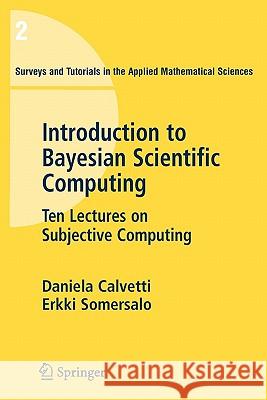
An Introduction to Bayesian Scientific Computing: Ten Lectures on Subjective Computing Calvetti, Daniela 9780387733937 SPRINGER-VERLAG NEW YORK INC. - książkaWidoczna okładka, to zdjęcie poglądowe, a rzeczywista szata graficzna może różnić się od prezentowanej.

An Introduction to Bayesian Scientific Computing: Ten Lectures on Subjective Computing

ISBN-13: 9780387733937 / Angielski / Miękka / 2007 / 220 str.

Erkki Somersalo; D. Calvetti
cena 181,11
(netto: 172,49 VAT:  5%)

Najniższa cena z 30 dni: 173,46
Termin realizacji zamówienia:
ok. 22 dni roboczych
Bez gwarancji dostawy przed świętami

Darmowa dostawa!

The book of nature, according to Galilei, is written in the language of mat- matics. The nature of mathematics is being exact, and its exactness is und- lined by the formalism used by mathematicians to write it. This formalism, characterized by theorems and proofs, and syncopated with occasional l- mas, remarks and corollaries, is so deeply ingrained that mathematicians feel uncomfortable when the pattern is broken, to the point of giving the - pression that the attitude of mathematicians towards the way mathematics should be written is almost moralistic. There is a de?nition often quoted, "A mathematician is a person who proves theorems," and a similar, more alchemistic one, credited to Paul Erd? os, but more likely going back to Alfr ed R enyi, statingthat"Amathematicianisamachinethattransformsco?eeinto 1 theorems ." Therefore it seems to be the form, not the content, that char- terizes mathematics, similarly to what happens in any formal moralistic code wherein form takes precedence over content. This book is deliberately written in a very di?erent manner, without a single theorem or proof. Since morality has its subjective component, to pa- phrase Manuel Vasquez Montalban, we could call it Ten Immoral Mathemat- 2 ical Recipes . Does the lack of theorems and proofs mean that the book is more inaccurate than traditional books of mathematics? Or is it possibly just a sign of lack of co?ee? This is our ?rst open question. Exactness is an interesting concept.


Kategorie:
Nauka, Matematyka
Kategorie BISAC:
Mathematics > Matematyka stosowana
Mathematics > Systemy liczbowe
Mathematics > Prawdopodobieństwo i statystyka
Wydawca:
SPRINGER-VERLAG NEW YORK INC.
Seria wydawnicza:
Surveys and Tutorials in the Applied Mathematical Sciences
Język:
Angielski
ISBN-13:
9780387733937
Rok wydania:
2007
Wydanie:
2007
Numer serii:
000320559
Ilość stron:
220
Waga:
0.30 kg
Wymiary:
23.11 x 15.24 x 1.27
Oprawa:
Miękka
Wolumenów:
01
Dodatkowe informacje:
Bibliografia
Wydanie ilustrowane

From the reviews:

"This witty, erudite, and surprisingly practical book is made up of ten chapters. ... A central topic of the book is the relationship between statistical inference and the inverse problems that define Bayesian (subjective) statistics. ... This excellent book will be valuable to scientists of various stripes, statisticians, numerical analysts, those who work in image processing, and those who implement Bayesian belief nets." (George Hacken, ACM Computing Reviews, Vol. 49 (11), November, 2008)

"Introduction to Bayesian Scientific Computing is a 200-page, easily accessible, pleasant introduction fusing Bayesian approaches with numerical linear algebra methods for inverse problems ... . What I like most about this book is the apparent enthusiasm of the authors and their genuine interest in explaining rather than showing off. This enthusiasm is contagious, and the result is very readable." (Uri Ascher, The Mathematical Intelligencer, Vol. 31 (1), 2009)

Inverse problems and subjective computing.- Basic problem of statistical inference.- The praise of ignorance: randomness as lack of information.- Basic problem in numerical linear algebra.- Sampling: first encounter.- Statistically inspired preconditioners.- Conditional Gaussian densities and predictive envelopes.- More applications of the Gaussian conditioning.- Sampling: the real thing.- Wrapping up: hypermodels, dynamic priorconditioners and Bayesian learning.

A combination of the concepts subjective – or Bayesian – statistics and scientific computing, the book provides an integrated view across numerical linear algebra and computational statistics. Inverse problems act as the bridge between these two fields where the goal is to estimate an unknown parameter that is not directly observable by using measured data and a mathematical model linking the observed and the unknown.

Inverse problems are closely related to statistical inference problems, where the observations are used to infer on an underlying probability distribution. This connection between statistical inference and inverse problems is a central topic of the book. Inverse problems are typically ill-posed: small uncertainties in data may propagate in huge uncertainties in the estimates of the unknowns. To cope with such problems, efficient regularization techniques are developed in the framework of numerical analysis. The counterpart of regularization in the framework of statistical inference is the use prior information. This observation opens the door to a fruitful interplay between statistics and numerical analysis: the statistical framework provides a rich source of methods that can be used to improve the quality of solutions in numerical analysis, and vice versa, the efficient numerical methods bring computational efficiency to the statistical inference problems.

This book is intended as an easily accessible reader for those who need numerical and statistical methods in applied sciences.


Somersalo, Erkki Erkki Somersalo is a Professor at Case Western Res... więcej >


Udostępnij

Facebook - konto krainaksiazek.pl


Opinie o Krainaksiazek.pl na Opineo.pl

Partner Mybenefit

Krainaksiazek.pl w programie rzetelna firma Krainaksiaze.pl - płatności przez paypal

Czytaj nas na:

Facebook - krainaksiazek.pl
  • książki na zamówienie
  • granty
  • książka na prezent
  • kontakt
  • pomoc
  • opinie
  • regulamin
  • polityka prywatności

Zobacz:

  • Księgarnia czeska

  • Wydawnictwo Książkowe Klimaty

1997-2025 DolnySlask.com Agencja Internetowa

© 1997-2022 krainaksiazek.pl
     
KONTAKT | REGULAMIN | POLITYKA PRYWATNOŚCI | USTAWIENIA PRYWATNOŚCI
Zobacz: Księgarnia Czeska | Wydawnictwo Książkowe Klimaty | Mapa strony | Lista autorów
KrainaKsiazek.PL - Księgarnia Internetowa

Polityka prywatnosci - link
Krainaksiazek.pl - płatnośc Przelewy24
Przechowalnia Przechowalnia





