• Wyszukiwanie zaawansowane
  • Kategorie
  • Kategorie BISAC
  • Książki na zamówienie
  • Promocje
  • Granty
  • Książka na prezent
  • Opinie
  • Pomoc
  • Załóż konto
  • Zaloguj się

An International Peace Court: Design for a Move from State Crime Toward World Law » książka


zaloguj się | załóż konto
Logo Krainaksiazek.pl

koszyk

konto

szukaj
topmenu
Księgarnia internetowa
Szukaj
Książki na zamówienie
Promocje
Granty
Książka na prezent
Moje konto
Pomoc
 
 
Wyszukiwanie zaawansowane
Pusty koszyk
Bezpłatna dostawa dla zamówień powyżej 20 złBezpłatna dostawa dla zamówień powyżej 20 zł

Kategorie główne

• Nauka
 [2946912]
• Literatura piękna
 [1852311]

  więcej...
• Turystyka
 [71421]
• Informatyka
 [150889]
• Komiksy
 [35717]
• Encyklopedie
 [23177]
• Dziecięca
 [617324]
• Hobby
 [138808]
• AudioBooki
 [1671]
• Literatura faktu
 [228371]
• Muzyka CD
 [400]
• Słowniki
 [2841]
• Inne
 [445428]
• Kalendarze
 [1545]
• Podręczniki
 [166819]
• Poradniki
 [480180]
• Religia
 [510412]
• Czasopisma
 [525]
• Sport
 [61271]
• Sztuka
 [242929]
• CD, DVD, Video
 [3371]
• Technologie
 [219258]
• Zdrowie
 [100961]
• Książkowe Klimaty
 [124]
• Zabawki
 [2341]
• Puzzle, gry
 [3766]
• Literatura w języku ukraińskim
 [255]
• Art. papiernicze i szkolne
 [7810]
Kategorie szczegółowe BISAC

An International Peace Court: Design for a Move from State Crime Toward World Law

ISBN-13: 9789401181815 / Angielski / Miękka / 1970 / 112 str.
Thomas Holton; George W. Keeton
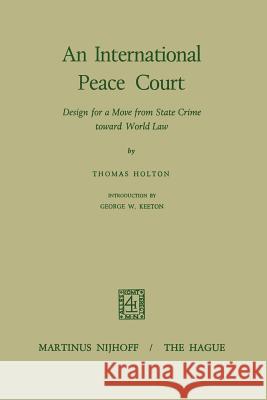
An International Peace Court: Design for a Move from State Crime Toward World Law Holton, Thomas 9789401181815 Springer - książkaWidoczna okładka, to zdjęcie poglądowe, a rzeczywista szata graficzna może różnić się od prezentowanej.

An International Peace Court: Design for a Move from State Crime Toward World Law

ISBN-13: 9789401181815 / Angielski / Miękka / 1970 / 112 str.

Thomas Holton; George W. Keeton
cena 201,24
(netto: 191,66 VAT:  5%)

Najniższa cena z 30 dni: 192,74
Termin realizacji zamówienia:
ok. 22 dni roboczych
Bez gwarancji dostawy przed świętami

Darmowa dostawa!

The classical concept ofInternationalLa w, as developed by Gentilis, Gro tius and their successors, accepted as its starting point the sovereignty of states, from which it followed that (r) the rules of International Law were based upon the general consent of those states; and (2) that, since state sovereignty was not capable of limitation, otherwise than by the consent of the state itself, in the last resort, International Law must accept the fact of war. Two world wars within the space of thirty years, and the development of nuclear weapons of unlimited potential, have compelled statesmen and lawyers to take a fresh look at the foundations of international relations. The First World War was followed by the creation of the League of Nations, and by the establish ment of the Permanent Court of International Justice. The failure of both, insofar as the preservation of peace was concerned, was apparent in the continuance of international insecurity, culminating in World War II. This again was followed by the establishment of a new inter national organisation, the United Nations, with its auxiliary, the International Court of Justice. Nevertheless, international security seems further away than ever, and it may be suggested that it is the devastating potential of nuclear weapons, rather than the strength of international machinery, which has so far prevented a third general conflict far more disastrous than either of the two World Wars which have already taken place."


Kategorie:
Nauka, Prawo i administracja
Kategorie BISAC:
Law > International
Law > Litigation
Law > Comparative
Wydawca:
Springer
Język:
Angielski
ISBN-13:
9789401181815
Rok wydania:
1970
Wydanie:
1970
Ilość stron:
112
Waga:
0.21 kg
Wymiary:
23.5 x 15.5
Oprawa:
Miękka
Wolumenów:
01

I. The Relevance of Law.- Responsibility for a Law of Peace.- The Placement of Responsibility.- The Format of Responsibility.- The Temptation of the Abstract.- The Reproach of the Unfamiliar.- The Present Design.- II. International Violence: The Total Challenge and the Partial Response.- International Violence: The Total Challenge.- The Partial Response.- The Security Council.- The Collective Decisions.- The Response Appraised.- III. Mission: A Move toward Law.- The Exercise of Responsibility.- By the Few.- By the Many.- Mission: A Move Toward World Law.- Credentials of Acceptability: Effectiveness and Legitimacy.- Summary.- IV. Medium: An International Peace Court.- The Choice of Means.- The Traditional Instruments of Power.- Military.- Economic.- Diplomatic.- A New Instrument: The Power of Mass Communication.- The Choice of Method.- Appeals.- Censure.- The Choice of Medium.- The General Assembly.- An International Peace Court.- V. The Court in Design.- Effective Structure.- A National Court.- The International Court of Justice.- A Special Tribunal.- A Permanent Special Tribunal.- Legitimacy.- Tacit Authorization of The United Nations Charter.- General Authorization of Article 95.- Specific Authorization of Article 52.- Participants.- Summary.- VI. The Court in Action.- Jurisdiction.- Judges.- Impartiality.- Competence.- The Lesson of the Central American Court of Justice.- National and Cultural Balance.- Parties.- Party Complainant.- Party Defendant.- The Presence of the Community.- Claims.- Included Issues of a Civil Nature.- The Issue of Statehood.- Trying the Facts.- Applying the Law.- Illustrative Case.- The Judgment.- The Addressee of the Judgment.- The Flexible Use of the Judgment.- VII. The Court in Impact.- Operational Effect.- The Circuitry of Deterrence.- The Moral Factor.- Summary.- Legal Consequence.- Toward an International Criminal Law.- Contrast with the Nurnberg and Tokyo Trials.- The Qualifications of a Criminal Tribunal.- Summary.- VIII. New Premises for a Legal Breakthrough.- First Premise: The Initiative of the Many.- Old Premise.- New Premise.- Second Premise: Moral Power as a Base of International Influence.- Old Premise.- New Premise.- Third Premise: Moral Power Harnessed to Legal Structure.- Old Premise.- New Premise.- Fourth Premise: Legal Judgment Free of the Consent of the Adjudged.- Old Premise.- New Premise.- Fifth Premise: The Unique Method of Implementation of International Law.- Old Premise.- New Premise.- Summary.- IX. Making the Move.- Establishment of the Court.- A Common Perspective.- A Common Strategy.- Maintenance of the Court.- Persons.- Place.- Procedure.- Rule Making.- Judicial Administration.- Forensic Proceedings.- Due Process Safeguards.- Summary.- X. Toward World Law.- Blessed are the Peacemakers.- Making Peace.- Community Acceptance.- Making Law.- Community Participation.- Conclusion.- Epilogue.- Model Statute for an International Peace Court.- I. General Principles.- II. Organization of the Court.- III. Jurisdiction of Parties and Subject Matter.- IV. Procedure.- V. Amendment and Participation.- Author index.


Udostępnij

Facebook - konto krainaksiazek.pl


Opinie o Krainaksiazek.pl na Opineo.pl

Partner Mybenefit

Krainaksiazek.pl w programie rzetelna firma Krainaksiaze.pl - płatności przez paypal

Czytaj nas na:

Facebook - krainaksiazek.pl
  • książki na zamówienie
  • granty
  • książka na prezent
  • kontakt
  • pomoc
  • opinie
  • regulamin
  • polityka prywatności

Zobacz:

  • Księgarnia czeska

  • Wydawnictwo Książkowe Klimaty

1997-2025 DolnySlask.com Agencja Internetowa

© 1997-2022 krainaksiazek.pl
     
KONTAKT | REGULAMIN | POLITYKA PRYWATNOŚCI | USTAWIENIA PRYWATNOŚCI
Zobacz: Księgarnia Czeska | Wydawnictwo Książkowe Klimaty | Mapa strony | Lista autorów
KrainaKsiazek.PL - Księgarnia Internetowa

Polityka prywatnosci - link
Krainaksiazek.pl - płatnośc Przelewy24
Przechowalnia Przechowalnia





