An Anthropology of the European Union: Building, Imagining and Experiencing the New Europe » książka





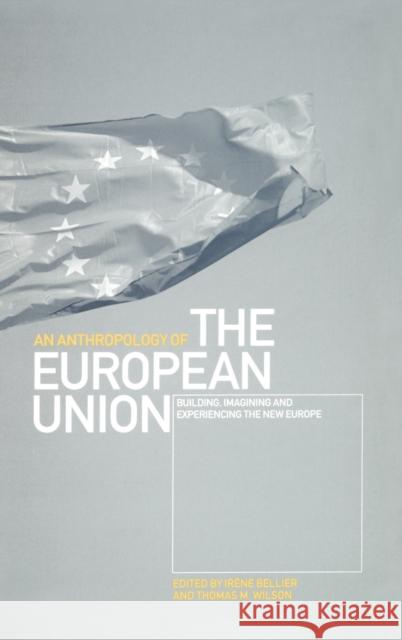
An Anthropology of the European Union: Building, Imagining and Experiencing the New Europe
ISBN-13: 9781859733240 / Angielski / Twarda / 2000 / 216 str.
An Anthropology of the European Union: Building, Imagining and Experiencing the New Europe
ISBN-13: 9781859733240 / Angielski / Twarda / 2000 / 216 str.
(netto: 670,84 VAT: 5%)
Najniższa cena z 30 dni: 654,86
ok. 22 dni roboczych
Dostawa w 2026 r.
Darmowa dostawa!
One of the problems facing Europe is that the building of institutional Europe and top-down efforts to get Europeans to imagine their common identity do not necessarily result in political and cultural unity. Anthropologists have been slow to consider the difficulties presented by the expansion of the EU model and its implications for Europe in the 21st Century. Representing a new trend in European anthropology, this book examines how people adjust to their different experiences of the new Europe. The role of culture, religion, and ideology, as well as insiders' social and professional practices, are all shown to shed light on the cultural logic sustaining the institutions and policies of the European Union.On the one hand, the activities of the European institutions in Brussels illustrate how people of many different nationalities, languages and cultures can live and work together. On the other hand, the interests of many people at the local, regional and national levels are not the same as the Eurocrats'. Contributors explore the issues of unity and diversity in 'Europe-building' through various European institutions, images, and programmes, and their effects on a variety of definitions of identity in such locales as France, Denmark, the United Kingdom, Ireland and Belgium. Adopting an anthropological approach, this book explores the quest to construct a sense of common identity at institutional level in the European Union (EU), and is particularly useful in identifying current research on the EU as project and object. The introductory essay by Irene Bellier and Thomas M. Wilson laments the marginalization of culture and identity in the EU and offers a useful overview of different approaches to the anthropology of Europe from American, British and French traditions. It examines the complexity of the concept of EU, which can refer to member states but also to a wider social system. Although Europe is currently in the process of defining and expanding a new public space, this project is severely hampered by the nation-state model, which dominates proceedings. Contributions to the book are divided in two parts. The first deals primarily with the institutional
level in Europe. Marc Abeles's contribution adopts an unusual approach by querying whether the construction of a harmonious Europe should be regarded as an indefinite, ongoing process, rather than an end product. Although in theory the EU is a borderless, post-national or perhaps supra-national region, its political practice has been rooted in a strong sense of territorial identity. The concept of a virtual Europe could serve as the catalyst for new perspectives on regional or national traditions.Irene Bellier explores the very interesting question of identity politics in the EU and the consequences of formal institutional recognition of many diverse interests. In the beginning, the European Common Market defended national interests and sustained sources of national identification among its civil servants. This process has been challenged by the identification of other sources of interest such as trans-national cultures or regional bodies, which also demand formal recognition of their interests. The change in the locus of representation from Parliament to specific lobby groups is impacting on the authority of individual nation-states. Gilbert Weiss and Ruth Wodak explore the globalization rhetoric of the EU with specific reference to unemployment policies. The central concern of this chapter is the linguistic nature of the decision-making process in the Competitiveness Advisory Group. Business-speak, location-speak and globalization rhetoric are used to construct an EU identity that differs significantly from other larger identities such as that of Japan or the USA.Essentially the EU is a collaborative project, which requires the input of all its member states. This is a process, which is not without tension as the EU has itself impacted on the authority of nation-states. Despite its constant reference to the principle of subsidiarity, the EU has implemented certain policy-making decisions at supra-national rather than national levels and created a new set of hierarchial relations. The principle of subsidiary is the focus of Douglas Holmes' essay, which examines the surrogate discourse of power in the EU. Holmes observes the significance of subsidiarity underlying the development of an increasingly federal EU but the principle also provides the substance of a complex moral discourse designed to sustain the European project and its relations with existing diversities.Four essays in part two of this book examine the concept of belonging and identity in the European Union. Catherine Neveu's contribution is particularly useful in its exploration of the potential contribution of anthropologists to the construction of European citizenship. Anthropologists can investigate different ways through which background models and representations regarding citizenship are invoked by European officials and lobbyists. They can investigate the negotiation process in deciding, implementing and evaluating policies and programmes. She suggests that an anthropological critique of European citizenship is increasingly necessary to address global questions of citizenship, issues of identity and the relative weight of representation and participation for the democratic process. Thomas Wilson examines the role of anthropology in EU scholarship on culture and identity. This chapter champions an approach exploring the impact of EU institutions as experienced on a day-to day basis. Wilson is a well-established authority on Northern Ireland and sets his argument in the context of Northern Ireland's borderlands where nationalist ideologies restrict the political and economic integration of Britain and Ireland. EU actions designed to alleviate this ethno-nationalist struggle are accepted or resisted withi




Czytaj nas na:
KrainaKsiazek.PL - Księgarnia Internetowa


